Tiebas Castle
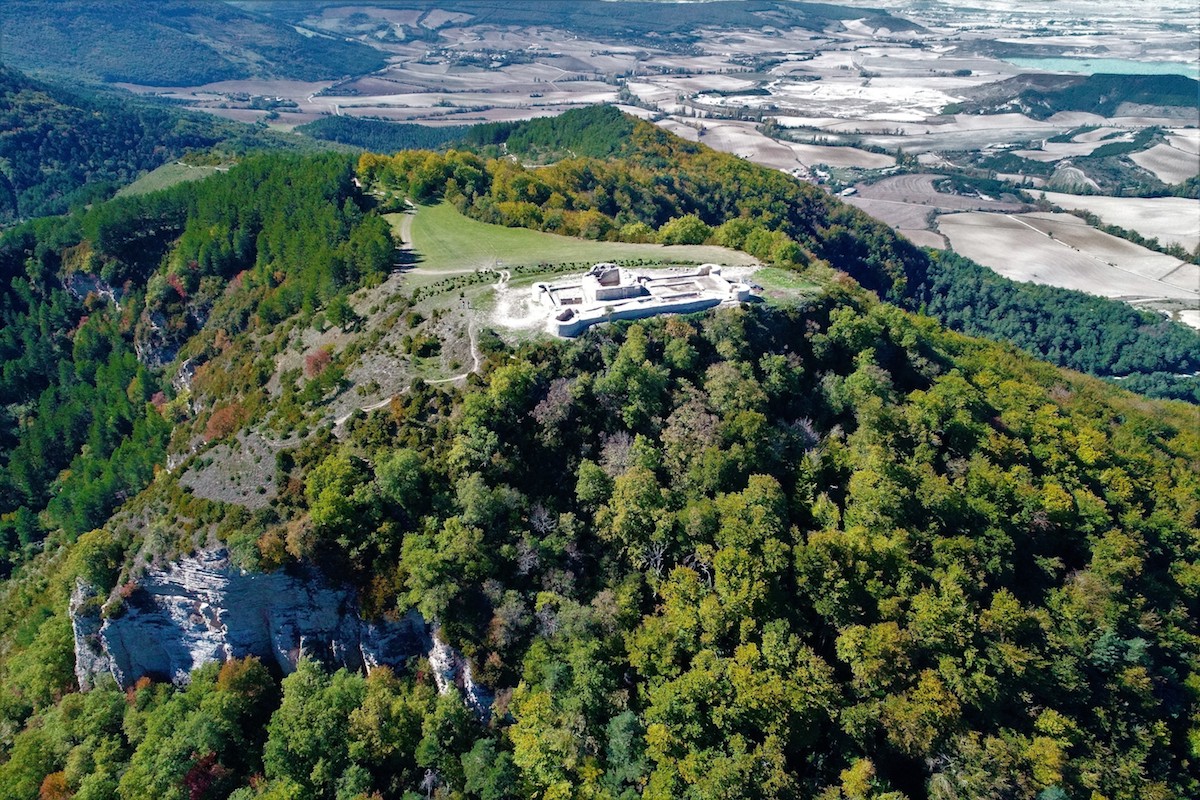
Tiebas Castle, located in the municipality of Tiebas-Muruarte de Reta in Navarra, Spain, is a remarkable example of a high medieval hill castle with a rich history tied to the Kingdom of Navarre. Constructed around 1250, traditionally attributed to King Theobald I of Navarre, the castle served multiple roles including royal residence, administrative center, and state prison. Its strategic position atop a hill allowed oversight of vital routes such as the Camino de Santiago pilgrimage path and the royal road linking Pamplona with other regions, compensating for the monarchy's limited authority within the episcopal lordship of Pamplona.
Historical significance and royal function
The castle's initial purpose was to establish a secure seat of power for the Navarrese monarchy outside Pamplona. Between 1264 and 1269, it functioned as a royal residence and housed key governmental offices including the seneschal, treasury, and archival chancery. This made Tiebas Castle a pivotal center for governance during the high medieval period.
In addition to administrative functions, the castle also operated as a state prison. Notably, in 1280, it detained 26 prisoners involved in the Navarrería rebellion of 1276, underscoring its role in maintaining royal authority. Throughout the 14th and 15th centuries, the fortress was maintained by royal castellans and governors, including members of the influential Beaumont family.
The castle endured significant trials, including a destructive Castilian attack in 1378 that left it aflame and resulted in the loss of much of the Navarre Archive, a critical blow to historical records. Despite this, it was spared demolition in 1512 under the orders of Cardinal Cisneros. Later, in 1810, it witnessed a fierce battle where four battalions led by Espoz y Mina confronted over 3,000 French soldiers during the Peninsular War, further embedding the castle in regional military history.
Ownership and restoration efforts
In 1445, King John II of Navarre granted Tiebas Castle and its lands to Juan de Beaumont, initiating a phase of reconstruction and noble residence development. The Beaumont family retained ownership well into the 19th century, preserving the castle's legacy. Modern recognition of its cultural and historical value began in the 20th century, with legal protections starting in 1949 and culminating in its designation as a cultural heritage site by Navarra in 1995.
After abandonment, much of the castle's stone was quarried for other uses, leading to its current ruined condition. Recent archaeological and consolidation efforts aim to preserve the remaining structure and uncover more about its architectural and historical significance.
Architectural features and layout
Tiebas Castle is built on a rectangular plan featuring two floors that enclose a large central courtyard, known as a patio de armas or "arming yard." This layout reflects a balance between residential comfort and defensive needs, characteristic of 13th-century northern French Gothic architecture. The influence of northern French craftsmen and materials is evident in the castle's design elements.
The castle's stone walls are notably thick and reinforced with buttresses to enhance structural stability. An outer curtain wall surrounds the main building, providing an additional defensive barrier. Residential wings flank the courtyard, containing spacious chambers equipped with Gothic-style fireplaces. The windows are large with elegant stone tracery, allowing natural light while maintaining security.
The roofs were originally adorned with polychrome tiles in green, yellow, and brown, adding vibrant color to the castle's silhouette. Several watchtowers capped with pointed, lead-covered spires once rose above the walls, as documented in early 19th-century plans, although only fragments remain today.
Archaeological discoveries
Excavations have revealed remains of Gothic rib vaults, a hallmark of Gothic architecture featuring intersecting stone arches that support the ceilings. An underground vaulted cellar with a stone barrel vault has also been uncovered, indicating the castle's involvement in wine production, a tradition linked to the House of Champagne.
The construction materials include finely cut ashlar masonry and richly colored floor tiles in red, green, and cream. These decorative elements underscore the castle's dual function as both a noble residence and a seat of administration rather than a purely military fortress.
Tiebas castle in the context of navarrese heritage
Tiebas Castle stands as a testament to the medieval political and cultural landscape of Navarre. Its strategic location and architectural sophistication reflect the kingdom's efforts to assert royal authority and manage governance from a secure stronghold. The castle's survival through wars, rebellions, and changing ownership highlights its resilience and importance.
Today, the castle is recognized as a significant cultural heritage site, with ongoing preservation work aimed at maintaining its ruins and promoting public awareness of its historical legacy. Visitors can appreciate the castle's Gothic architectural features and imagine its role in the medieval kingdom's administration and defense.
Visiting information
While the castle remains in a ruined state, efforts to consolidate and preserve the structure have made it accessible for visitors interested in medieval history and architecture. Its location on a hill provides scenic views of the surrounding Navarrese landscape, enhancing the visitor experience.
Visitors are encouraged to explore the site with respect for its fragile condition, and guided tours or informational materials may be available through local heritage organizations. The castle's proximity to the Camino de Santiago makes it a meaningful stop for pilgrims and history enthusiasts alike.
Frequently asked questions (FAQ)
- When was Tiebas Castle built and by whom?
- Tiebas Castle was built around 1250, traditionally attributed to King Theobald I of Navarre, with some sources suggesting Theobald II may have overseen its construction.
- What was the strategic importance of Tiebas Castle?
- Situated on a hill, Tiebas Castle oversaw important routes including the Camino de Santiago and the royal road to Pamplona, serving as a secure royal seat outside the episcopal jurisdiction.
- What architectural style characterizes Tiebas Castle?
- The castle exhibits 13th-century northern French Gothic architectural influences, evident in its stone tracery windows, rib vaults, and polychrome tiled roofs.
- Is Tiebas Castle open to visitors?
- Yes, although in ruins, the castle is accessible to visitors. Preservation efforts have made it safe to explore, and its scenic hilltop location offers panoramic views.
- What significant historical events took place at Tiebas Castle?
- Notable events include the 1378 Castilian attack that burned the castle and Navarre Archive, the 1280 imprisonment of rebellion participants, and the 1810 battle during the Peninsular War.
Information
Loading map...
Visitor reviews
No reviews yet. Been here? Write the first review and help other travelers!
Write the first reviewVisited this castle? Share your experience
Your review helps other travelers and adds first-hand knowledge to our encyclopedia.