Irulegui Castle
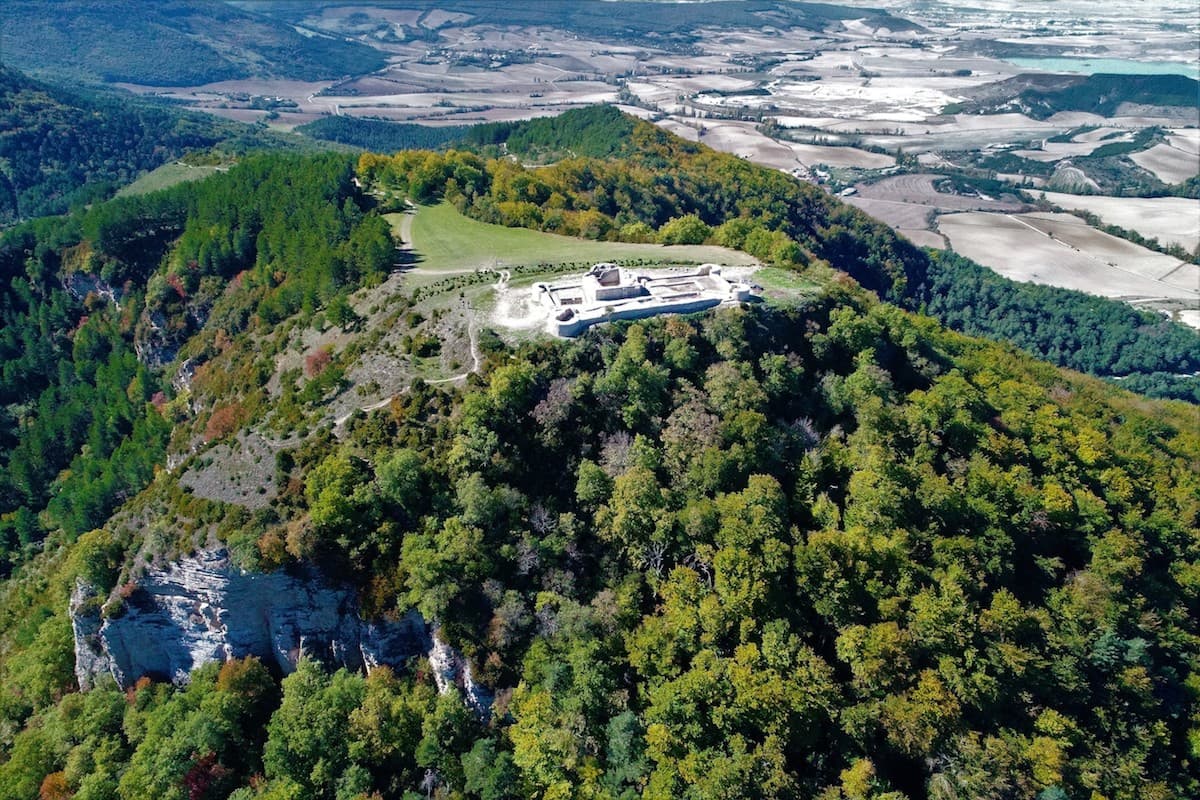
Irulegi Castle stands prominently on the Sierra de Aranguren in the municipality of Laquidáin, Spain, occupying a commanding hilltop position that has been strategically significant since ancient times. This hill castle is remarkable for its layered history, tracing back to the Iron Age when the site was home to a Vascon castro, a fortified pre-Roman settlement. The castle's location atop Mount Irulegi allowed control over important routes connecting the Izagaondoa valley with the Pamplona Basin, underscoring its military and administrative importance throughout the high medieval period.
Archaeological evidence reveals that the original castro de los Vascones was destroyed around 76 BCE during the Sertorian Wars, a turbulent period of civil conflict within the Roman Republic. The destruction marked the end of the Iron Age settlement, which featured robust defensive walls and underground structures dating back to the Late Bronze Age. Centuries later, the medieval fortress was established, with the earliest reliable documentation dating from the late 12th century. Although local legends hint at a defensive presence during the 11th century Almanzor raids, historical records primarily confirm the castle's significance from the 12th century onward.
Historical development and strategic role
During the 14th century, Gonzalo Ruiz de Eransus served as the alcaide or governor of Irulegi Castle, residing there with his family in 1374. The fortress was maintained by a small garrison, reflecting its evolving military role. In 1416, significant modernization efforts were undertaken to adapt the castle to new forms of warfare, especially the threat posed by artillery. A distinctive triangular addition was constructed at the front of the keep, transforming it into a unique pentagonal tower—a rarity among Navarrese fortifications. This period also saw the erection of a rectangular enclosure with corner towers to enhance the castle's defensive capabilities.
The castle's strategic importance waned towards the end of the 15th century amidst political upheaval in Navarre. In 1494, Queen Catherine of Foix and King John III ordered the fortress's demolition to prevent it from falling into the hands of the powerful Beaumont faction. The destruction included the keep, defensive walls, corner towers, main gate, and the filling of the cistern, effectively rendering the castle unusable. This act marked the end of Irulegi Castle's active military function.
Architectural features and layout
The castle is enclosed within roughly rectangular curtain walls covering about 569 square meters. These walls are reinforced by cylindrical towers at each corner and a central tower on the southern side. The southern wall remains the most intact, featuring a small gate and signs of maintenance from the castle's active period. The main entrance was located on the northwest side near a cliff, where archaeological remains reveal the foundations of a large gate and a paved vestibule with a stone hinge and worn steps, indicating frequent use.
A defining architectural element is the pentagonal keep on the southern curtain wall. Its walls average two meters thick, with some sections rising over four meters high today. This five-sided tower, resulting from the 1416 modernization, was designed to better resist artillery attacks. Below the keep lies a rectangular chapel of approximately 14 square meters, evidencing multiple phases of construction and use, highlighting the castle's religious as well as military functions.
Along the northern wall, three sequentially built rooms from the early 15th century stand atop original floor paving, illustrating adaptations of the castle's interior spaces. Adjacent to the chapel is a large L-shaped room running parallel to the southern and western walls, likely serving domestic or administrative purposes.
The circular northwest tower near the entrance includes a small stepped passage and covers about 11 square meters. Nearby, sandstone paving arranged at two levels in the northeastern enclosure suggests planned spatial organization within the courtyard.
Water supply was secured by a large cistern carved into natural rock, measuring approximately 3.85 by 4.25 meters and over three meters high. This reservoir could hold an estimated 54,000 liters of water and was likely vaulted before the castle's demolition. The patio de armas or courtyard features a paved surface of about 42 square meters, indicating a well-maintained open area within the defenses.
Archaeological significance and discoveries
Extensive excavations by the Sociedad de Ciencias Aranzadi between 2007 and 2017 have documented the castle's well-preserved remains, largely intact due to the absence of later construction on the site. These investigations also uncovered the underlying Iron Age settlement at the castle's base, covering at least 370 square meters and including two houses and a main street about four meters wide. This reveals a well-organized community predating the medieval fortress.
Among the most remarkable finds is the "Hand of Irulegi", a small bronze plaque shaped like a right hand, measuring roughly 14 by 13 centimeters and weighing nearly 36 grams. Composed of an alloy of tin, copper, and lead, the plaque bears an inscription of 40 ancient characters arranged in four lines. This inscription represents the oldest known written evidence in an ancient Vasconic language related to Basque. The plaque likely served a ritual function, possibly placed at the entrance of a dwelling to offer protection or good fortune. Its unique dual engraving technique and stylized design make it a significant artifact in the study of ancient Western writings.
Iron age settlement remains
The earlier settlement included robust defensive walls and underground structures, with archaeological layers dating back to the Late Bronze Age and continuing into the Second Iron Age. The community was destroyed around 76 BCE during the Sertorian Wars, likely by fire, marking a violent end to the pre-Roman occupation.
Medieval fortress remains
The castle's remains include the curtain walls, cylindrical corner towers, the unique pentagonal keep, the chapel, and various domestic rooms. The architectural adaptations in the 15th century, such as the triangular keep addition and the rectangular enclosure with corner towers, reflect responses to evolving military technology and political needs.
Cultural and heritage importance
Irulegi Castle is a site of profound historical and cultural significance, encapsulating a continuous occupation from the Late Bronze Age through the high medieval period. Its layered history offers insights into the ancient Vasconic peoples, medieval Navarrese politics, and military architecture. The discovery of the Hand of Irulegi has elevated the castle's profile as a key location for understanding the origins of the Basque language and culture.
Today, the castle remains a valuable archaeological site and a symbol of regional identity. Its well-preserved ruins attract scholars and visitors interested in medieval fortifications and ancient history alike. The site exemplifies the strategic use of natural topography for defense and the evolution of castle architecture in response to changing warfare methods.
Frequently asked questions (FAQ)
- When was Irulegi Castle originally built?
- Irulegi Castle was first reliably documented in the late 12th century, although the site had earlier Iron Age fortifications.
- What is unique about the architecture of Irulegi Castle?
- The castle features a distinctive pentagonal keep added in 1416, a rare design among Navarrese castles, built to resist artillery attacks.
- Can visitors see the Hand of Irulegi artifact at the castle?
- The Hand of Irulegi is a significant archaeological find from the site, but it is typically housed in a museum for preservation rather than displayed at the castle ruins.
- Why was Irulegi Castle demolished?
- The castle was ordered demolished in 1494 by Queen Catherine of Foix and King John III to prevent its capture by the Beaumont faction during political conflicts.
- What remains can be seen at Irulegi Castle today?
- Visitors can see the castle's curtain walls, cylindrical towers, the pentagonal keep remains, a chapel area, and the foundations of the main gate and cistern.
Photo gallery

Information
Loading map...
Visitor reviews
No reviews yet. Been here? Write the first review and help other travelers!
Write the first reviewVisited this castle? Share your experience
Your review helps other travelers and adds first-hand knowledge to our encyclopedia.