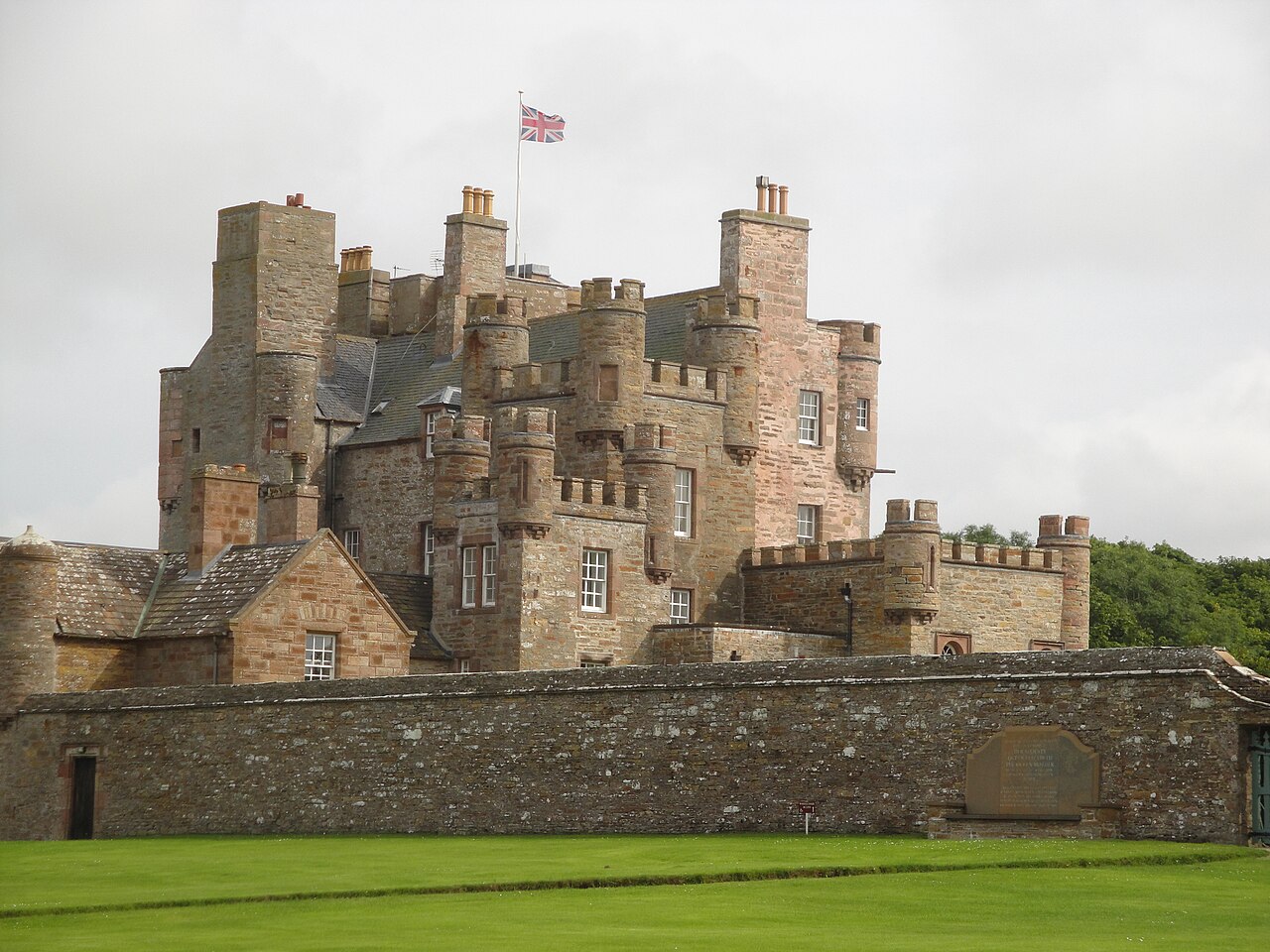
Thurso Castle
Thurso Castle, located in the town of Thurso in northern Scotland, stands as a site rich in history spanning from the 12th century through the Victorian era. Its strategic position near the River Thurso and close to the Atlantic coast has made it a focal point of regional power, especially for the influential Sinclair family. The castle's story intertwines with Norse rulers, Scottish nobility, and Victorian architectural ambitions, reflecting centuries of cultural and political shifts.
The medieval origins and Norse connections
The earliest known fortress on the site dates back to the 12th century, with historical mentions of a castle called "Thorsa Castle" as early as 1157. This medieval stronghold likely served as a residence for the Earls of Orkney and Caithness, who were prominent figures in the region. The castle's location and name suggest a probable link to the Norse jarls who ruled parts of northern Scotland during the Viking Age. However, archaeological investigations conducted in 1962 did not uncover remains from this initial structure, indicating that little physical evidence survives from the earliest phases.
The medieval castle was destroyed by fire in the early 16th century, leaving no visible ruins today. This loss marked a significant turning point, after which the site underwent various phases of rebuilding and redevelopment under the Sinclair family's stewardship.
17th and 18th century rebuilding and estate development
In 1665, George Sinclair, 6th Earl of Caithness, commissioned a new building on the site known as "The Arch." This project was executed by master mason Donald Ross at a cost of 600 merks, a substantial sum at the time. This construction represented a transitional phase, blending functional estate architecture with elements of fortification.
Later, Sir John Sinclair, 1st Baronet, a descendant of the same family line, acquired the estate and undertook the construction of a new castle or fortress. The estate saw further restorative and expansion work in 1806 and again in 1835, reflecting evolving architectural tastes and the Sinclairs' desire to maintain their ancestral seat.
Nearby landmarks such as Brown Hill and Harald's Tower (built in 1780) underscore the family's long-standing presence in the region. Harald's Tower, located approximately 1.6 kilometers northeast of the castle, served as a burial site for Sinclair family members, emphasizing the estate's role as a familial and territorial center.
Victorian gothic transformation and decline
Between 1872 and 1878, John George Tollemache Sinclair replaced earlier structures with a new mansion designed in the Victorian Gothic style, specifically incorporating elements of Scottish baronial architecture. This style is characterized by features such as turrets, battlements, and decorative stonework, which aimed to evoke the grandeur of medieval castles while providing modern comforts.
Unfortunately, the mansion suffered a partial destruction by fire, and concerns about its structural stability led to partial demolition in 1952. Despite this, portions of the castle remain habitable and continue to serve as the residence of the Viscounts Thurso, a title granted to the family in the same year.
The castle's former gatehouse, a notable example of the Scottish baronial style, has been designated a Category B listed building, recognizing its regional architectural and historical significance.
20th century events and present condition
During World War II, the castle grounds experienced an explosion from an anti-shipping mine, reflecting the strategic importance of the nearby coastline. This event is part of the castle's more recent history, linking it to global conflicts.
Today, the castle remains privately owned but is considered dangerously unstable. Only the external masonry and parts of the structure can be safely viewed by visitors. The gatehouse and an adjoining lodge survive in reasonable condition, showcasing the later Victorian-era construction phases.
Other remnants include the ruins of the north tower near the riverbank and a roofless northern wing that hints at the castle's original extent. Modifications in the 20th century, such as bricking up lower windows and entrances, were likely safety measures.
A deep well on the grounds, measuring approximately 6.1 meters (20 feet), indicates the historical necessity of a reliable water supply within the castle complex. Additionally, stones from earlier castle buildings were repurposed in estate structures like a manse built in 1818, illustrating the continuity of material use over centuries.
Sinclair family legacy and cultural significance
The Sinclair family played a central role in shaping the castle's history and the surrounding region. Their acquisition of the baronetcy of Ulbster in 1786 and later elevation to Viscounts Thurso reflect their enduring influence. The estate remains a symbol of their heritage and status.
The castle's layered history, from Norse origins through medieval fortifications to Victorian reinterpretations, offers valuable insights into Scottish noble architecture and regional power dynamics. Its surviving structures, though fragile, provide a tangible link to multiple historical periods and architectural styles.
Frequently asked questions (FAQ)
- When was Thurso Castle originally built?
- The earliest known fortress at Thurso Castle dates back to the 12th century, with historical records mentioning a castle called "Thorsa Castle" as early as 1157.
- What architectural style characterizes the current remains of Thurso Castle?
- The surviving structures primarily reflect the Victorian Gothic style, specifically Scottish baronial architecture, from the late 19th century.
- Is Thurso Castle open to the public for visits?
- Thurso Castle is privately owned and considered dangerously unstable, so public access is limited to viewing the exterior parts of the castle only.
- What significant events are associated with Thurso Castle?
- Notable events include a World War II anti-shipping mine explosion near the grounds and a visit by U.S. President Ulysses S. Grant during his 1877 world tour.
- Who were the main historical owners of Thurso Castle?
- The Sinclair family were the main historical owners, holding titles such as Earls of Caithness, baronets of Ulbster, and Viscounts Thurso.
Information
Current owner
Private owner
Loading map...
Visitor reviews
No reviews yet. Been here? Write the first review and help other travelers!
Write the first reviewVisited this castle? Share your experience
Your review helps other travelers and adds first-hand knowledge to our encyclopedia.