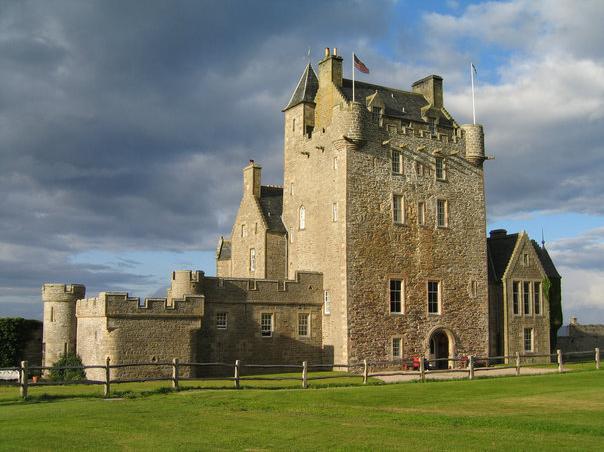
Keiss Castle
Keiss Castle stands as a striking example of a Scottish Renaissance tower house located on the rugged coastline of Caithness in the Scottish Highlands. Perched on the very edge of a low cliff above a rocky shoreline, this castle commands expansive views over Sinclair’s Bay to the south, a long sandy beach historically used for small boat landings. The castle’s site reflects the maritime culture of northern Scotland, where travel and communication were primarily by sea.
Constructed around the turn of the 17th century, Keiss Castle was built in the distinctive Z-plan layout, a popular architectural form in late 16th- and early 17th-century Scotland. This design features a rectangular central block with two round towers projecting from diagonally opposite corners, combining both defensive capabilities and residential comfort. The castle rises to four stories plus an attic, with a vaulted basement providing secure storage and protection.
The castle’s location on a promontory cliff offered natural defense and commanding views over the surrounding landscape and sea routes. This strategic positioning was common among Caithness castles, which prioritized coastal vantage points to monitor maritime activity rather than inland military campaigns. The proximity to other Sinclair family strongholds, such as Ackergill Tower to the south, underscores the regional network of fortified sites controlling this part of the Scottish coast.
Architectural features and layout
Keiss Castle’s Z-plan design is characterized by a central rectangular block aligned northwest to southeast, with two round towers at the northeast and southwest corners. The northern tower has collapsed, exposing the vaulted basement and interior structural elements, while the southern towers remain partially intact. The southwest tower is integrated into the wall without projecting northward, while the southeast tower projects slightly eastward, constrained by the cliff’s shape.
The entrance was uniquely positioned at ground level in the northeast section, which is now collapsed. Unlike many contemporaneous tower houses, the doorway was not flanked by defensive towers, suggesting a balance between security and accessibility. Decorative masonry features include chequered corbelling and a heraldic panel atop the southeast gable, indicating the castle’s noble association and aesthetic considerations beyond mere fortification.
Adjacent cliff masonry suggests the castle may have once been connected to a courtyard or ancillary buildings facing shoreward, with a possible secondary entrance providing direct access to the rocky shoreline below. The cliffside stabilization work visible today reflects ongoing efforts to preserve the structure against natural erosion.
Historical context and ownership
The castle is traditionally attributed to George Sinclair, 5th Earl of Caithness (1582–1643), who is believed to have constructed it on or near the site of an earlier fortification known as Raddar. While no archaeological evidence confirms this predecessor, the presence of ancient brochs nearby suggests a long history of occupation and defense in the area.
First documented in 1623, Keiss Castle played a role during the turbulent reign of James VI, when the earl fortified his holdings against a royal punitive expedition led by Sir Robert Gordon of Gordonstoun. The earl fled, leaving the castle under the control of his countess, who surrendered it peacefully. This episode highlights the castle’s defensive function amid regional power struggles.
Following the death of the 5th earl in 1643, the castle passed to his grandson, the 6th earl, who preferred residence elsewhere and granted Keiss to a cousin. Disputes over the earldom and estate ensued, culminating in a 1681 legal victory for George Sinclair of Keiss. The 7th earl died at the castle in 1698, but by 1700 the building was described as "ruinous." Despite this, repairs were undertaken by 1726, coinciding with the construction of a more convenient house nearby.
In the early 18th century, the estate was acquired by Sir William Sinclair, 2nd Baronet of Dunbeath, who made Keiss his family seat. Around 1755, the old castle was superseded by Keiss House, a mansion reflecting changing tastes and domestic needs. Financial difficulties forced the Sinclairs to sell the estate in 1765 to the Sinclairs of Ulbster, who retained it for many years.
Keiss house and later developments
Keiss House was extensively remodeled in 1860 under the direction of architect David Bryce, commissioned by Colonel K. Macleay. The renovations embraced the Scottish Baronial style, a 19th-century revivalist movement inspired by medieval castles, featuring turrets, battlements, and ornate stonework. The estate’s gate lodge, gate piers, and cast-iron carriage gates date from this period, contributing to the property’s historic character.
In 1866, the estate was sold to the Duke of Portland, marking another chapter in its ownership history. Today, Keiss Castle remains a partially ruined historic monument, fenced off for safety due to structural instability, particularly the collapsed northern tower. The adjacent Keiss House and associated gardens are recognized as Category B listed buildings, preserving the legacy of this evolving estate.
Archaeological significance and surrounding landscape
The castle’s site is part of a broader archaeological landscape that includes nearby ancient structures such as the Keiss Broch, an Iron Age stone tower. This continuity of occupation underscores the strategic importance of the Caithness coastline through millennia.
Keiss Castle’s cliff-top position, architectural form, and historical associations provide valuable insights into the defensive strategies, domestic arrangements, and noble ambitions of Scottish Renaissance lairds. Its preservation as a scheduled monument ensures ongoing study and appreciation of Scotland’s rich medieval and early modern heritage.
Frequently asked questions (FAQ)
- What is the historical significance of Keiss Castle?
- Keiss Castle, located in the Highland region of Scotland, dates back to the 16th century and is a prime example of Scottish baronial architecture. It was once the residence of the Sinclair family and played a crucial role in the local history, reflecting the tumultuous events of the Scottish Reformation and the Civil War.
- When was Keiss Castle built?
- Keiss Castle was constructed in the late 16th century, with significant renovations taking place in the 17th century. Its unique design and historical features make it an important landmark in the region.
- Can I visit Keiss Castle?
- Yes, visitors are welcome to explore the grounds of Keiss Castle. However, it’s advisable to check in advance for any specific visiting hours or restrictions, as some areas may be closed to the public due to preservation efforts.
- What are the opening hours for Keiss Castle?
- Keiss Castle typically opens to visitors during the warmer months, from April to September, with hours varying by day. It’s best to check the official website or local tourism information for the most current opening hours before planning your visit.
- Is it possible to access Keiss Castle by public transport?
- Yes, Keiss Castle is accessible via local bus services that connect to nearby towns. However, visitors may need to walk a short distance from the nearest bus stop, so plan accordingly.
- What is the best time to visit Keiss Castle?
- The best time to visit Keiss Castle is during the spring and summer months when the weather is more favorable and the gardens are in bloom. Visiting during this time also allows for a more enjoyable exploration of the surrounding landscape.
- Are there any nearby attractions to Keiss Castle?
- Yes, nearby attractions include the charming village of Keiss, the stunning coastline, and other historical sites such as Sinclair Castle. Exploring these sites can provide a rich experience of Scottish heritage and natural beauty.
- What are the ticket prices for visiting Keiss Castle?
- Entry to Keiss Castle is often free, but there may be a small fee for guided tours or special events. It's recommended to check for any updates on ticket prices or special offers before your visit.
Information
Loading map...
Visitor reviews
No reviews yet. Been here? Write the first review and help other travelers!
Write the first reviewVisited this castle? Share your experience
Your review helps other travelers and adds first-hand knowledge to our encyclopedia.