Thun Castle
Thun Castle stands as a commanding medieval fortress perched on a hill overlooking the old town of Thun and the Aare River in the canton of Bern, Switzerland. Constructed in the 12th century, the castle is a remarkable example of high medieval hill castle architecture and remains one of the most significant heritage sites in the region. Today, the castle functions as a museum, showcasing the cultural and historical development of the surrounding area over some 4,000 years.
The castle's origins trace back to the early Middle Ages, when a small fortification and church occupied the hilltop, serving as a refuge for local inhabitants during times of conflict. Between 1180 and 1190, Duke Berthold V of Zähringen erected the stone castle that forms the core of the present structure. Although the Zähringen family never resided here, preferring their Burgdorf Castle, they established the castle as a symbol of their power, constructing the impressive keep and the grand Knights' Hall (Rittersaal) with a soaring ceiling height of 14 meters, designed to impress and assert their dominance.
The kyburg era and turbulent history
In 1218, the castle passed to the House of Kyburg, who expanded the fortress by adding upper levels and strengthening its defenses. The Kyburg period was marked by significant events, including a notorious fratricide in 1322 when Eberhard II von Kyburg murdered his brother Hartmann II within the castle walls. To safeguard his lands from the rising power of the Habsburgs, Eberhard II sold the territory to the city of Bern but retained it as a fief, maintaining Kyburg influence for nearly two centuries.
The Burgdorferkrieg (Kyburger War) erupted in 1382, triggered by conflicts over regional control. Following decisive Bernese victories, the Kyburgs were compelled to cede Thun and Burgdorf to Bern in 1384. Under Bernese rule, the castle became the administrative center for the region, housing municipal institutions, a garrison, and the local court.
Bernese modifications and architectural features
During the Bernese period, the castle underwent significant alterations to suit its new administrative role. Between 1430 and 1436, a massive roof was constructed to cover the inner courtyard, an ambitious architectural project that protected the castle's core structures. Around 1429, a late Gothic administrative and residential wing, known as the "new castle," was added to the west of the main keep to provide additional space for governing functions.
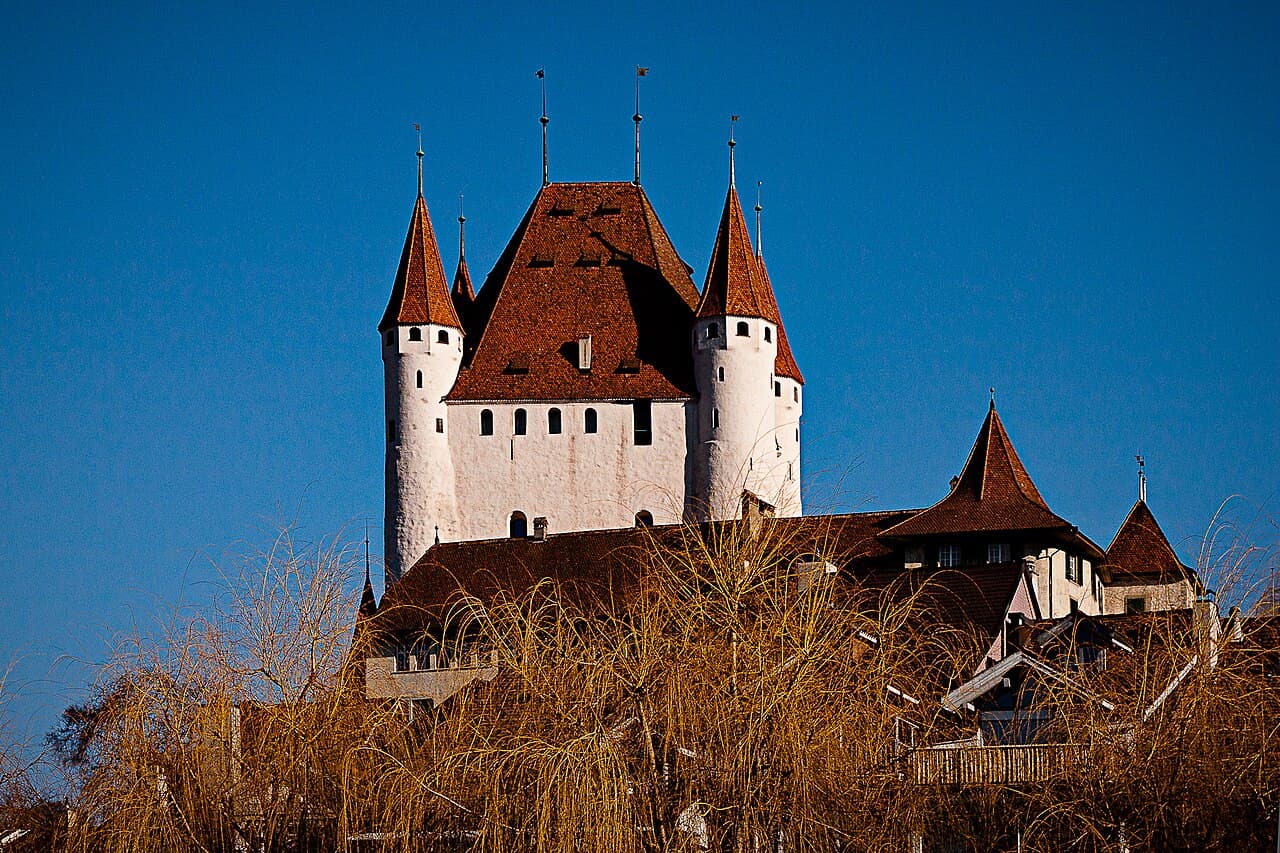
The castle's bergfried (main tower) is a striking feature, with a nearly rectangular base rising five stories high. Each corner is reinforced by a round tower of equal height, all capped with pointed conical roofs, exemplifying medieval defensive architecture. The castle complex also includes two large wings extending from the southern side of the keep, enclosing an open courtyard surrounded by former outer fortifications known as the vorburg.
Knights' Hall and prison
The Knights' Hall remains one of the castle's most notable interior spaces. Dating from the original Zähringen construction, this grand hall with its 14-meter ceiling was designed as a powerful symbol of feudal authority. Unusually, the castle's prison cells were located under the roof of the bergfried rather than in the basement, a unique feature in medieval fortifications. In 1886, a new prison was built on the castle grounds, reflecting the site's evolving judicial role.
Thun castle museum and cultural significance
Since opening as a museum in 1888, Thun Castle has preserved and presented a wealth of cultural and historical artifacts. The museum spans five floors within the main tower, featuring exhibits that trace the region's development from prehistoric times through the medieval period to modern history. Visitors can explore archaeological finds from nearby valleys, medieval weaponry, and displays on local customs and traditions.
The former Knights' Hall now serves as a versatile event space, hosting concerts, theatrical performances, and private functions. The castle's elevated position offers visitors panoramic views of the Thuner See (Lake Thun), the Bernese Alps, and the historic town below, enhancing its appeal as a cultural landmark.
Preservation and modern use
Thun Castle remains well preserved, with its medieval walls, towers, and later additions intact. The castle's role has shifted from a military fortress to a cultural and historical monument, integrating modern amenities such as a hotel and restaurant within the complex. In 2006, ownership transferred from the canton of Bern to the municipality of Thun, ensuring local stewardship of this iconic site.
The castle was the seat of the Bernese Oberland district court until 2009, after which judicial functions ceased. Today, the castle is a popular tourist destination, celebrated for its rich history, architectural grandeur, and cultural offerings. Its designation as a Swiss heritage site of national significance underscores its importance in Switzerland's historical landscape.
Frequently asked questions (FAQ)
- What is the historical significance of Thun Castle?
- Thun Castle, built in the 12th century, has played a crucial role in the defense and administration of the region. It served as a residence for the Counts of Thun and later became a prison and a government building, reflecting its importance throughout Swiss history.
- What are the opening hours of Thun Castle?
- Thun Castle is generally open to visitors from 10 AM to 5 PM during the summer months and from 10 AM to 4 PM in winter. It's advisable to check the official website for any seasonal changes or special closures before planning your visit.
- Can I access Thun Castle with a wheelchair?
- Yes, Thun Castle is accessible for visitors with mobility challenges. The castle has made efforts to provide wheelchair access, including ramps and designated pathways, ensuring that everyone can enjoy its historical offerings.
- When is the best time to visit Thun Castle?
- The best time to visit Thun Castle is during the spring and summer months when the weather is pleasant and the gardens are in full bloom. Additionally, many cultural events and exhibitions take place during this time, enhancing the visitor experience.
- What are the ticket prices for Thun Castle?
- Tickets for Thun Castle are priced at approximately CHF 8 for adults, while discounts are available for students and seniors. Children under the age of 16 can enter for free, making it a family-friendly destination.
- Is it possible to take guided tours of Thun Castle?
- Yes, guided tours are available at Thun Castle, offering deeper insights into its history and architecture. These tours are typically conducted in multiple languages and are a great way to enhance your understanding of this remarkable site.
- What nearby attractions can I visit while at Thun Castle?
- While visiting Thun Castle, you can also explore the beautiful Old Town of Thun, which features charming streets, shops, and cafes. Additionally, Lake Thun is just a short walk away, providing stunning views and opportunities for outdoor activities.
- How do I get to Thun Castle from the city center?
- Thun Castle is conveniently located within walking distance from the city center, making it easily accessible. You can enjoy a pleasant stroll through the picturesque streets or opt for public transport, with several bus lines serving the area.
Photo gallery

Information
Website
Visit websiteSources & official resources
Verify the information above using these authoritative references.
Loading map...
Visitor reviews
No reviews yet. Been here? Write the first review and help other travelers!
Write the first reviewVisited this castle? Share your experience
Your review helps other travelers and adds first-hand knowledge to our encyclopedia.