Laupen Castle
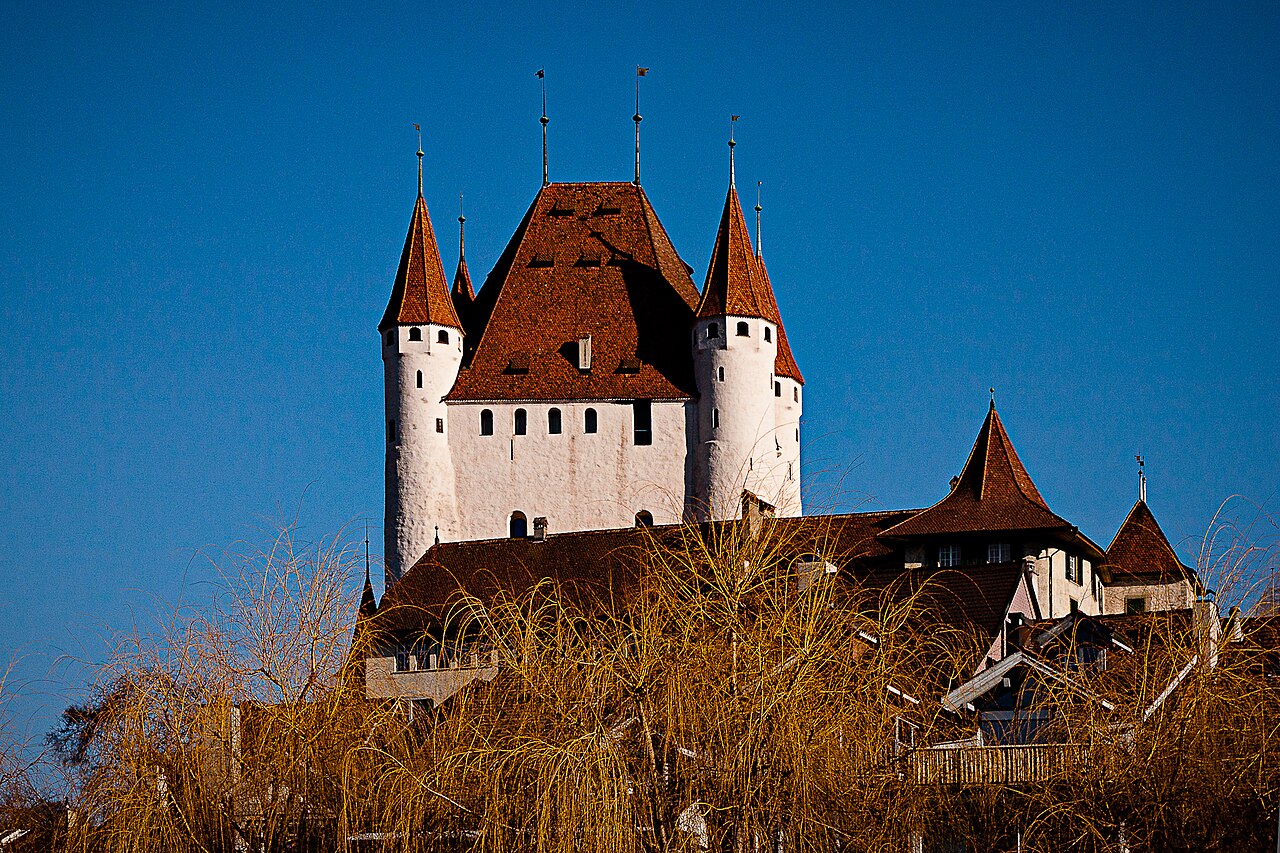
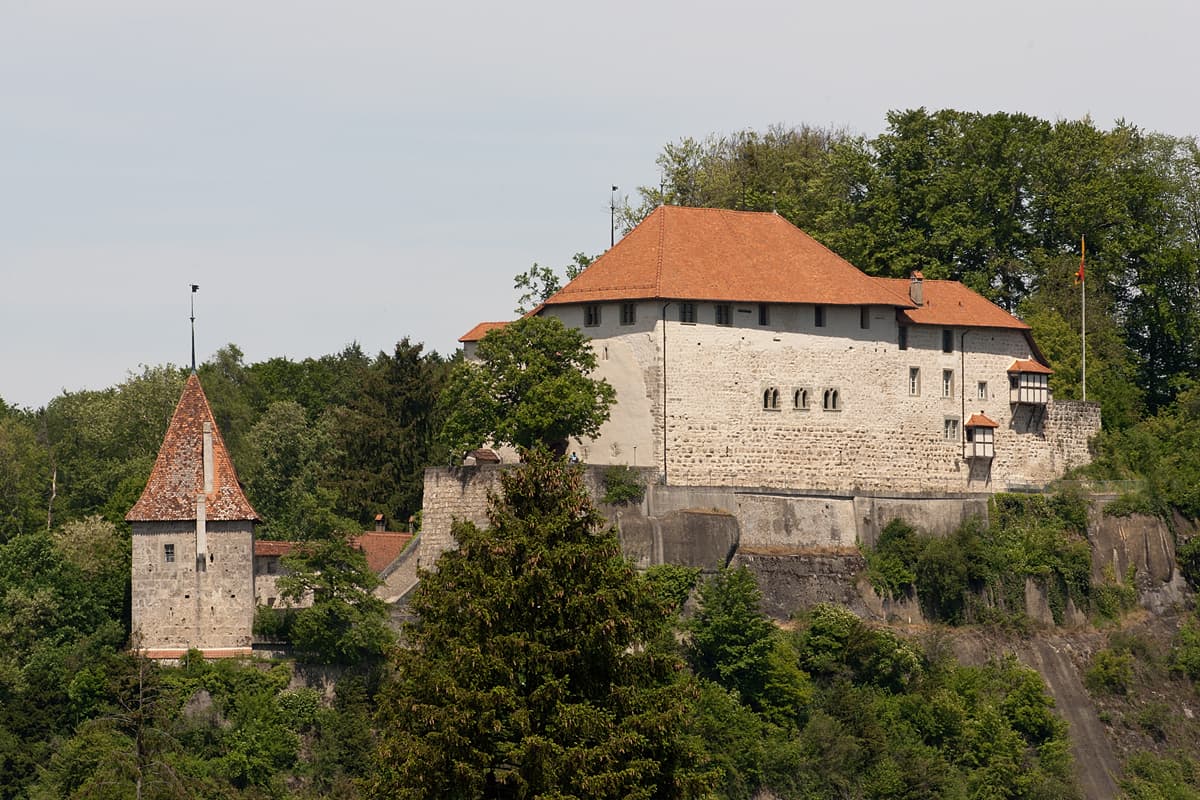
Laupen Castle stands as a significant medieval fortress located in the municipality of Laupen, in the canton of Bern, Switzerland. Constructed primarily between the 10th and 13th centuries, the castle occupies a commanding position on a molasse rock spur overlooking the confluence of the Sense (Singine) and Saane (Sarine) rivers. This strategic location provided natural defensive advantages and control over riverine routes, making it a key stronghold in regional power struggles throughout the Middle Ages.
The castle was originally part of a series of imperial castles established to secure the borderlands along these rivers. Its design incorporates a keep, main tower (bergfried), and a thick elliptical ring wall that encloses the fortress. The ring wall, measuring approximately 2.5 to 3 meters in thickness and rising 10 to 12 meters high, is built with bossed ashlar masonry, a medieval technique where stone blocks have a roughened, protruding surface to enhance strength and aesthetics. While the south, west, and north sections of the wall remain largely intact, only the foundations survive on the eastern side and at the main tower.
Historical context and significance
Throughout its history, Laupen Castle was a focal point of territorial disputes between powerful noble families. In the 13th century, it lay on the contested border between the Counts of Kyburg and Habsburg on one side and the Counts of Savoy on the other. This rivalry led to multiple changes in ownership, often through pledges to the king, notably in 1295 and again around 1309-1310. These pledges underscored the castle's importance as a royal asset in controlling the region.
By 1324, the rising city-state of Bern redeemed the castle’s pledge, establishing its first bailiwick (administrative district) at Laupen. This marked a crucial step in Bern’s territorial expansion and consolidation of power during the Middle Ages.
The Laupen war and military importance
The castle’s military significance was dramatically demonstrated during the Laupen War of 1339. A coalition of nobles from Burgundy, Savoy, and Habsburg, allied with the city of Fribourg, laid siege to the castle for twelve days. Despite the intense siege, the defenders held firm, and Bern, supported by allies from central Switzerland, decisively defeated the attacking forces. This victory solidified Bern’s control over Laupen and its surrounding territories.
Architectural features and layout
Laupen Castle’s architecture reflects its evolution from a medieval fortress to a regional administrative center. The castle is strategically positioned on a sandstone spur, separated from the adjacent hill by a deep neck ditch that enhances its defensibility. The elliptical ring wall encloses the main structures and courtyard, featuring various defensive elements such as arrow slits and battlements.
The palas and knights’ hall
One of the castle’s most remarkable features is the palas, the principal residential building constructed around 1315. This building houses a spacious knights’ hall illuminated by three pairs of pointed-arch double windows, characteristic of early 14th-century Gothic style. The hall retains its original fireplace, a massive wooden beam ceiling, and exposed masonry walls, making it one of the best-preserved medieval halls in Switzerland. Above the hall is a residential floor beneath a large hipped roof dating from 1395, indicating ongoing development of the living quarters.
Administrative buildings and later modifications
The castle courtyard also contains the Amtshaus, or administrative building, constructed in the late Gothic style. This building features a side stair tower topped with a distinctive curved roof. The interior decoration from the 17th and 18th centuries remains preserved, reflecting the castle’s continued use as a center of governance.
Notably, the castle cafeteria incorporates visible fragments of the original Romanesque outer walls of the bergfried, a rare architectural survival in Swiss castles. Between 1580 and 1599, a stair ramp was added to improve access, and the bailiff’s residence was constructed between 1648 and 1650. The prominent cage tower (Käfigturm), used historically as a prison, was rebuilt between 1660 and 1662.
Preservation and modern use
Laupen Castle remained the official residence of the Bernese bailiff until the end of the Ancien Régime in 1798, overseeing local administration and justice. It continued to house district offices responsible for land registry, debt enforcement, and bankruptcy until 2009. In 2012, ownership transferred to a dedicated foundation tasked with preserving and operating the site.
A major renovation and rock stabilization project between 1983 and 1988 ensured the castle’s structural integrity and preserved its historical features. Today, Laupen Castle stands as a well-preserved example of a hill castle that combines military, residential, and administrative functions. Its rich history, architectural diversity, and commanding location continue to attract visitors interested in medieval heritage and Swiss history.
Castle grounds and views
The castle’s terraces, including the circular Rondenweg path and an eastern bastion, offer expansive views of the surrounding landscape, emphasizing the strategic importance of its location. Visitors can explore the well-maintained courtyard, defensive walls, and the palas, gaining insight into medieval life and fortification techniques.
Cultural and heritage significance
Laupen Castle is recognized as a cultural heritage site of national importance in Switzerland. Its combination of Romanesque and Gothic architectural elements, along with its well-documented history, makes it a valuable resource for understanding medieval castle construction and regional politics in the Swiss plateau. The castle’s preservation efforts ensure that this heritage remains accessible for future generations.
Frequently asked questions (FAQ)
- How do I get to Laupen Castle?
- To reach Laupen Castle, you can take public transportation from Bern, which is approximately a 30-minute train ride followed by a short walk. If you prefer driving, there is parking available near the castle for easy access.
- What is the historical significance of Laupen Castle?
- Laupen Castle dates back to the 13th century and played a crucial role in the region's defense against various conflicts. It is a symbol of the historical power struggles in the area and reflects the medieval architecture and feudal history of Switzerland.
- When was Laupen Castle built?
- Laupen Castle was constructed in the early 13th century, with its first documented mention occurring around 1230. Over the centuries, it has undergone various renovations and restorations, maintaining its historical charm.
- Can I visit Laupen Castle year-round?
- Yes, Laupen Castle is open to visitors year-round, though certain areas may be closed during the winter months. It's advisable to check the official website for any seasonal changes in access or special events.
- Why is Laupen Castle a popular tourist destination?
- Laupen Castle attracts visitors due to its stunning architecture, rich history, and picturesque views of the surrounding landscape. It serves as a wonderful site for exploring Swiss heritage and offers guided tours that delve into its fascinating past.
- Is it possible to book a guided tour of Laupen Castle?
- Yes, guided tours of Laupen Castle are available and can be booked in advance. These tours provide in-depth knowledge about the castle's history, architecture, and its significance in Swiss culture.
- What are the opening hours for Laupen Castle?
- Laupen Castle typically opens its doors to visitors from 10 AM to 5 PM during the main tourist season. However, hours may vary in the off-season, so it's best to verify current timings on their official website before your visit.
- What are the ticket prices for Laupen Castle?
- Tickets for Laupen Castle are affordably priced, with discounts available for students and seniors. Children under a certain age often enter for free, making it a great destination for families.
- What nearby attractions should I visit while in Laupen?
- While in Laupen, you can explore the charming old town with its traditional Swiss architecture, as well as nearby natural sites such as the river Aare. Additionally, the city of Bern is just a short train ride away, offering further cultural experiences.
Photo gallery

Information
Website
Visit websiteSources & official resources
Verify the information above using these authoritative references.
Loading map...
Visitor reviews
No reviews yet. Been here? Write the first review and help other travelers!
Write the first reviewVisited this castle? Share your experience
Your review helps other travelers and adds first-hand knowledge to our encyclopedia.