Oberhofen Castle
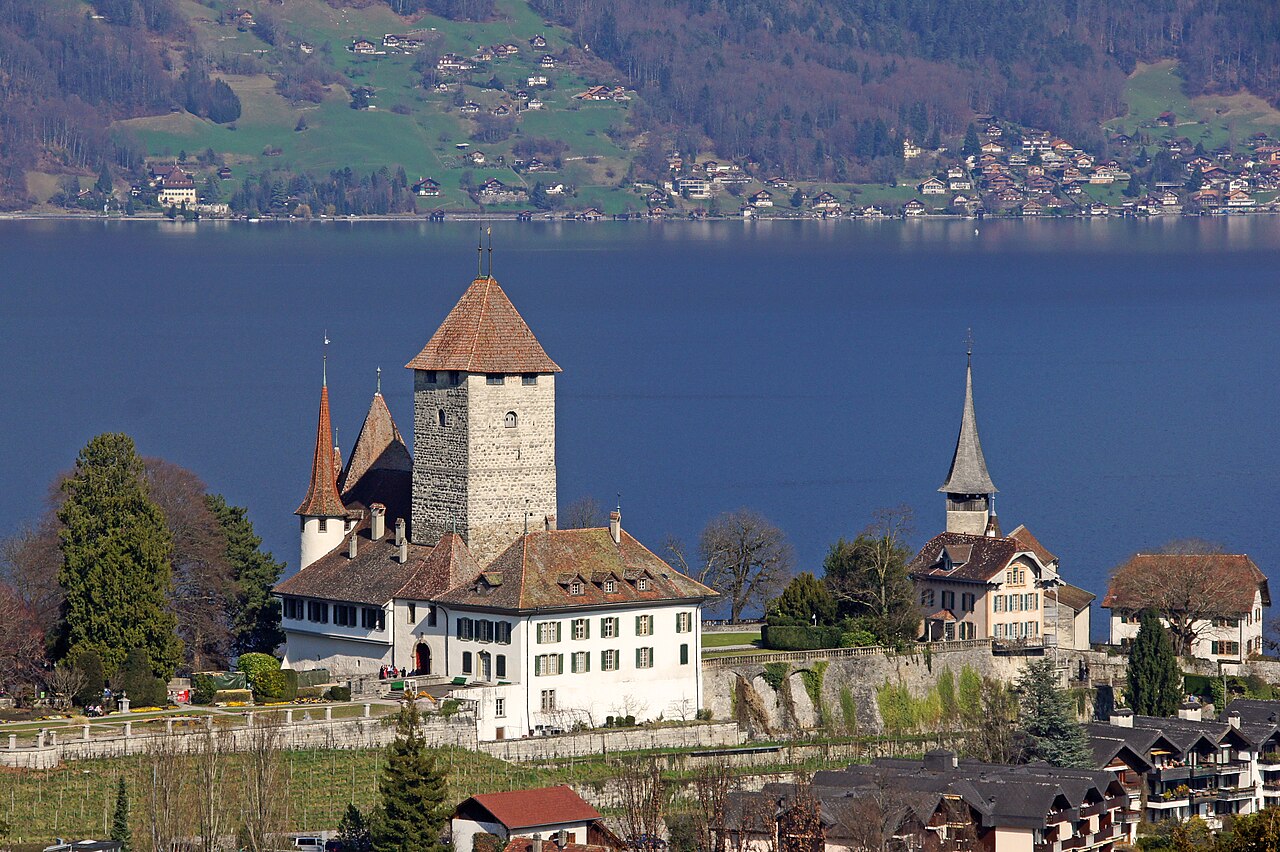
Oberhofen Castle stands as a striking example of a High Medieval hill castle nestled on the shores of Lake Thun in Oberhofen am Thunersee, Switzerland. Its origins trace back to around 1200, anchored by a robust central keep or bergfried that served as a formidable defensive structure. Over the centuries, the castle evolved architecturally and functionally, reflecting the shifting tides of regional power, ownership, and stylistic trends.
Medieval origins and early history
The castle's foundation is attributed to the Freiherr von Oberhofen family during the High Middle Ages. The earliest notable event was the marriage of Ita von Oberhofen to a member of the von Eschenbach family around 1200, which transferred ownership and initiated the construction of a new moated castle on the lake's edge during the 13th century. This early phase established the castle’s strategic position overlooking the lake and surrounding lands.
In the early 14th century, the castle became entangled in the political upheavals of the region. The von Eschenbach family was compelled to sell Oberhofen Castle and its associated lands to the powerful Habsburg dynasty in 1306. The Habsburgs, through a series of vassals including the Kyburg family, administered the castle as part of their extensive territories.
The castle's history is marked by notable figures such as Walter IV von Eschenbach, who was assassinated in 1308 alongside King Albert I of Germany, a testament to the turbulent times. The Habsburgs’ influence waned after their defeats in the Burgdorferkrieg (1383-84) and the Battle of Sempach (1386), leading to Bernese expansion into the Bernese Oberland and eventual acquisition of Oberhofen in 1397.
Bernese rule and administrative role
Following Bern’s takeover, Oberhofen Castle became the seat of a Bailiwick, serving as the administrative center for the region. The castle passed through several prominent Bernese patrician families, including the von Scharnachthal and von Erlach families. When the male line of the von Erlach family ended in 1652, the city of Bern assumed direct control, reinforcing the castle’s role in governance.
Bernese renovations in the late 17th century introduced Baroque architectural elements, partially surrounding the medieval keep with new buildings. The Garden Room was constructed on the lake side, and the original water tower was demolished, reflecting a shift from purely defensive to more residential and administrative functions.
19th-century romantic revival and architectural transformation
In the 19th century, Oberhofen Castle underwent significant transformation under the ownership of the Neuchâtel-Prussian Pourtàles family. Between 1849 and 1852, the castle was extensively renovated and expanded in the Romantic Neo-Gothic style, a popular architectural movement that sought to revive medieval aesthetics with a picturesque flair.
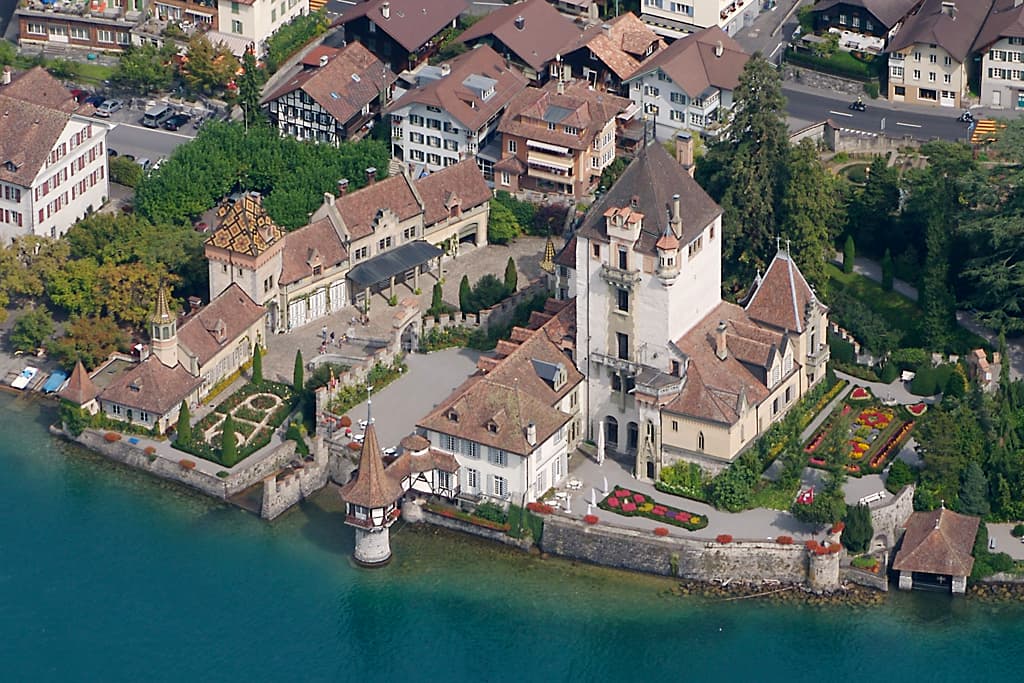
The renovations included the rebuilding of the north-eastern side of the keep and the entire western facade. The water tower was reconstructed and crowned with a fanciful spire, reinstating a lakeside architectural feature lost in earlier centuries. The addition of corner towers, battlements, and tiled roofs enhanced the castle’s fairy-tale appearance.
Inside, the castle was lavishly updated with new interiors designed by Theodor Zerleeder, a Bernese architect. Notable rooms include a grand dining hall, a library filled with ornate woodwork, and a unique Turkish smoking room inspired by the wealthy houses of Cairo. This room reflects the cosmopolitan influences brought by Count Albert Alexander de Pourtalè, who had diplomatic ties to Istanbul.
The castle’s grounds were transformed with the creation of a 2.5-hectare English-style landscaped park south of the main buildings. The park takes advantage of the region’s mild climate to cultivate a diverse array of plants, offering stunning views of the Bernese Alps and Lake Thun.
Architectural features and layout
The castle’s centerpiece is the massive bergfried, measuring approximately 11 by 12.5 meters, with walls about two meters thick. This tower exemplifies medieval military architecture designed for defense and surveillance. Surrounding the bergfried are residential and administrative buildings added over centuries, including the late medieval palas and the chapel consecrated in 1473 on the lake side of the keep.
The castle’s lakeside location is enhanced by the presence of a water tower, rebuilt in the 19th century to complement the Romantic aesthetic. The castle complex includes multiple towers, battlements, and fortified walls that create an imposing silhouette against the lake and mountains.
Cultural heritage and museum today
Since 1952, Oberhofen Castle has been part of the Historical Museum of Bern, serving as a museum that showcases the castle’s rich history and the lives of its inhabitants over eight centuries. The castle’s interiors display period furnishings, artworks, and exhibits that illuminate the social and political history of the region.
The castle chapel features impressive 15th-century frescoes, providing insight into the religious art and practices of the late medieval period. Visitors can also experience the unique Turkish smoking room, a rare example of 19th-century Orientalist interior design in Switzerland.
The castle’s park is renowned for its beauty and tranquility, offering panoramic views that make it one of the most picturesque gardens in the Alpine region. The mild climate supports a variety of plant species, enhancing the visitor experience throughout the seasons.
Oberhofen Castle remains well preserved, retaining its medieval core alongside the Romantic additions, making it a significant cultural landmark in Switzerland. Its combination of military architecture, administrative history, and 19th-century Romantic revival makes it a unique destination for those interested in history, architecture, and landscape design.
Visitor experience and significance
Visitors to Oberhofen Castle can explore the extensive museum collections spread across the first and second floors, which detail the castle’s architectural evolution and the daily lives of its former residents. The eastern smoking room atop the tower offers spectacular views of Lake Thun and the surrounding mountains, providing a memorable highlight.
The castle’s location on a hill overlooking the lake affords visitors a unique perspective on the natural and historical landscape of the Bernese Oberland. The well-maintained English-style park invites leisurely strolls and contemplation amid historic surroundings.
Frequently asked questions (FAQ)
- How do I get to Oberhofen Castle?
- Oberhofen Castle is located in Oberhofen am Thunersee, easily accessible by car or public transport from Bern and Thun. Visitors can take local buses or boats on Lake Thun to reach the castle.
- What are the opening hours of Oberhofen Castle?
- The castle is generally open to visitors from April to October, typically from 10:00 to 17:00 daily. It is advisable to check the official website for seasonal variations and special closures.
- Is there an admission fee to visit Oberhofen Castle?
- Yes, there is an admission fee to enter the castle museum. Prices vary, with discounts available for children, seniors, and groups. Tickets can be purchased on-site or online.
- What architectural styles are represented in Oberhofen Castle?
- Oberhofen Castle showcases a blend of High Medieval defensive architecture and 19th-century Romantic Neo-Gothic renovations, including Baroque influences from the Bernese period.
- Can I visit the castle chapel and see the frescoes?
- Yes, the castle chapel is open to visitors and features impressive 15th-century frescoes that provide insight into medieval religious art and history.
- Is the castle park accessible to the public?
- The English-style landscaped park surrounding Oberhofen Castle is open to visitors year-round, offering beautiful views of Lake Thun and the Bernese Alps.
- Are guided tours available at Oberhofen Castle?
- Guided tours are available and recommended to fully appreciate the castle’s history, architecture, and art collections. Information on tours can be found at the visitor center or official website.
Photo gallery

Information
Sources & official resources
Verify the information above using these authoritative references.
Loading map...
Visitor reviews
No reviews yet. Been here? Write the first review and help other travelers!
Write the first reviewVisited this castle? Share your experience
Your review helps other travelers and adds first-hand knowledge to our encyclopedia.