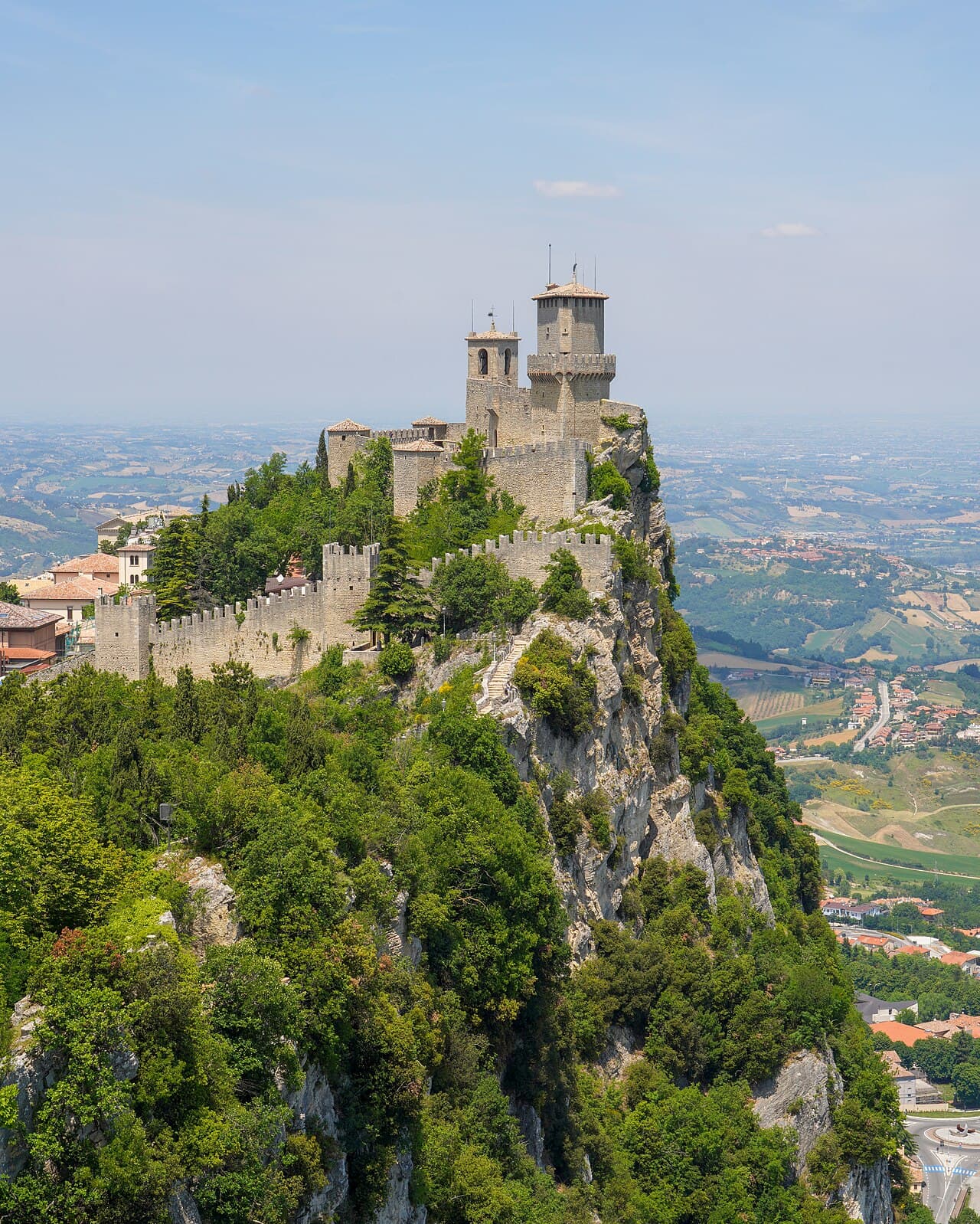
Three Towers of San Marino
The Three Towers of San Marino are iconic medieval fortresses perched on the three peaks of Mount Titano, overlooking the capital city of the Republic of San Marino. These towers—Guaita, Cesta, and Montale—have served as vital defensive structures throughout San Marino's history, symbolizing the resilience and independence of one of the world's oldest republics. Their strategic placement atop the mountain allowed for control over the surrounding territory and protection against invaders, making them key military and cultural landmarks.
Constructed primarily from local stone, the towers exemplify medieval military architecture adapted to the unique topography of Mount Titano. Each tower has a distinct history and architectural character that reflects its specific defensive role and period of construction. Together, they form a continuous defensive system that has been carefully preserved and remains a powerful symbol of San Marino's heritage.
The oldest fortress: guaita tower
Guaita, the northernmost and oldest of the three towers, was built in the 11th century as a refuge and stronghold during times of conflict. It is a hill castle featuring two concentric stone walls that provided robust defense. The inner wall once included corner watchtowers, which were destroyed in the 16th century, enclosing key structures such as a bell tower, a pentagonal watchtower, and guard quarters.
The tower's entrance gate, dating from the early 15th century, includes a drawbridge typical of medieval fortifications, enhancing its defensive capabilities. Inside the central courtyard, several cannons dating to the early 20th century were donated by King Victor Emmanuel III of Italy and were used for ceremonial purposes. A chapel dedicated to Saint Barbara was added in 1960 beside the southern tower, reflecting the tower's continued cultural significance.
Guaita also served as a prison from the late 18th century until 1970, holding inmates for short sentences. Its bell tower, likely constructed in the mid-16th century, functioned as a warning system and continues to ring on religious and national holidays, maintaining its historical role in the community.
Cesta tower: the highest peak and museum
Cesta tower stands at the highest point of Mount Titano, at an elevation of 755 meters above sea level. First recorded in 1253, it was built atop the remains of ancient Roman fortifications, linking San Marino's medieval history with its classical past. The tower was fortified further in 1320 with an outer wall, enhancing its defensive perimeter.
Today, Cesta houses the Museo delle Armi Antiche, a museum dedicated to ancient weapons. Its collection includes approximately 700 weapons dating from the 13th century through to modern times, providing visitors with a comprehensive view of the evolution of arms and armor. The tower underwent significant restoration in 1924–1925 to preserve its medieval character and stone construction, ensuring its longevity as a cultural and historical site.
Montale tower: the smallest and most secretive fortress
Montale, the smallest of the three towers, was constructed in the 14th century on the southern peak of Mount Titano. It replaced earlier fortifications and primarily served as a lookout against threats approaching from the south until 1479. Its narrow silhouette and elevated entrance door, positioned about seven meters above ground level, are typical features of prison architecture designed to prevent escapes.
Beneath Montale lies a deep prison cell known as the "fondo della torre", accessible only from above and situated approximately eight meters underground. This feature underscores the tower's role as a detention facility. Although Montale lost its strategic importance after the 15th century and was abandoned for some time, it was restored in the 18th and 20th centuries. Unlike the other towers, Montale remains closed to the public, preserving its mystery and historical integrity.
Historical significance and cultural legacy
Throughout their history, the Three Towers played crucial roles in defending the Republic of San Marino, particularly during conflicts with the Malatesta family, a powerful regional dynasty. Their robust construction and strategic locations allowed the small republic to maintain its independence amid larger territorial powers.
Guaita's use as a prison from the late 1700s until 1970 highlights the towers' multifaceted functions beyond military defense. Montale's deep prison cell further emphasizes their role in law enforcement and detention. The towers' enduring presence has made them iconic symbols of San Marino, prominently featured on the national emblem, flag, and euro coins, reinforcing their importance to the republic's identity.
Architectural features and preservation
The Three Towers form a linked defensive system atop the three peaks of Mount Titano, constructed primarily from durable local stone. Guaita's two concentric walls, the pentagonal watchtower, and the early 15th-century entrance with a drawbridge exemplify medieval military design adapted to the mountainous terrain.
Cesta's high outer wall connects with the defensive walls linking all three towers, creating a continuous fortification line. The tower's well-preserved medieval stonework and the extensive collection of ancient weapons housed within its walls highlight its dual role as a fortress and museum.
Montale's narrow form and elevated entrance reflect its prison function, while its deep underground cell is a rare architectural feature demonstrating medieval incarceration methods. The restorations carried out in the 18th and 20th centuries have preserved these unique characteristics, although Montale remains inaccessible to visitors.
Overall, the towers have been meticulously maintained to retain their original defensive features and historical authenticity. Their strategic arrangement provides a panoramic defensive network that historically protected the capital and surrounding areas, making the Three Towers a remarkable example of medieval fortification adapted to a mountainous landscape.
Frequently asked questions (FAQ)
- How do I get to the Three Towers of San Marino?
- The Three Towers of San Marino are easily accessible by foot from the historic center of San Marino. Visitors can enjoy a scenic walk through the charming streets or take a local bus that connects the main attractions in the area.
- What is the historical significance of the Three Towers?
- The Three Towers of San Marino, known as Guaita, Cesta, and Montale, are symbols of the Republic of San Marino and represent its rich medieval history. They were built between the 11th and 13th centuries for defensive purposes and now serve as a testament to the country's independence and resilience.
- When was the last restoration of the Three Towers?
- The last significant restoration of the Three Towers took place in the late 20th century, with efforts to preserve their historical integrity while making them safe for visitors. Ongoing maintenance ensures that these iconic structures remain a vital part of San Marino's cultural heritage.
- Can I enter the towers during my visit?
- Yes, visitors can enter the towers, specifically Guaita and Cesta, which offer stunning views of the surrounding landscape. Each tower has its own unique features and exhibits that enhance the visitor experience, making it a must-see during your trip.
- Why is the best time to visit the Three Towers during spring or fall?
- Spring and fall are ideal times to visit the Three Towers of San Marino due to milder weather and fewer crowds. These seasons provide a comfortable climate for exploring the towers and enjoying the picturesque views without the heat of summer or the chill of winter.
- Is it possible to buy tickets in advance for the Three Towers?
- Yes, visitors can purchase tickets in advance online, which can save time and ensure entry during peak tourist seasons. Tickets grant access to the towers and the surrounding areas, allowing for a full experience of this historic site.
- What are the opening hours for the Three Towers?
- The Three Towers are typically open daily from 9 AM to 5 PM, with extended hours during the summer months. It is advisable to check the official website for any seasonal changes in opening hours before your visit.
- What nearby attractions should I visit while at the Three Towers?
- While visiting the Three Towers, consider exploring the nearby Palazzo Pubblico, the State Museum, and the Basilica di San Marino. These attractions, along with the charming streets of San Marino, create a rich cultural experience for all visitors.
- Are there any accessibility options available at the Three Towers?
- The Three Towers have some accessibility features, but due to their historical nature and location on a hillside, some areas may be challenging for visitors with mobility issues. It is recommended to contact the visitor center for detailed information regarding accessibility options before your visit.
Photo gallery

Information
Loading map...
Visitor reviews
No reviews yet. Been here? Write the first review and help other travelers!
Write the first reviewVisited this castle? Share your experience
Your review helps other travelers and adds first-hand knowledge to our encyclopedia.


