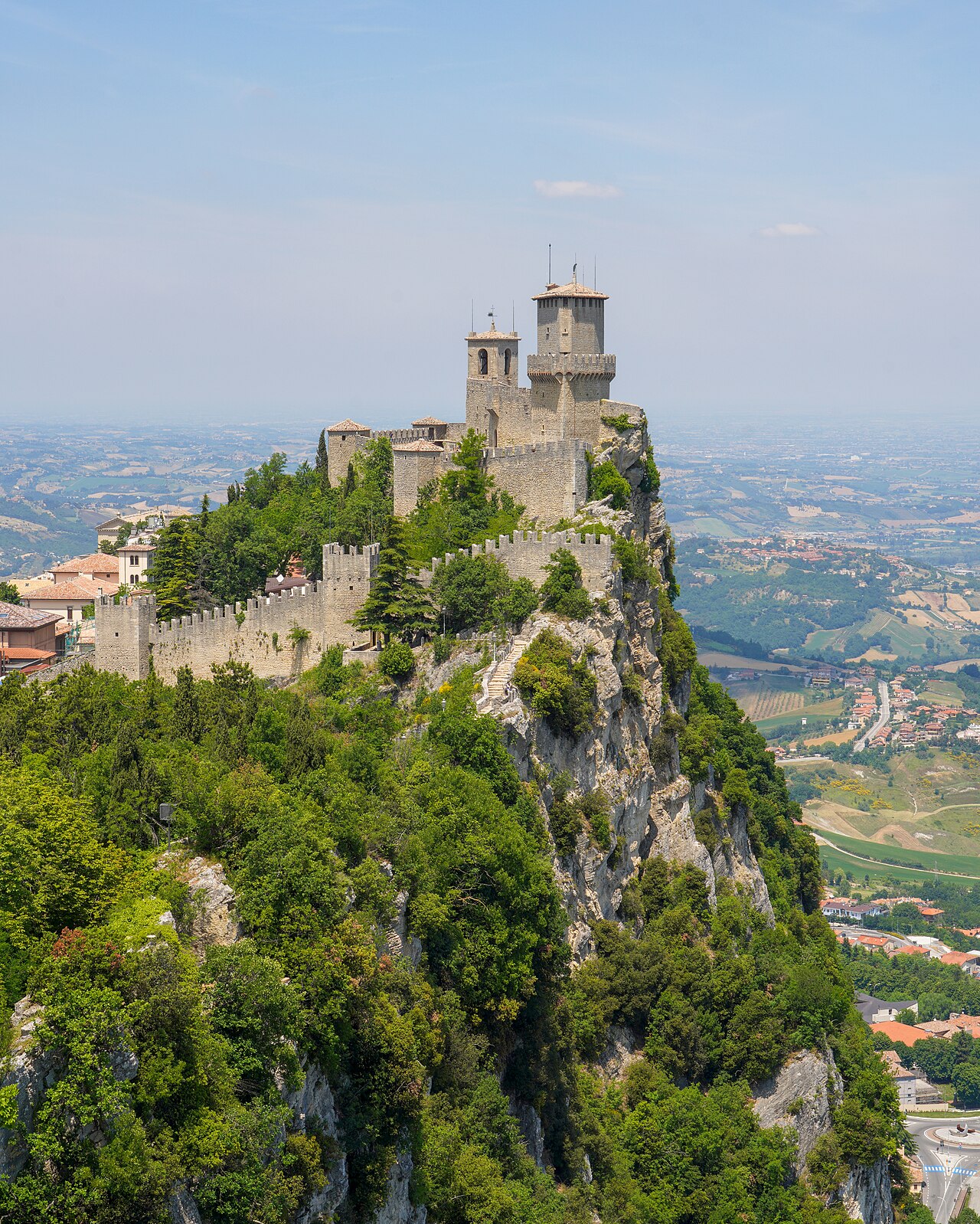
Castello di Montebello
The Castello di Montebello stands as a remarkable medieval fortress perched above the village of Montebello di Torriana in Italy, offering a vivid glimpse into the region's military and noble history. Positioned strategically on a hill 436 meters above sea level, the castle commands sweeping views of the village and the expansive Valmarecchia valley, underscoring its historical role in territorial defense and control.
The earliest documented mention of the castle dates back to September 24, 1186, recorded in a notarized sale contract where Ugolinuccio di Maltalone sold the fortress to Giovanni Malatesta, a member of the influential Malatesta family. This family emerged as a dominant power in the region, and over the subsequent three centuries, they undertook significant enhancements to the castle's fortifications. These included expanding the outer walls, erecting new defensive towers, and adding essential military features such as battlements and an armory, all designed to strengthen the stronghold against potential sieges and attacks.
Historical evolution and ownership transitions
During the mid-15th century, the castle's ownership shifted dramatically following military conflicts. After the defeat of Sigismondo Malatesta and his son Roberto—Sigismondo being notorious for pillaging the surrounding area—the fortress was awarded to Giovanni Francesco Guidi di Bagno. This transfer of power was formalized when Pope Pius II granted Guidi di Bagno the title of Count on June 1, 1464, recognizing his role in the campaign against the Malatesta family. The Guidi di Bagno family then maintained control over the castle and its lands, elevating their status to marquises by 1549, and preserving the castle as a noble residence through centuries of change.
The Guidi di Bagno family's stewardship continued until the abolition of feudal privileges in Italy in 1797, a reform enacted under Napoleon Bonaparte. Despite the challenges of time and conflict, including damage sustained during World War II, the family retained ownership and initiated major restoration efforts beginning in 1989 to conserve the castle's structural and historical integrity.
Architectural features and defensive elements
The castle exemplifies a hill castle typology, with a compact medieval layout focused on defense and residential functionality. Its thick, robust outer walls encircle the main courtyard and living quarters, providing formidable protection. Central to the fortress is the imposing keep (mastio), a tall tower serving as the last refuge and lookout during sieges, embodying the castle's military purpose.
Adjacent to the keep are the feudal prisons, historically used to detain prisoners, and several secret passages and defensive traps designed to confuse and deter attackers. These features remain partially accessible today, offering insight into medieval security strategies. An intriguing artifact within the castle is a heavily secured safe that French troops attempted but failed to remove during their occupation at the end of the 18th century, highlighting the castle's continued strategic importance.
Outside the primary fortress complex lies the armory, a rectangular building originally constructed during the medieval period and substantially remodeled in the 18th century. This adaptation reflects the evolving military needs and the castle's sustained role as a defensive site well into the modern era.
Symbolism and noble residence features
Access to the castle is marked by the honor gate, featuring a stone-carved coat of arms from the 16th century that symbolizes the union of the Guidi di Bagno and Colonna di Zagarolo families through marriage. This heraldic emblem stands as a testament to the castle's role not only as a fortress but also as a symbol of noble lineage and alliances.
The castle's interior includes a Renaissance wing built by the Guidi di Bagno family, housing collections that illustrate its residential use. Visitors can view jewelry, mirrors, ancestral portraits, and a large painted family tree that charts the lineage of its noble inhabitants. Additionally, chests and wedding trunks provide a window into the domestic and ceremonial life of the castle's residents.
The Salone delle Feste (Festive Hall) retains original furnishings that reflect the castle's use as a venue for noble gatherings and celebrations. Nearby, the family chapel contains a notable painting of Carlo Guidi, the family saint, underscoring the Guidi di Bagno's religious devotion and the spiritual significance of the castle.
Legend of azzurrina and cultural heritage
One of the most captivating aspects of Castello di Montebello is the enduring legend of Azzurrina, the albino daughter of Ugolinuccio di Maltalone and his wife Costanza. According to tradition, she mysteriously vanished within the castle on June 21, 1375, coinciding with the summer solstice. This story has become deeply embedded in the castle's cultural memory, with the Azzurrina corridor marked as the site of her disappearance. The legend contributes a layer of intangible cultural heritage, blending history with folklore and attracting visitors intrigued by the castle's ghostly tales.
Preservation and visitor experience
Today, Castello di Montebello offers a well-preserved example of a medieval fortress that has continuously adapted to changing times while retaining its historical essence. The castle's partially restored condition following extensive conservation work since 1989 allows visitors to explore its architectural and historical layers. The combination of military fortifications, noble residential elements, and legendary narratives makes it a unique heritage site in the Emilia-Romagna region of Italy.
Visitors can appreciate the castle's defensive architecture, including its towers, walls, and secret passages, alongside the noble family's domestic artifacts and art collections. The site serves as a powerful reminder of the region's feudal past, noble lineages, and the enduring allure of medieval castles in Italian history.
Frequently asked questions (FAQ)
- When was Castello di Montebello originally built?
- Castello di Montebello was originally built in the 12th century, with the earliest recorded mention in 1186.
- What architectural style characterizes Castello di Montebello?
- The castle primarily reflects Gothic architectural style, typical of its high medieval origins and subsequent fortifications.
- Is the castle open to visitors today?
- Yes, Castello di Montebello is open to visitors, offering tours that showcase its medieval fortifications, noble residences, and the legend of Azzurrina.
- What is the legend of Azzurrina associated with the castle?
- Azzurrina was the albino daughter of Ugolinuccio di Maltalone who mysteriously disappeared within the castle in 1375. Her story is a famous ghost legend tied to the castle's cultural heritage.
- Who were the main historical owners of the castle?
- The castle was initially owned by the Malatesta family and later passed to the Guidi di Bagno family, who maintained it until the end of the feudal era.
- What notable architectural features does the castle have?
- Notable features include a massive keep, thick defensive walls, feudal prisons, secret passages, an armory, and the honor gate with a 16th-century coat of arms.
Information
Sources & official resources
Verify the information above using these authoritative references.
Loading map...
Visitor reviews
No reviews yet. Been here? Write the first review and help other travelers!
Write the first reviewVisited this castle? Share your experience
Your review helps other travelers and adds first-hand knowledge to our encyclopedia.