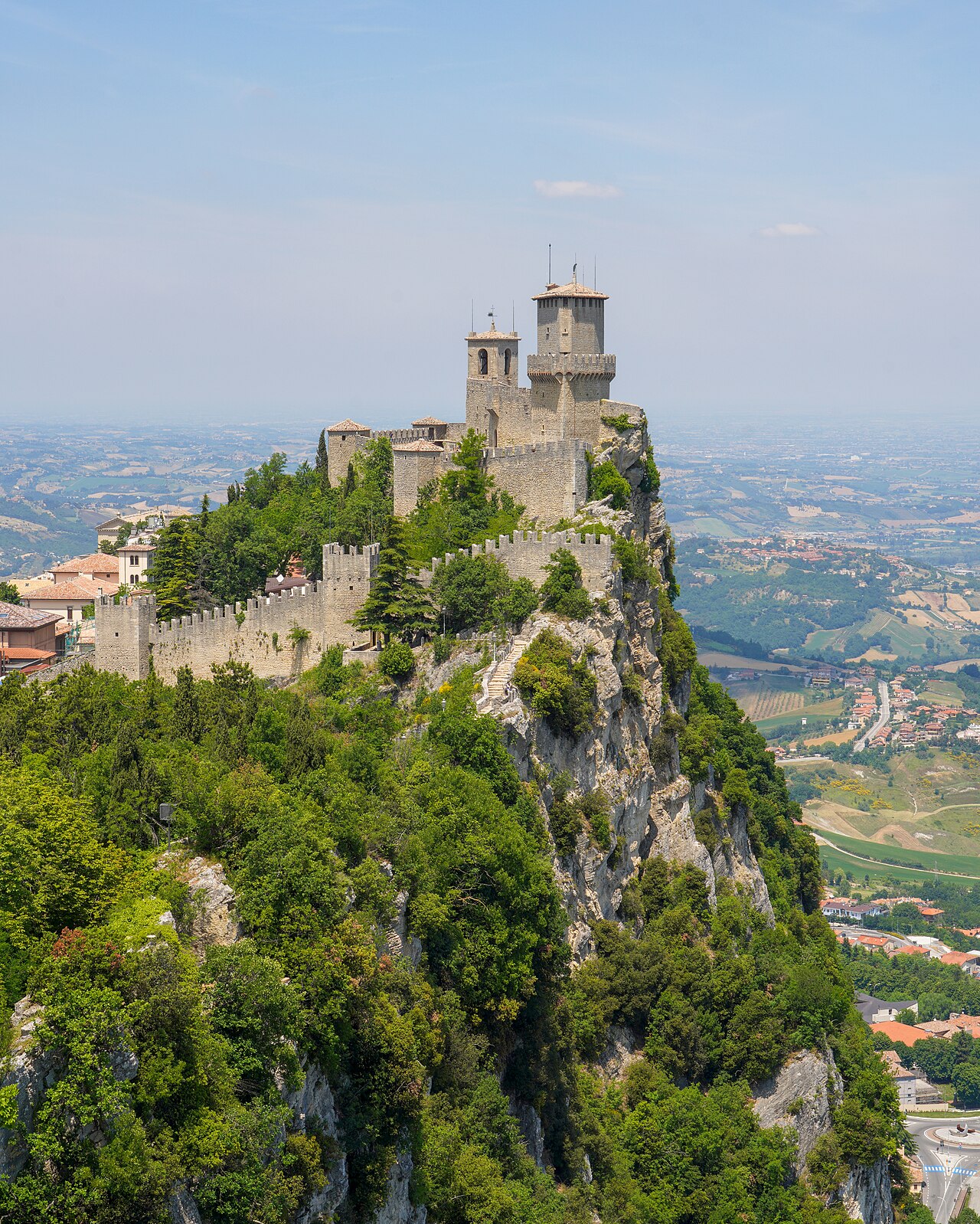
Castello Due Torri di Scorticata
Castello Due Torri di Scorticata is a significant medieval hill castle located in the municipality of Poggio Torriana, in the region of Emilia-Romagna, Italy. Established around the year 1000 AD, the castle was originally constructed as a fortified stronghold to control the surrounding hills near Verucchio. Its strategic position on two hilltops allowed it to oversee and defend a vast territory, playing a crucial role in the medieval military network of the area.
The earliest documented mention of the castle dates back to 1141, when Pope Lucius II transferred its ownership to the church authorities in Rimini. This early ecclesiastical control underscores the castle's importance in regional power dynamics. By 1186, the castle came under the control of the influential Malatesta family, a prominent dynasty that dominated much of the Romagna region during the Middle Ages. The Malatesta used the castle as part of a defensive system linking other key fortresses such as those in Verucchio, Fano, and Mondolfo.
Historical significance and ownership transitions
The Malatesta family's control of the castle lasted until the mid-15th century, marking a period of consolidation and military importance. In 1462, the castle was seized by Federico da Montefeltro, Duke of Urbino, who took it on behalf of the Church. This transfer reflected the shifting political landscape in the region, as the Papal States expanded their influence.
During the early 16th century, the castle experienced a brief occupation by the Republic of Venice, highlighting its continued strategic value. In 1519, Pope Leo X granted the castle, along with nearby Verucchio, to minor members of the Medici family. Subsequently, ownership passed to Ippolita Comnena, widow of Zanobi de’ Medici, and then to their son Alberto IV Pio di Savoia. After Alberto's death in 1580, the fiefdom reverted to the direct control of the Apostolic Camera, the Papal treasury.
By around 1608, the castle's military role had diminished significantly, and administration was transferred to the Municipality of Rimini. Over the following centuries, the surrounding hills underwent extensive quarrying for marble and building stone, which altered the landscape and impacted the castle's environs.
Legend and cultural associations
The castle is also steeped in local legend, particularly relating to the Malatesta family. Tradition holds that it was here that Paolo Malatesta’s sons avenged their uncle Gianciotto Malatesta, who notoriously murdered his wife Francesca da Polenta and her lover. This tragic story was immortalized by Dante Alighieri in his Divine Comedy, linking the castle to a broader cultural and literary heritage.
Architectural features and layout
The Castello Due Torri di Scorticata was uniquely positioned across two hilltops, with an extensive defensive wall system stretching approximately 1000 meters. This impressive enclosure indicates a large-scale military installation designed to control and monitor the surrounding territory effectively.
A 1371 description by Cardinal Anglico recorded that the castle contained 35 rooms, though detailed information about the internal layout, specific chambers, or their functions remains scarce. The lack of surviving inscriptions, decorative elements, or detailed architectural records leaves much about the castle's internal structure to speculation.
The materials used in construction are not explicitly documented, but typical medieval building materials in the region included local stone and brick. The castle’s design likely incorporated fortified walls, battlements, and possibly towers, consistent with other hill castles of the period. However, no specific gates, stairways, or other architectural features have been formally described or preserved.
Impact of quarrying on preservation
The surrounding slopes have been heavily quarried for marble and stone over centuries, which has significantly altered the original landscape. This quarrying has likely contributed to the deterioration of the castle's immediate environment and may have damaged archaeological remains or ancillary structures once part of the complex.
Current status and archaeological importance
Today, the castle remains primarily as ruins, with the enclosing fortifications still visible but many internal details lost to time. No major restorations have been recorded, and the site awaits further archaeological investigation to uncover more about its construction phases, usage, and historical context.
Despite the limited physical remains, Castello Due Torri di Scorticata stands as an important archaeological testament to medieval fortification practices in the Rimini area. Its strategic location and historical associations with powerful families like the Malatesta and the Medici highlight its significance in the feudal and ecclesiastical power struggles of medieval and Renaissance Italy.
Its enduring legacy is also cultural, linked to the dramatic stories of the Malatesta family and its place in Italian literary history through Dante’s work. The castle's evolving name—from "Castello di Torriana" in 1938 to "Castello Due Torri" in the 1960s—reflects changing local identities and the continuing importance of this site in regional heritage.
Frequently asked questions (FAQ)
- How do I get to Castello Due Torri di Scorticata?
- You can reach Castello Due Torri di Scorticata by car or public transportation from nearby cities such as Rimini or Cesena. The castle is located on a hill in Poggio Torriana, providing stunning views of the surrounding landscape, making it a picturesque journey.
- What is the historical significance of Castello Due Torri di Scorticata?
- Castello Due Torri di Scorticata dates back to the Middle Ages and played a crucial role in the defense against invasions in the region. It reflects the architectural styles and historical events of its time, showcasing the strategic importance of its location.
- When was Castello Due Torri di Scorticata built?
- The construction of Castello Due Torri di Scorticata began in the 12th century, and it was completed over the following decades. The castle has undergone various renovations throughout the centuries, preserving its medieval character while adapting to modern needs.
- Can I visit Castello Due Torri di Scorticata with children?
- Yes, Castello Due Torri di Scorticata is family-friendly and offers a unique experience for visitors of all ages. Children can enjoy exploring the castle grounds and learning about its rich history through engaging exhibits and guided tours.
- Why is Castello Due Torri di Scorticata a popular tourist destination?
- Castello Due Torri di Scorticata attracts visitors due to its captivating history, stunning architecture, and breathtaking views of the Emilia-Romagna region. The castle offers a glimpse into the past while providing a serene environment for relaxation and exploration.
- Is it possible to host events at Castello Due Torri di Scorticata?
- Yes, Castello Due Torri di Scorticata is available for private events, including weddings and corporate gatherings. The unique setting and historical ambiance make it an ideal location for memorable celebrations.
- What are the opening hours for Castello Due Torri di Scorticata?
- The castle is typically open to visitors from 10 AM to 5 PM, but hours may vary seasonally. It is advisable to check the official website or contact the castle directly for the most current information before your visit.
- What are the ticket prices for visiting Castello Due Torri di Scorticata?
- Ticket prices for Castello Due Torri di Scorticata are generally affordable, with discounts available for children, seniors, and groups. Special rates may apply during certain events or exhibitions, so it's best to verify current prices before planning your visit.
- What is the best time to visit Castello Due Torri di Scorticata?
- The best time to visit Castello Due Torri di Scorticata is during the spring and early autumn months when the weather is mild and pleasant. This timing allows visitors to fully enjoy the beautiful surroundings and participate in outdoor activities and events hosted at the castle.
Information
Website
Visit websiteSources & official resources
Verify the information above using these authoritative references.
Loading map...
Visitor reviews
No reviews yet. Been here? Write the first review and help other travelers!
Write the first reviewVisited this castle? Share your experience
Your review helps other travelers and adds first-hand knowledge to our encyclopedia.