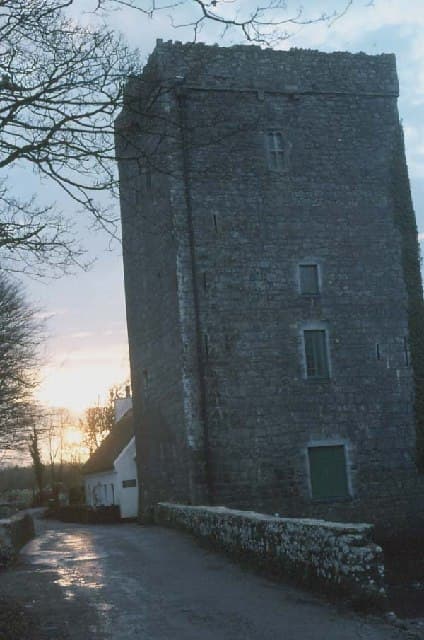
Thoor Ballylee
Thoor Ballylee Castle, also known by its Irish name Túr Bhaile Uí Laí, is a 15th-century Anglo-Norman tower house situated near the town of Gort in County Galway, Ireland. This fortified residence was constructed by the de Burgo (Burke) septs, a prominent Anglo-Norman family influential in the region during the Late Medieval period. The castle exemplifies the typical tower house architecture prevalent across Ireland during the 15th century, serving both as a defensive structure and a domestic dwelling.
Architectural features and design
Thoor Ballylee is a compact, rectangular tower house rising several stories high, characterized by thick stone walls, narrow slit windows, and a crenellated parapet crowning the roofline. Its defensive features include a fortified entrance and battlements designed to protect against raids common in medieval Ireland. The interior originally comprised multiple floors connected by a spiral staircase, with living quarters, storage rooms, and a great hall for social and administrative functions.
The tower's modest size reflects its role as a fortified residence for a local lord rather than a large military fortress. Its hilltop location provided strategic views over the surrounding landscape, enabling early warning of approaching threats.
Historical context and ownership
Built in the 15th century, Thoor Ballylee was part of a broader network of tower houses erected by Anglo-Norman settlers to consolidate their control over Irish territories. The de Burgo family, who commissioned the castle, were influential landowners and played a significant role in the political and social life of County Galway during the medieval era.
In the 20th century, Thoor Ballylee gained cultural significance when it was acquired and restored by the renowned Irish poet William Butler Yeats. Yeats used the castle as a summer home and a source of inspiration for his poetry, linking the site indelibly with Irish literary heritage. Due to this association, the castle is often referred to as Yeats's Tower.
Preservation and cultural significance
Today, Thoor Ballylee stands as a well-preserved example of a late medieval tower house, although it has undergone various restorations to maintain its structural integrity. The castle is recognized not only for its architectural and historical value but also for its cultural importance as a symbol of Ireland's literary and national identity.
Late Nobel laureate Seamus Heaney described Thoor Ballylee as "the most important public building in Ireland," highlighting its unique place in Irish culture. Visitors can explore the castle's interior, view exhibits related to Yeats's life and work, and enjoy the scenic surroundings that inspired much of his poetry.
Visiting Thoor Ballylee
The castle is accessible to the public during designated opening hours, offering guided tours that explain its architectural features and historical background. Its location near Gort makes it a notable destination for those interested in medieval architecture, Irish history, and literary tourism.
Nearby attractions
Visitors to Thoor Ballylee can also explore the surrounding County Galway region, known for its rich cultural heritage, scenic landscapes, and other historic sites.
Photo gallery

Information
Loading map...
Visitor reviews
No reviews yet. Been here? Write the first review and help other travelers!
Write the first reviewVisited this castle? Share your experience
Your review helps other travelers and adds first-hand knowledge to our encyclopedia.



