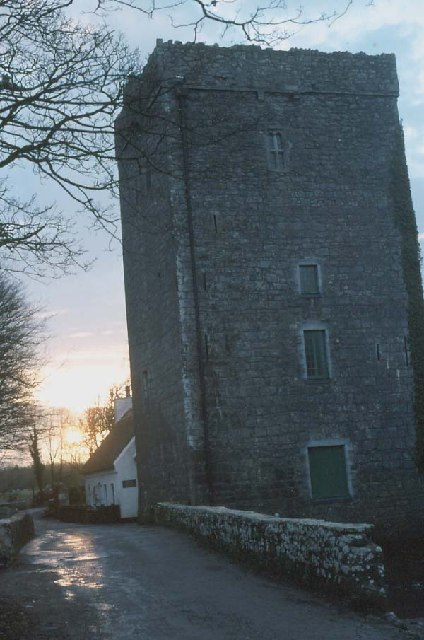
Thoor Ballylee
Thoor Ballylee stands as a remarkable example of a medieval tower house nestled in the Irish countryside near the town of Gort, within the province of Connacht. Constructed by the Anglo-Norman Burke family during the late medieval period, this compact tower has witnessed centuries of Irish history, from feudal aristocracy to the cultural renaissance of the early 20th century. Its enduring presence and layered past make it a significant monument of both architectural and literary heritage.
The tower was originally built in the 15th or 16th century by the Burkes, also known as the de Burgo family, who were influential landowners and rulers in Connacht. As part of the extensive estates controlled by the Earls of Clanricarde, Thoor Ballylee served as a fortified residence and a symbol of feudal power in the region. The tower’s strategic location near the Streamstown River provided natural defense and access to water, which was essential for both domestic use and milling operations.
Architectural features and restoration
The tower is a four-story structure characterized by its thick stone walls measuring approximately 2.13 meters (7 feet) in thickness. Each floor contains a single room, illuminated by windows that overlook the river, integrating the building harmoniously with its natural surroundings. The tower’s design includes a narrow spiral stone staircase embedded within the wall, which connects all floors. This staircase held special symbolic significance for W.B. Yeats, who called it “my ancestral stair,” linking him metaphorically to notable historical figures such as Goldsmith, Berkeley, and Burke.
The ground floor features a large, wide window and a round-arched doorway that leads to an adjoining thatched miller’s cottage. This outbuilding, originally serving as the miller’s residence, has been repurposed in modern times as a tea room and shop. It was expanded with an additional structure to accommodate visitors, enhancing the site’s role as a cultural and tourist destination.
During the early 20th century, W.B. Yeats purchased Thoor Ballylee for a modest sum and undertook significant restoration efforts with architect William A. Scott. Their work preserved the original medieval windows on the upper floors while enlarging those on the lower levels to increase natural light and improve residential comfort. A commemorative stone tablet on the tower’s exterior honors Yeats’s wife, George, and celebrates the restoration craftsmanship, referencing materials such as old mill boards, sea-green slates, and blacksmith’s work from the local forge.
Historical context and literary significance
The tower’s history is deeply intertwined with the cultural revival of Ireland during the early 20th century. In the 19th century, the castle was leased by the Carrig family from William Henry Gregory, owner of the nearby Coole Estate. Coole Estate was a renowned cultural hub under Lady Augusta Gregory, hosting prominent figures of the Irish Literary Revival such as W.B. Yeats and John Millington Synge.
Yeats’s acquisition of Thoor Ballylee in 1916 or 1917 symbolized his deep connection to the Irish landscape and heritage. He renamed the building from “castle” to “Thoor,” adopting the Irish word for “tower” to emphasize his commitment to Irish language and culture. From 1921 to 1929, Yeats and his family used the tower as a summer home, a retreat that inspired much of his later work and reinforced his identity as an Irish poet rooted in his homeland.
Challenges and preservation efforts
After Yeats’s family left in 1929, the tower fell into disrepair, suffering from neglect and exposure to the elements. Its riverside location near the Streamstown River made it vulnerable to flooding, with significant damage occurring during floods in 1995, 2009–2010, and Storm Desmond in 2015.
Restoration efforts resumed in 1964, led by Mary Hanley, founder of the Kiltartan Society, with support from Bord Fáilte and the Yeats family. The tower was opened as a museum dedicated to Yeats in 1965, featuring original furnishings and early editions of his work. The miller’s cottage was adapted into a tea room and shop, later expanded to accommodate visitors.
Further restoration was undertaken after 2012 with backing from Fáilte Ireland and political advocates, including Senator Lorraine Higgins. The Yeats Thoor Ballylee Society took over management in 2014, preparing the site for Yeats’s 150th birth anniversary in 2015. Since reopening that June, the tower has been accessible during summers, maintaining its role as a cultural landmark despite ongoing challenges from flooding.
The surrounding landscape and cultural heritage
Thoor Ballylee is situated near a four-arched bridge dating from around 1825, adding to the historic ambiance of the site. The tower’s location within the rural landscape of County Galway connects it to a broader narrative of Irish history, from the Anglo-Norman aristocracy to the literary renaissance that shaped modern Irish identity.
The tower’s preservation reflects a commitment to maintaining both its architectural integrity and cultural significance. It stands as a testament to the enduring legacy of the Burke family, the Earls of Clanricarde, and the literary genius of W.B. Yeats. Visitors today can experience a unique blend of medieval architecture and Irish literary history, set against the tranquil backdrop of the Irish countryside.
Frequently asked questions (FAQ)
- When was Thoor Ballylee originally built and by whom?
- Thoor Ballylee was constructed in the 15th or 16th century by the Anglo-Norman Burke family, who were influential landowners in the Connacht region.
- What is the significance of W.B. Yeats in relation to Thoor Ballylee?
- W.B. Yeats purchased Thoor Ballylee in 1916 or 1917 and restored it with architect William A. Scott, using it as his summer home and a symbol of Irish cultural heritage.
- Can visitors explore the interior of Thoor Ballylee today?
- Yes, Thoor Ballylee is open to visitors during the summer months, offering a glimpse into its medieval architecture and its connection to W.B. Yeats.
- How has flooding affected Thoor Ballylee over the years?
- The tower’s riverside location has made it vulnerable to flooding events, notably in 1995, 2009–2010, and during Storm Desmond in 2015, which caused significant damage and necessitated restoration.
- What facilities are available for visitors at Thoor Ballylee?
- Visitors can enjoy a tea room and shop located in the attached miller’s cottage, which has been expanded to accommodate tourists and enhance the cultural experience.
Information
Sources & official resources
Verify the information above using these authoritative references.
Loading map...
Visitor reviews
No reviews yet. Been here? Write the first review and help other travelers!
Write the first reviewVisited this castle? Share your experience
Your review helps other travelers and adds first-hand knowledge to our encyclopedia.