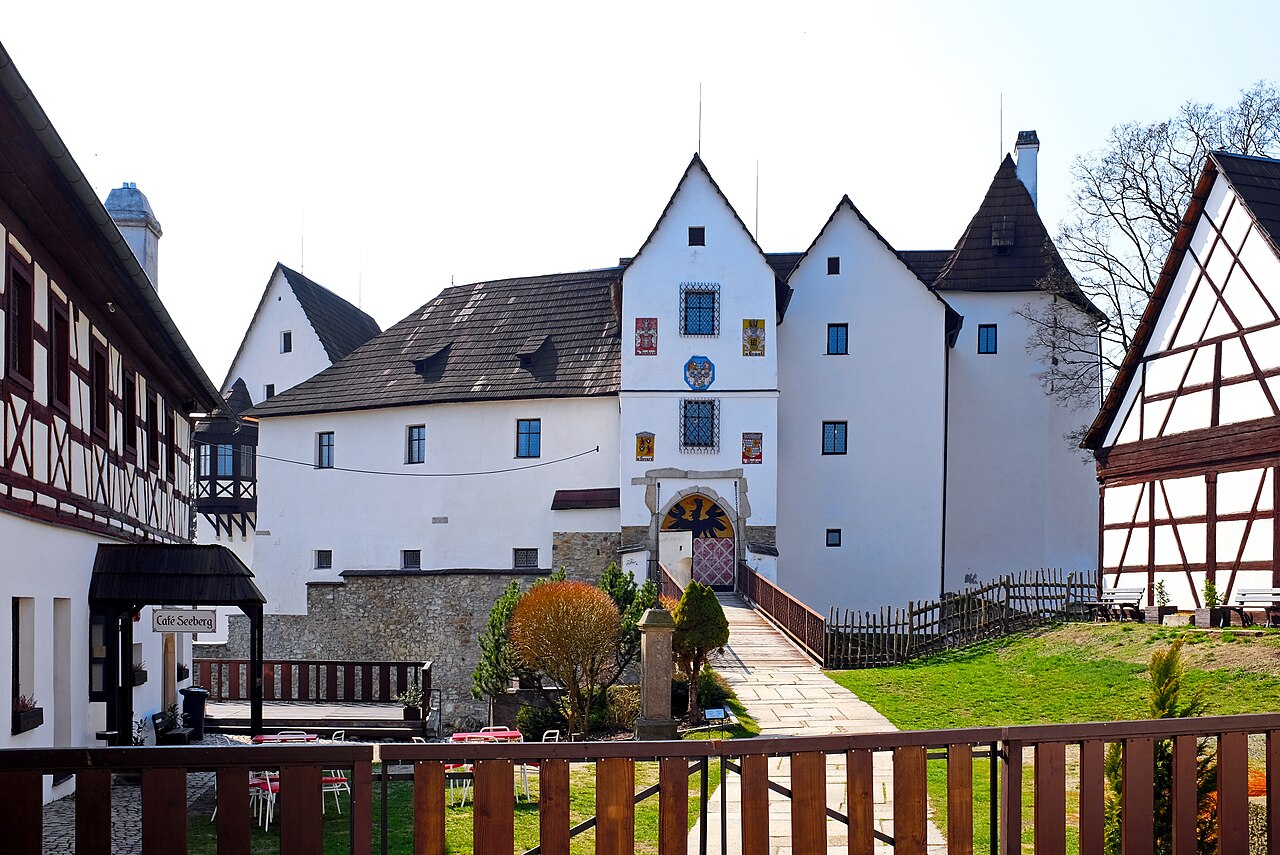
Libá Castle
Libá Castle, located in the municipality of Libá in the modern Czech Republic, stands as a remarkable example of a hill castle that has witnessed centuries of historical evolution from its medieval origins to its later Rococo transformation. Constructed initially in the 13th century during the high medieval period, the castle was originally a fortified stronghold serving as the seat of the Liebenstein family. This fortress was strategically built to oversee and control the surrounding Bohemian lands, reflecting the typical defensive architecture of the time.
The earliest written record of the castle dates back to 1264, mentioning Ruprecht of Nový Liebenstein, confirming the castle's prominence in the region. The original fortress was designed as a bergfried-type stronghold, centered around a tall defensive tower known as a bergfried, with a forecourt and a cramped inner ward. This layout was typical of medieval castles focused on defense and control, featuring ashlar masonry in key structures such as the small palace-like building on the southwest side of the inner ward.
Medieval origins and early history
By the end of the 13th century, the original fortress was destroyed following the extinction of the Liebenstein family line. The castle lay in ruins until the mid-14th century when Franz Goßwein undertook a significant reconstruction between 1346 and 1349. This restoration was officially sanctioned by King Charles IV in 1355, who reinstated the castle as a Czech crown fief. This royal endorsement underscored the site's renewed strategic and administrative importance within the kingdom.
Throughout the late medieval period, the castle changed hands multiple times. In 1381, King Václav IV confiscated the estate due to its association with lawlessness, particularly robberies conducted by its occupants. Subsequently, the castle was granted to Johann I of Leuchtenberg, who sold it in 1400 to Erhard Rudisch. Following Rudisch’s death in 1406, the property passed to the Sparneck knights and later to the von Zedtwitz family after 1425, who retained ownership for several centuries.
The zedtwitz family and the era of robber knights
The von Zedtwitz family's tenure marked a turbulent period in the castle's history. Notably, the castle became infamous as the base of the robber baron Jörg von Zedtwitz, who launched raids against the nearby city of Eger and neighboring castles such as Seeberg and Haslau. These attacks provoked retaliation, and troops from Eger eventually destroyed the castle, though Jörg narrowly escaped capture.
Despite this destruction, the castle remained a significant defensive site. In 1553, Christoph von Zedtwitz played a crucial role as the defending captain during the siege of the town of Hof, highlighting the castle's ongoing military relevance during the 16th century. However, the conflicts of the Thirty Years’ War inflicted further damage, necessitating repairs and adaptations.
Architectural transformations and the rococo chateau
Over the centuries, Libá Castle evolved from its original medieval fortress form into a more comfortable and representative residence. The defensive moats were filled in, and ramparts were removed to accommodate changing architectural tastes and functions. Around 1770, the castle underwent a significant transformation into a Rococo-style chateau, reflecting the period's emphasis on elegance and residential comfort rather than military defense.
This transformation included the construction of a larger palace within the castle complex and the addition of decorative stucco interiors. A mid-18th-century depiction shows a round corner tower replacing the earlier castle church, illustrating the shift from religious to residential architectural elements. The castle church, originally documented in 1406 within the forecourt, was replaced by the Baroque Church of St. Catherine, evidencing the site's layered historical development.
Decline, damage, and modern restoration efforts
The von Zedtwitz family maintained ownership until 1915, after which the castle changed hands several times. Following World War II, the chateau was confiscated by the state in 1945 and used by the forestry administration. Neglect and looting led to significant deterioration, compounded by a devastating fire in 1978 that left the structure in a ruinous state.
Since 1991, the castle has been privately owned, with ongoing efforts to stabilize and preserve the site. Initial restoration measures included comprehensive roof repairs, window installations, and façade refurbishments to halt further decay. Archaeological excavations in the basement have uncovered foundational elements of the original fortress, providing valuable insights into its early construction phases.
Some rooms have been reconstructed with stucco decorations based on historical photographs, reviving the Rococo interiors. Despite these efforts, the castle remains largely inaccessible to the public due to ongoing restoration and conservation work. The site is recognized as a cultural monument since 1963, underscoring its historical and architectural significance.
Architectural features and layout
The original medieval castle featured a compact layout centered around a bergfried, with a forecourt fortified by square towers or bastions. These defensive structures allowed for effective protection of the approaches and gate areas. The small palace-like building in the inner ward, built with tightly fitted ashlar masonry, likely served as the residential and administrative core.
During the 14th-century expansion, the addition of a larger palace and alterations to internal communication routes improved the castle's functionality and comfort. The forecourt's reinforcement with bastions enhanced its defensive capabilities, adapting to the evolving military needs of the period.
The later Baroque and Rococo modifications softened the castle's martial character, introducing elegant residential features and decorative elements. The replacement of the castle church with the Baroque Church of St. Catherine and the filling in of moats reflected the transition from fortress to chateau.
Archaeological discoveries
Excavations in the 21st century have shed light on the castle's earliest construction phases, revealing foundational walls and structural details of the original bergfried and associated buildings. These findings have enriched the understanding of medieval castle-building techniques in the Bohemian region and informed restoration strategies.
Current status and future prospects
Libá Castle today stands as a testament to the layered history of Bohemian fortifications and noble residences. While restoration work is ongoing, the site remains a construction zone, limiting public access. A private investor has expressed intentions to convert the castle into a hotel, which would ensure its preservation and adaptive reuse, contributing to regional cultural tourism.
Frequently asked questions (FAQ)
- What is the best time to visit Libá Castle?
- The best time to visit Libá Castle is during the late spring to early autumn months when the weather is mild and suitable for exploring the castle grounds. However, due to ongoing restoration, public access may be limited, so checking current visitor information beforehand is recommended.
- Is Libá Castle accessible to visitors?
- Currently, Libá Castle is largely inaccessible to the public as it is an active construction and restoration site. Visitors should verify access conditions before planning a visit.
- What architectural styles are represented at Libá Castle?
- Libá Castle showcases a blend of architectural styles, primarily its original medieval fortress design from the 13th century and later Baroque and Rococo modifications from the 18th century.
- Who were the notable historical figures associated with Libá Castle?
- Notable figures include the Liebenstein family, the robber baron Jörg von Zedtwitz, and Christoph von Zedtwitz, who defended the castle during the 1553 siege.
- Are there any archaeological findings at Libá Castle?
- Yes, archaeological excavations in the castle's basement have revealed foundational elements of the original fortress, providing valuable insights into its early construction and layout.
Information
Sources & official resources
Verify the information above using these authoritative references.
Loading map...
Visitor reviews
No reviews yet. Been here? Write the first review and help other travelers!
Write the first reviewVisited this castle? Share your experience
Your review helps other travelers and adds first-hand knowledge to our encyclopedia.