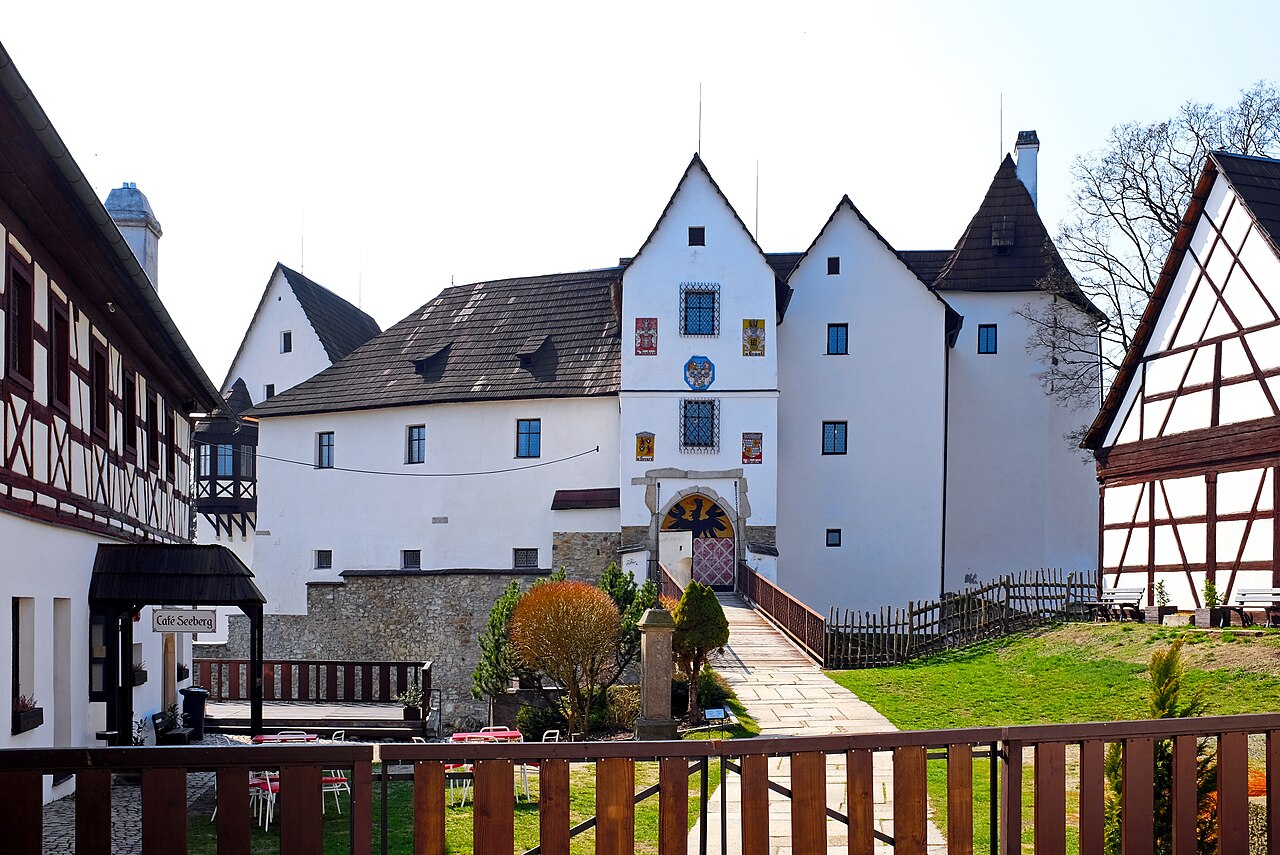
Hohenberg Castle
Hohenberg Castle stands as a prominent high medieval hill castle located in the town of Hohenberg an der Eger, Bavaria, Germany. Perched strategically on a rocky promontory overlooking the Eger River and near the Czech border, the castle was originally constructed during the Hohenstaufen period between 1170 and 1220 to control the vital Schirnding Pass, a key route linking the Fichtelgebirge plateau with the Eger basin and Bohemia. Its commanding position enabled it to serve as a defensive stronghold, protecting important trade and military routes through this border region.
The castle’s early history is closely tied to the noble von Hohenberg family, with the first known mention dating to 1222 when Berchtoldus de Honberg is recorded as a witness. Around the turn of the 14th century, ownership passed to the Burgraves of Nuremberg, influential rulers who sought to consolidate power in the Egerland region. The castle’s role as a military fortification was highlighted during the Hussite Wars in the early 15th century, notably in 1433 when Hans von Kotzau successfully defended it against Hussite forces.
Architectural development and fortifications
Medieval construction and enhancements
The castle underwent significant rebuilding and strengthening around 1480, when the existing ring wall was constructed on an irregular hexagonal plan. This fortification incorporated three round gun towers designed to withstand artillery attacks, a square prison tower, and a gatehouse at the corners of the enclosure. Originally, a fourth round tower also formed part of the defensive system but was lost in the 19th century. These features reflect the transition in castle architecture towards accommodating gunpowder weaponry, marking Hohenberg Castle as a significant example of late medieval military design in the region.
Early modern fortifications
During the early 17th century, specifically in 1621 and 1622, Margrave Christian enhanced the castle’s defenses by adding a system of seven bastioned earthen walls equipped with wooden palisades. This bastioned fortification was intended to modernize the castle’s defenses in line with contemporary military engineering principles. Although these improvements were substantial, they ultimately failed to prevent the castle’s capture by imperial troops in 1632 during the Thirty Years’ War, who occupied it for three years after seizing the nearby Schirnding Pass.
Historical significance and events
Medieval and early modern conflicts
Hohenberg Castle played a pivotal role in regional conflicts across several centuries. Its initial purpose was to secure the border and control passage through the Schirnding Pass. The castle’s defense against the Hussites in 1433 under Hans von Kotzau exemplifies its military importance during the turbulent early 15th century. Later, during the Bavarian War in 1462, the castle suffered damage when a local servant set fire to one of its towers during a Bohemian incursion, prompting the extensive fortification efforts around 1480.
Thirty years' war and decline
The Thirty Years’ War marked a turning point, with the castle reinforced but eventually captured by imperial forces in 1632. Following the war, the fortress lost much of its strategic military value. In 1666, Margrave Christian Ernst repurposed part of the castle by constructing the Fürstenhaus (princely house), which served as a hunting lodge and administrative center. This marked a shift from purely military functions to residential and governance uses.
Later history and modern use
Ownership changes and 19th-century transformations
Political realignments in the late 18th and early 19th centuries saw the castle transition from the Margraviate of Ansbach-Bayreuth to the Kingdom of Prussia in 1791, followed by French occupation and eventual incorporation into Bavaria in 1810. During the 19th century, many auxiliary buildings within the castle complex, such as the granary and cattle house, were demolished. A fourth round tower was also lost during this period.
20th-century damage and restoration
In 1936, the castle came under the ownership of the National Socialist Teachers’ League and was converted into a rural school home. However, during the final months of World War II, American artillery bombardments inflicted significant damage, destroying the outer bailey walls, the gate tower, and the Stork Tower. Post-war restoration began in 1951 under Bavarian state supervision. From 1955 to 2014, the castle functioned as a youth hostel and educational center managed by the Sudetendeutsches Sozial- und Bildungswerk foundation.
Recent renovations and current function
Since 2015, management has been undertaken by the VEZ e.V. / Learning Campus organization, which has overseen extensive renovations aimed at preserving the castle’s historic fabric while adapting it for modern use. Since 2017, Hohenberg Castle has been extensively renovated and now serves as a youth hostel and venue for meetings and conferences, blending its rich heritage with contemporary educational and cultural functions.
Architectural remains and notable features
Fortification layout and towers
The castle’s surviving fortifications are centered on the irregular hexagonal ring wall dating from around 1480. This defensive enclosure is reinforced by a gatehouse, three surviving round artillery towers, and a square prison tower. The design reflects late medieval adaptations to gunpowder warfare, with thick walls and rounded towers to better deflect cannon fire. The loss of the fourth round tower in the 19th century slightly diminished the original defensive perimeter.
Princely house and interior buildings
The Fürstenhaus, built in 1666 by Margrave Christian Ernst, is the most prominent surviving interior building. Originally intended as a hunting lodge and town hall, it includes an attached kitchen wing and a steward’s residence. Other medieval interior structures have not survived, as many auxiliary buildings were demolished in the 19th century.
Earthworks and bastions
Remnants of the early 17th-century earthwork bastions constructed by Margrave Christian remain visible to the south of the ring wall. These earthen ramparts, originally seven in number and fortified with wooden palisades, represent an important phase in the castle’s defensive evolution, showcasing early modern military engineering techniques.
Historic markers and landscape features
Within the castle courtyard, four stone pillars mark the boundaries of the former imperial free sanctuary status held by the castle and town until 1799. This legal privilege underscored the castle’s significance beyond military functions, symbolizing its role in regional governance and law.
A wooden pavilion known as the Königsruhe once stood on the southeastern bastion, commemorating Queen Theresia of Bavaria’s visit in 1847. Although removed in 1959, the site remains a campfire area for the youth hostel. While the panoramic views of the surrounding Egerland region were once a highlight, natural overgrowth has since obscured much of the vista.
Hohenberg Castle today stands as a testament to centuries of military architecture, regional power struggles, and adaptive reuse. Its layered history from the Hohenstaufen period through the Thirty Years’ War to modern cultural use offers rich insights into the evolution of fortress design and borderland politics in Bavaria.
Frequently asked questions (FAQ)
- How do I get to Hohenberg Castle?
- Hohenberg Castle is located in the town of Hohenberg an der Eger in Bavaria, Germany, near the Czech border. It is accessible by car via local roads and public transportation to nearby towns, followed by a short walk to the castle site.
- What is the best time to visit Hohenberg Castle?
- The best time to visit Hohenberg Castle is during the spring to early autumn months when weather conditions are favorable for exploring the castle grounds and enjoying the surrounding landscape.
- Is Hohenberg Castle wheelchair accessible?
- Due to its historic hilltop location and medieval fortifications, Hohenberg Castle has limited wheelchair accessibility. Visitors with mobility concerns should contact the management in advance for specific access information.
- Can I tour the interior of Hohenberg Castle?
- The interior of Hohenberg Castle primarily consists of the Fürstenhaus, built in 1666, which is used for youth hostel accommodations and meetings. While some areas may be accessible during events or tours, the castle is not a traditional museum with extensive public interior access.
- What are the opening hours and ticket prices for Hohenberg Castle?
- Hohenberg Castle operates mainly as a youth hostel and event venue, so public visiting hours vary. It is best to check with the current management for visiting times and any applicable ticket prices or tour availability.
Information
Website
Visit websiteSources & official resources
Verify the information above using these authoritative references.
Loading map...
Visitor reviews
No reviews yet. Been here? Write the first review and help other travelers!
Write the first reviewVisited this castle? Share your experience
Your review helps other travelers and adds first-hand knowledge to our encyclopedia.