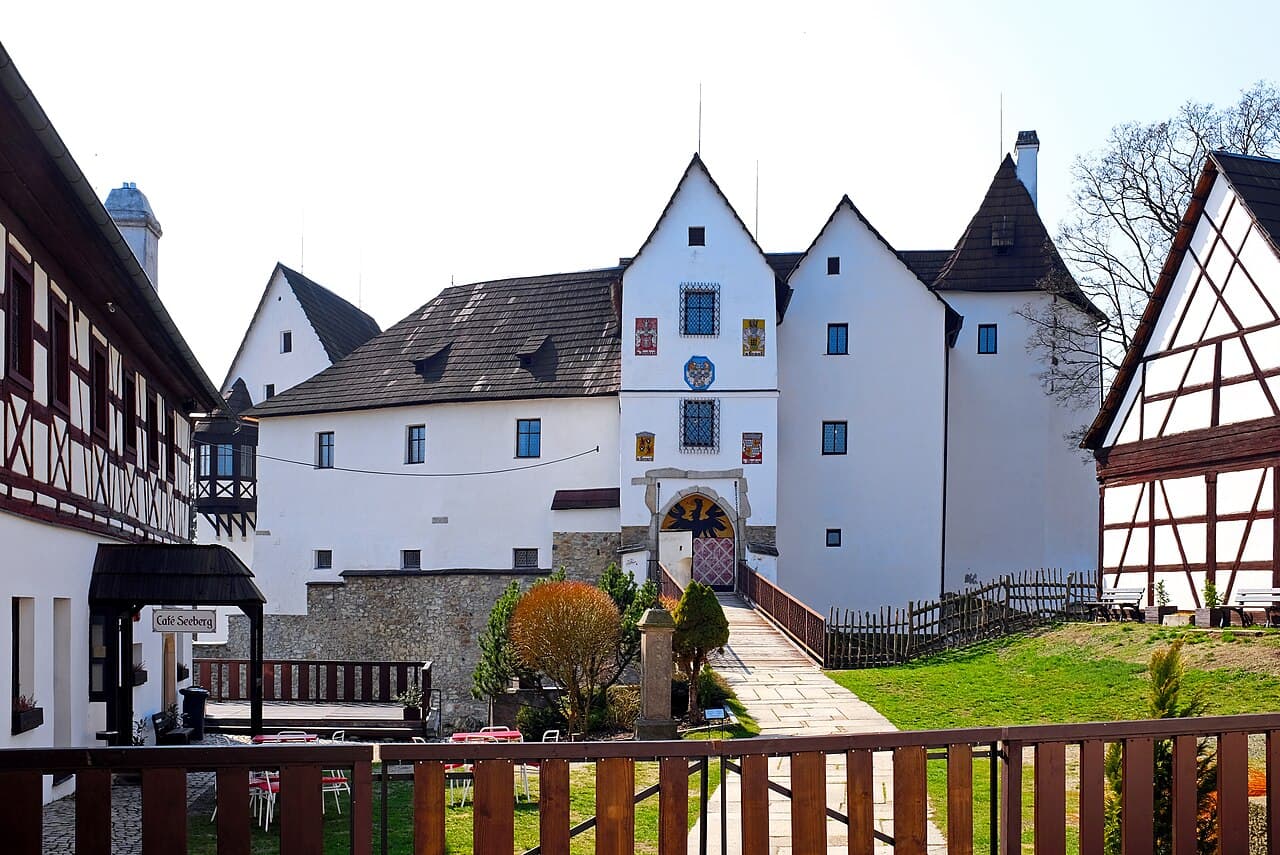
Seeberg Castle
Seeberg Castle, also known as Ostroh Castle, stands as one of the oldest and most historically significant landmarks in the region near Františkovy Lázně, Czechia. Founded in the 13th century, this hill castle was originally constructed on a high rocky spur overlooking a brook, a strategic location that provided natural defense and commanding views of the surrounding landscape. Its foundation as the manor house of ministeriales under the imperial palatinate in Cheb situates it firmly within the High Medieval period, reflecting the feudal and military structures of the time.
The castle's architectural evolution is a testament to its long and turbulent history. Despite suffering from multiple fires and frequent plundering by enemy armies, Seeberg Castle has endured through centuries thanks to persistent reconstruction efforts. Among its most valuable architectural features are the Romanesque Stork Tower, which stands as a rare surviving element from the original medieval fortifications, and the Gothic south palace that exemplifies the castle's later medieval expansions. These structures showcase the transition from the robust, rounded forms typical of Romanesque architecture to the pointed arches and vertical emphasis characteristic of Gothic design.
Visitors to the castle today can explore interiors furnished with 19th-century furniture that evoke the historical ambiance of the site. The exhibition includes period clothing and an open-hearth kitchen complete with original kitchenware, offering a vivid glimpse into the domestic life of the castle's past inhabitants. Additionally, the castle grounds feature an open-air folk architecture exhibition that illustrates rural life in the Cheb district during the 19th century. Highlights include the oldest logged Baroque granary dating to 1714 and a shed displaying agricultural machinery and equipment, enriching the cultural narrative of the region.
Historical development and ownership
The site of Seeberg Castle has a history extending beyond its medieval origins, with archaeological findings indicating a predecessor settlement from the late Bronze Age associated with the Urnfield culture. This early human presence underscores the strategic importance of the location long before the castle's construction.
The castle itself was erected around the year 1200 as the residence of a ministerial family linked to the nearby town of Cheb. The first documented mention of Seeberg Castle appears in 1322, when Louis IV of Bavaria pledged it as part of his holdings to King John of Luxembourg. This transfer highlights the castle's integration into the broader political dynamics of the High Middle Ages and its connection to prominent ruling houses.
In 1398, administrative control of the castle passed to the town of Cheb, reflecting its civic importance. Later, in 1435, Emperor Sigismund of Luxembourg granted Seeberg to his chancellor, Kašpar Šlik. Financial difficulties led Šlik to abandon the castle, initiating a period of frequent ownership changes. By 1461, the castle was acquired by Cheb councilor Kašpar Juncker, and subsequently passed to the brothers Konrád and Jošt of Neuberg. Their tenure was marked by involvement in the prolonged Neuberg-Zedtwitz conflict, which inflicted significant damage on the fortress.
The castle's fortunes declined sharply during the Thirty Years’ War. In 1648, Swedish troops led by General Königsmark captured, looted, and set fire to Seeberg Castle as part of their military campaign. The devastation was extensive, but restoration efforts were undertaken by the owner Vít Dětřich of Steinheim to repair the damage.
In the early 18th century, Seeberg returned to the ownership of the town of Cheb, which maintained it sporadically due to financial limitations. The castle's condition worsened until the early 20th century when significant restoration was carried out by J. Pröckl between 1905 and 1915, preventing further decay.
Following World War II, neglect again threatened the castle until the 1970s, when the Municipal Museum of Františkovy Lázně initiated a reconstruction program. The castle was officially opened to the public in 1990, marking a new chapter in its preservation and public engagement.
Architectural features and layout
Medieval fortifications and structures
Seeberg Castle is situated on a prominent rocky outcrop overlooking the Slatinný stream. Its layout comprises two main sections, with the original core smaller than the present complex. The castle retains remnants of a Romanesque curtain wall and a partially preserved gate within the core zone. Attached to the northeastern corner near this gate is the Romanesque Stork Tower, a tower-like structure indicative of later medieval fortification additions.
Before 1349, the castle underwent modifications that reduced the size of its original core by erecting a dividing wall with a gate, which separated the back section. Buildings in this rear area were subsequently demolished, reflecting changing defensive strategies.
Gothic enhancements and outer defenses
The castle's defenses were further enhanced during the Gothic period with the addition of a barbican, a fortified outwork enclosing the original core, and an extended gate projecting outward. These features demonstrate adaptation to evolving military technologies and the need for stronger protection against siege warfare.
The outer bailey contains several younger half-timbered buildings, including an 18th-century barn and servants’ quarters. Two buildings were relocated to the castle grounds: a tower granary from 1717 originally from Mlýnek village, and a shed built in 1809. These structures exemplify the folk architectural traditions of the Cheb region and contribute to the castle's role as a cultural museum.
Cultural significance and exhibitions
Today, the castle's principal buildings serve as exhibition halls featuring multiple floors. A pedestrian bridge across a steep valley connects visitors to the nearby Church of St. Wolfgang, highlighting the historical connection between the castle and its ecclesiastical site.
Decorative elements include four coats of arms carved on the gate tower guarding the inner moat, representing the Junker, Brandt, Gerard, and Steinheim families, all historically linked to the castle. Additional coats of arms on the rear façade commemorate the Nostiz, Neuberg, and Seeberg families, underscoring the complex lineage of ownership.
The shape of the outer bailey reflects post-medieval modifications and does not correspond to its original Gothic design. Inside, the castle displays reconstructed 19th-century interiors ranging from Empire to Chippendale styles. Collections include fine glassware and porcelain from notable Czech manufacturers, enhancing the historical narrative of the region's craftsmanship.
An open-air museum (skanzen) on the castle grounds portrays 18th-century rural life in the Cheb region, featuring traditional clothing, agricultural tools, and a scale model of a typical half-timbered farmstead. This exhibition offers visitors an immersive experience of the local folk culture.
Recent developments and public access
Since 2011, the castle's cellars have been accessible to the public, hosting exhibitions dedicated to notable historical figures such as the poet Johann Wolfgang von Goethe and the Cheb executioner Karel Huss. The cellars also contain an armory displaying medieval weapons and a library collection.
In 2015, a new exhibit was introduced focusing on the death of the military leader Albrecht von Wallenstein, located in the space formerly used as the castle restaurant. This addition enriches the castle's role as a center for historical education and cultural preservation.
Overall, Seeberg Castle stands as a remarkable example of medieval hill castle architecture that has adapted through centuries of conflict, restoration, and cultural transformation. Its combination of Romanesque and Gothic elements, coupled with extensive exhibitions on regional history and folk culture, make it a significant heritage site in Czechia.
Frequently asked questions (FAQ)
- When was Seeberg Castle originally built?
- Seeberg Castle was originally constructed in the 13th century, around the year 1200, serving as a residence for ministeriales under the imperial palatinate in Cheb.
- What architectural styles are represented at Seeberg Castle?
- Seeberg Castle features a mix of Romanesque and Gothic architectural styles, including the Romanesque Stork Tower and the Gothic south palace.
- Can visitors explore exhibitions inside Seeberg Castle?
- Yes, visitors can explore multiple exhibition halls inside the castle showcasing 19th-century furnishings, period clothing, an open-hearth kitchen, and displays on regional folk culture.
- What notable historical events affected Seeberg Castle?
- Seeberg Castle was damaged during the Thirty Years’ War, particularly in 1648 when Swedish troops captured and set fire to it. It also played a role in regional conflicts such as the Neuberg-Zedtwitz dispute.
- Is there an open-air museum at Seeberg Castle?
- Yes, the castle grounds include an open-air folk architecture exhibition that illustrates 18th and 19th-century rural life in the Cheb district, featuring traditional buildings and agricultural tools.
- What family coats of arms can be seen at Seeberg Castle?
- Coats of arms representing the Junker, Brandt, Gerard, Steinheim, Nostiz, Neuberg, and Seeberg families are carved on various parts of the castle, reflecting its historical owners.
- Are the castle cellars open to the public?
- Yes, since 2011, the castle cellars have been open to visitors and include exhibitions about Johann Wolfgang von Goethe, Karel Huss, an armory, and a library.
Photo gallery

Information
Sources & official resources
Verify the information above using these authoritative references.
Loading map...
Visitor reviews
No reviews yet. Been here? Write the first review and help other travelers!
Write the first reviewVisited this castle? Share your experience
Your review helps other travelers and adds first-hand knowledge to our encyclopedia.



