Thielle Castle
Thielle Castle, located in the municipality of Gals, Switzerland, is a remarkable example of medieval fortification that has evolved through centuries of architectural and historical development. Originally constructed in the late 13th century by Berchtold, Count of Neuchâtel, the castle was strategically positioned to control the vital crossing over the Zihl river. This location underscored its importance in securing regional passage and asserting feudal authority in what is now western Switzerland.
The castle's initial construction phase, spanning approximately from 1270 to 1300, reflects the typical characteristics of high medieval fortifications. It was commissioned to protect the Zihl bridge near the village of Thielle, a crucial transit point that influenced the area's economic and military significance. The castle's establishment coincided with the rise of the Neuchâtel counts, with Berchtold's son Rudolf adopting the title Baron de Thielle, signaling the consolidation of their territorial influence.
Architectural evolution and styles
Between 1320 and 1325, Thielle Castle underwent significant reconstruction that introduced late Gothic architectural elements. This transformation included the addition of more refined stonework and structural enhancements that reflected the evolving defensive and residential needs of the period. Later, the castle incorporated Baroque features, particularly evident in its entrance portal, which presents an ornate contrast to the earlier medieval elements.
Structural layout and features
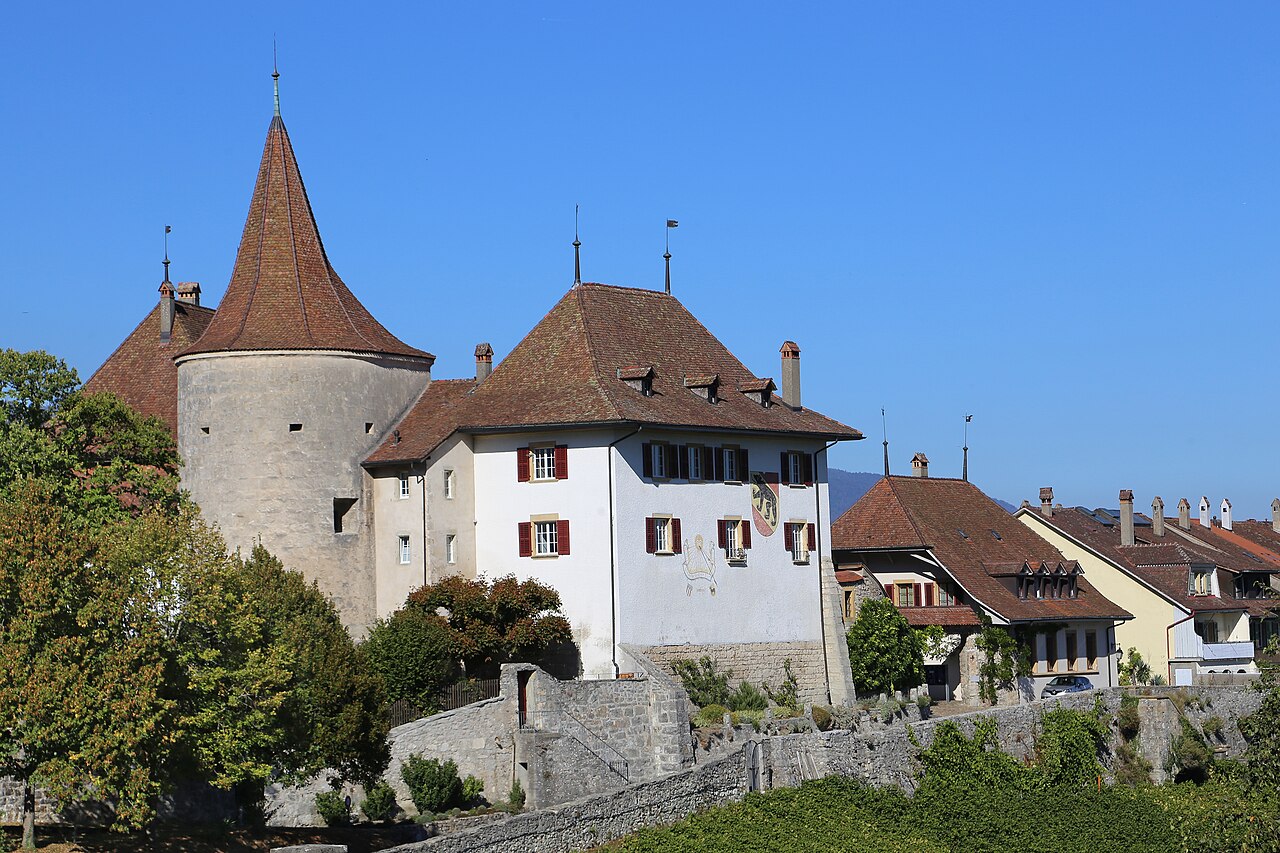
The castle is classified as a water castle, originally situated on the left bank of the Zihl river. However, the course of the river was altered following the construction of the Zihl Canal in 1883, which now places the castle on the canal's right bank. The castle's layout centers on a nearly rectangular courtyard, enclosed by the remains of a ring wall that once provided formidable defense.
Two round towers, though currently reduced to stumps, flank the Baroque-style entrance portal facing the former main road. The main residential building rises three to four stories and is topped with a distinctive half-hipped roof (Krüppelwalmdach), which slopes on all sides except parts of the gable ends. This roof design is both aesthetically pleasing and practical for weather conditions.
At two corners of the main building, tall, narrow stair towers with pointed conical roofs provide vertical access, blending seamlessly into the structure's silhouette. The castle's exterior walls feature Romanesque-style slender windows, characterized by their elongated, simple openings that balance natural light with defensive needs.
Interior spaces and surroundings
Inside, the first floor boasts a knight’s hall with a notably high ceiling, indicative of its use for gatherings, ceremonies, or administrative functions. This hall reflects the castle's dual role as both a military stronghold and a noble residence. Surrounding the castle is a park spanning approximately 5,300 square meters, which includes mature trees that enhance the historic atmosphere and provide a verdant setting.
Historical significance and uses
Historically, Thielle Castle played a crucial role in regional defense and administration. It was part of the Burgundian Wars in the late 15th century, specifically in 1476, when it contributed to the Swiss Confederation's defensive line against Burgundian invasions. This military engagement underscores the castle's strategic importance well beyond its initial construction period.
For several centuries, the castle served as the administrative center of a Neuchâtel bailiwick, a form of local jurisdiction, until 1807. Following this administrative role, the castle was repurposed as a prison from 1807 to 1848, reflecting changing political and social functions. In 1861, the castle transitioned into private ownership, marking a shift from public use to private stewardship.
Historical documentation, such as the detailed 1843 account by David Guillaume Huguenin and earlier mentions in the March-Buch by Samuel Bodmer circa 1710, provide valuable insights into the castle's role within the governance and border defense system of the Bernese Republic. These records contribute to understanding the castle's layered history and its significance in regional power dynamics.
Restoration and current condition
Thielle Castle today stands as a well-preserved monument that reflects its medieval origins alongside later architectural adaptations. Restoration efforts carried out in the 1960s and 1980s were instrumental in maintaining the castle's structural integrity and preserving its historical character. These restorations carefully respected the castle's diverse architectural layers, from Gothic to Baroque styles, ensuring that its complex past remains visible and accessible.
The castle's current condition allows visitors and scholars alike to appreciate its architectural evolution and historical significance. Its location near the Zihl Canal and the surrounding parkland enhance its appeal as a cultural heritage site, offering both scenic and educational value.
Visiting and cultural importance
While the castle is privately owned, its historical and architectural importance makes it a notable landmark within the region of Gals. It stands as a testament to the feudal history of the Neuchâtel region and the broader medieval landscape of Switzerland. The castle's blend of defensive and residential features offers a rich narrative of medieval life, military strategy, and architectural trends.
The surrounding park and the castle's proximity to waterways provide a picturesque setting that complements its historical ambiance. As a site that has witnessed centuries of change—from medieval stronghold to prison to private residence—Thielle Castle embodies the dynamic history of Swiss castles and their enduring legacy.
Frequently asked questions (FAQ)
- When was Thielle Castle originally built and by whom?
- Thielle Castle was originally built between 1270 and 1300 by Berchtold, the Count of Neuchâtel, to secure an important river crossing.
- What architectural styles are visible in Thielle Castle?
- The castle features a mixture of architectural styles, primarily Gothic from the early 14th-century reconstruction and Baroque elements added later, especially in the entrance portal.
- Is Thielle Castle accessible to the public for visits?
- Thielle Castle is privately owned, and public access may be limited or restricted. Visitors should check local resources for current visiting opportunities.
- What was the castle's role during the Burgundian Wars?
- In 1476, Thielle Castle was part of the Swiss Confederation's defensive line against Burgundian invasions, highlighting its strategic military importance.
- What are the notable features of Thielle Castle's layout?
- The castle has a nearly rectangular courtyard enclosed by ring walls, two round towers flanking a Baroque entrance portal, a main residential building with a half-hipped roof, and Romanesque-style slender windows.
Information
Website
Visit websiteSources & official resources
Verify the information above using these authoritative references.
Loading map...
Visitor reviews
No reviews yet. Been here? Write the first review and help other travelers!
Write the first reviewVisited this castle? Share your experience
Your review helps other travelers and adds first-hand knowledge to our encyclopedia.