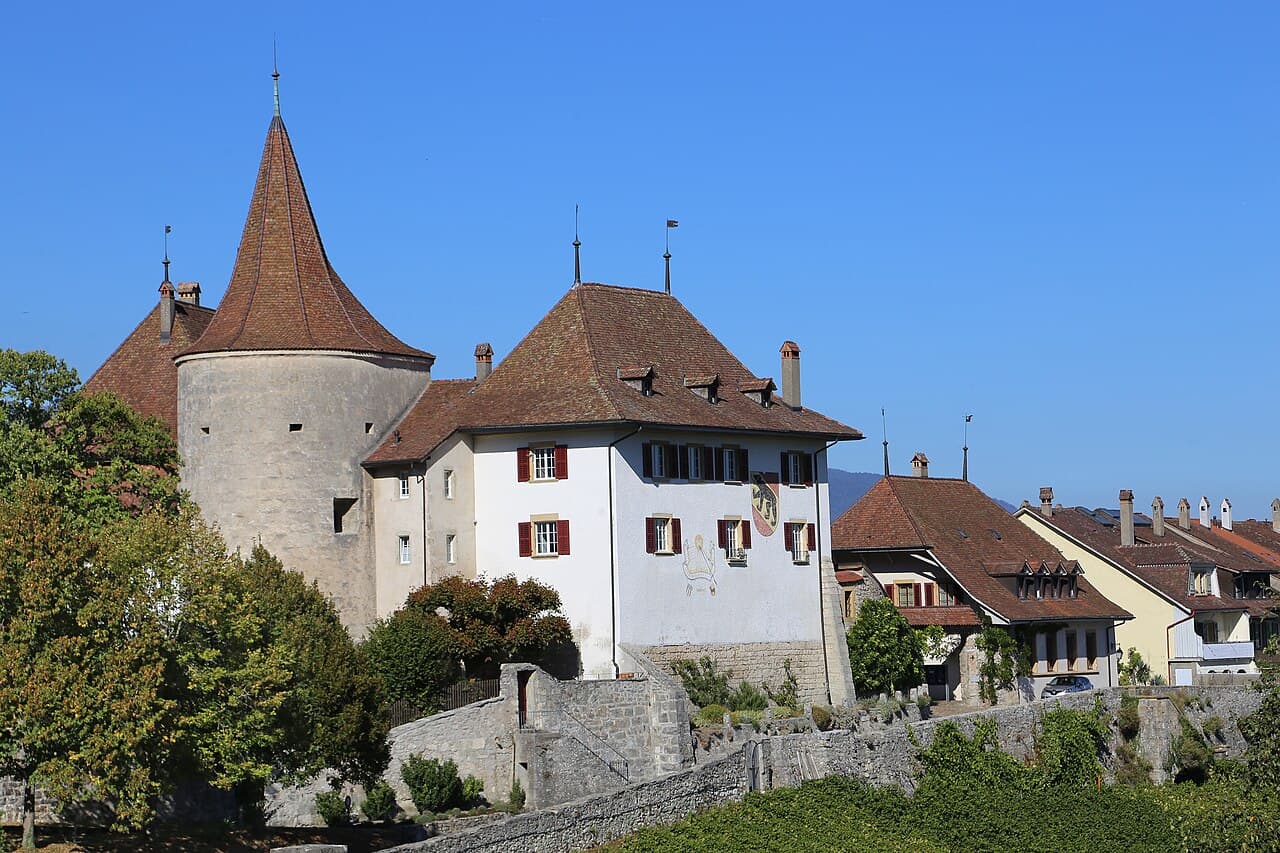
Erlach Castle
Erlach Castle stands as a significant medieval hill castle located in the municipality of Erlach, within the Canton of Bern, Switzerland. Constructed between 1090 and 1100 by Burkart von Fenis, the Bishop of Basel, this fortress was originally established as a center of ecclesiastical authority and territorial control during the High Medieval period. Its strategic position on a hill overlooking the surrounding landscape provided both defensive advantages and administrative oversight for the region.
Early history and foundation
The foundation of Erlach Castle reflects the medieval practice of bishops and religious authorities establishing fortified residences to secure their influence. Burkart von Fenis, who held the bishopric of Basel, initiated the construction of the castle to assert control over the surrounding lands and to serve as a stronghold in this part of Switzerland. The castle's location was carefully chosen for its defensive potential, commanding views of the nearby town and the vital routes along Lake Biel.
Transition to noble control and the house of savoy
In 1224, the castle and its adjacent town became the property of the Counts of Nidau, marking a shift from ecclesiastical to secular noble control. This transfer integrated Erlach into the feudal network of local nobility. Subsequently, in 1265, Peter II of Savoy extended the influence of the House of Savoy over the region by bringing the counts and their castle under his feudal authority. Under Savoyard rule, the castle was administered by a warden appointed by Peter II, who managed the estates and governance from this stronghold.
The von erlach family emergence
The knights serving as wardens adopted the name von Erlach, derived from their association with the castle and town. This family rose to prominence in the region, becoming influential in both military and political spheres. Notably, Rudolf von Erlach emerged as a key figure, renowned for his leadership as the Swiss commander who secured victory at the Battle of Laupen in 1339. By around 1300, the von Erlach family had established themselves as citizens of the city of Bern, reflecting their integration into the urban aristocracy and expanding their influence beyond the castle's immediate domain.
Later medieval developments and bernese acquisition
Following the death of Isabella of Neuchatel in 1395, who was the widow of the last Count of Nidau, the House of Savoy assumed direct control over Erlach. The town was subsequently mortgaged to the de Chalon family in 1407, indicating a period of noble administration under different hands. This arrangement lasted until the late 15th century, during which the castle remained an important administrative center.
During the Burgundian Wars in 1474, Bernese troops captured Erlach Castle and the town, bringing them under the jurisdiction of the city of Bern. This conquest was part of Bern's territorial expansion and consolidation of power in the region. Following the takeover, Rudolf von Erlach, who had previously served as castellan under the de Chalon family, was appointed the first governor of the district under Bernese control. From this point onward, Erlach remained within the Bernese territory, playing a role in the canton’s governance and defense.
Architectural features and castle structure
While detailed architectural descriptions of Erlach Castle are scarce, its classification as a hill castle suggests typical features of medieval fortifications built on elevated terrain. Such castles generally included stone curtain walls, defensive towers, and a central keep or donjon that served as the last line of defense. The castle’s location would have been chosen for visibility and control over the surrounding area, including the nearby town and lake.
The castle likely had a courtyard enclosed by walls, with residential quarters for the warden or castellan and spaces for administrative functions. Defensive elements such as battlements, , and possibly a or natural water defenses would have enhanced its security. However, no specific records detail the layout or distinctive architectural embellishments of the castle, nor have significant archaeological excavations revealed such features.
Current status and cultural significance
Today, Erlach Castle is recognized as a Swiss heritage site of national significance. Although the physical remains are limited and detailed descriptions of the castle’s architecture are not well documented, its historical importance as a seat of power through successive ruling families and political transformations is well acknowledged. The castle’s legacy is closely tied to the von Erlach family, whose members played key roles in Swiss medieval history, and to the broader historical narrative of Bernese territorial expansion.
The castle’s presence in Erlach continues to attract interest from historians, archaeologists, and visitors intrigued by medieval Swiss history and feudal architecture. Its role in regional governance, military history, and noble lineage underscores its importance beyond the physical structure itself.
Frequently asked questions about erlach castle
- What is the historical significance of Erlach Castle? Erlach Castle was a medieval administrative center built in the late 11th century, linked to the bishopric of Basel, the House of Savoy, and the influential von Erlach family.
- When was Erlach Castle built? Construction began around 1090-1100 under Bishop Burkart von Fenis.
- Can visitors tour Erlach Castle today? The castle remains are limited and not extensively developed for tourism, but the site is accessible for visitors interested in its historical context.
- What architectural style characterizes Erlach Castle? As a High Medieval hill castle, it likely featured typical medieval defensive elements, though specific stylistic details are undocumented.
- How did the von Erlach family influence Swiss history? The von Erlach family produced notable leaders like Rudolf von Erlach, commander at the Battle of Laupen, contributing to Bern’s military and political history.
- Is Erlach Castle part of any heritage protection? Yes, it is listed as a Swiss heritage site of national significance.
Frequently asked questions (FAQ)
- What is the historical significance of Erlach Castle?
- Erlach Castle was a medieval administrative center built in the late 11th century, linked to the bishopric of Basel, the House of Savoy, and the influential von Erlach family.
- When was Erlach Castle built?
- Construction began around 1090-1100 under Bishop Burkart von Fenis.
- Can visitors tour Erlach Castle today?
- The castle remains are limited and not extensively developed for tourism, but the site is accessible for visitors interested in its historical context.
- What architectural style characterizes Erlach Castle?
- As a High Medieval hill castle, it likely featured typical medieval defensive elements, though specific stylistic details are undocumented.
- How did the von Erlach family influence Swiss history?
- The von Erlach family produced notable leaders like Rudolf von Erlach, commander at the Battle of Laupen, contributing to Bern’s military and political history.
- Is Erlach Castle part of any heritage protection?
- Yes, it is listed as a Swiss heritage site of national significance.
Photo gallery

Information
Website
Visit websiteSources & official resources
Verify the information above using these authoritative references.
Loading map...
Visitor reviews
No reviews yet. Been here? Write the first review and help other travelers!
Write the first reviewVisited this castle? Share your experience
Your review helps other travelers and adds first-hand knowledge to our encyclopedia.



