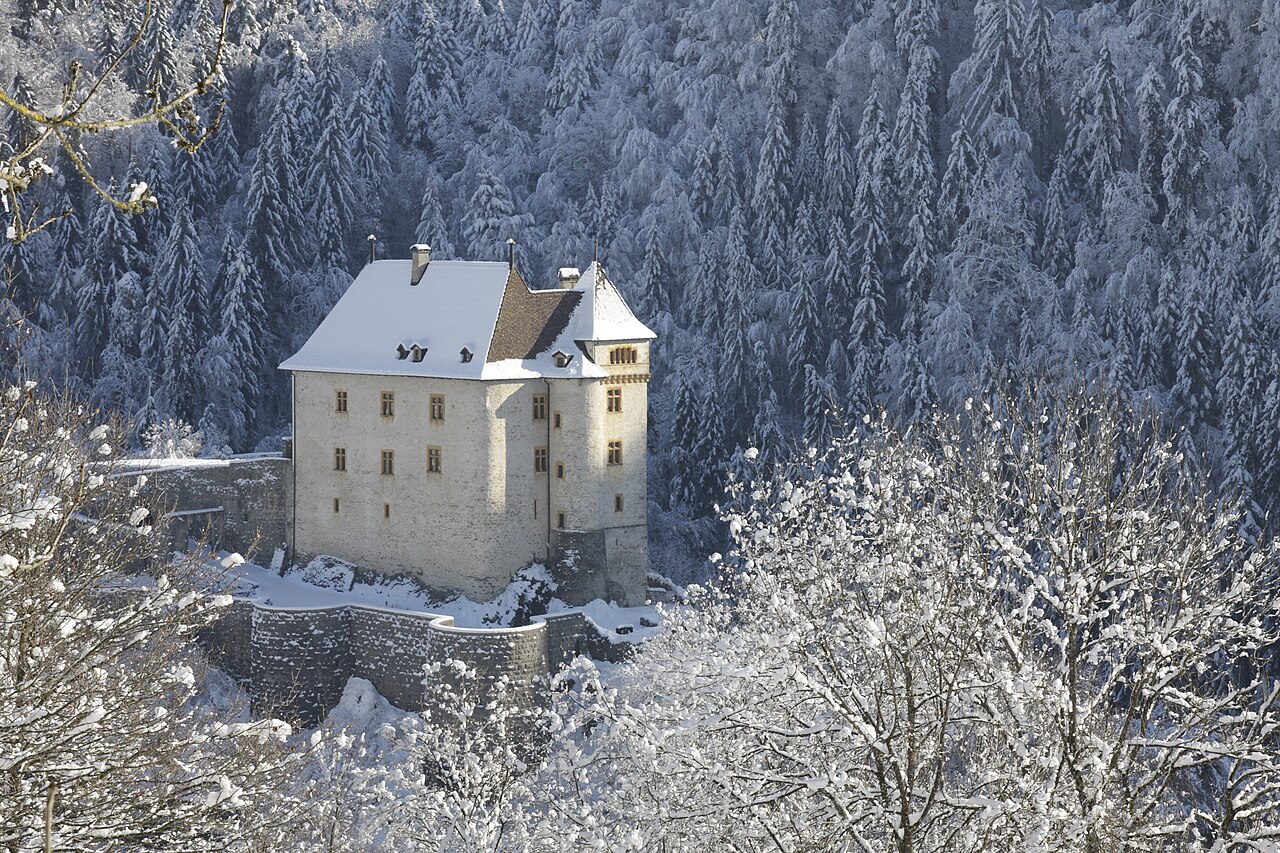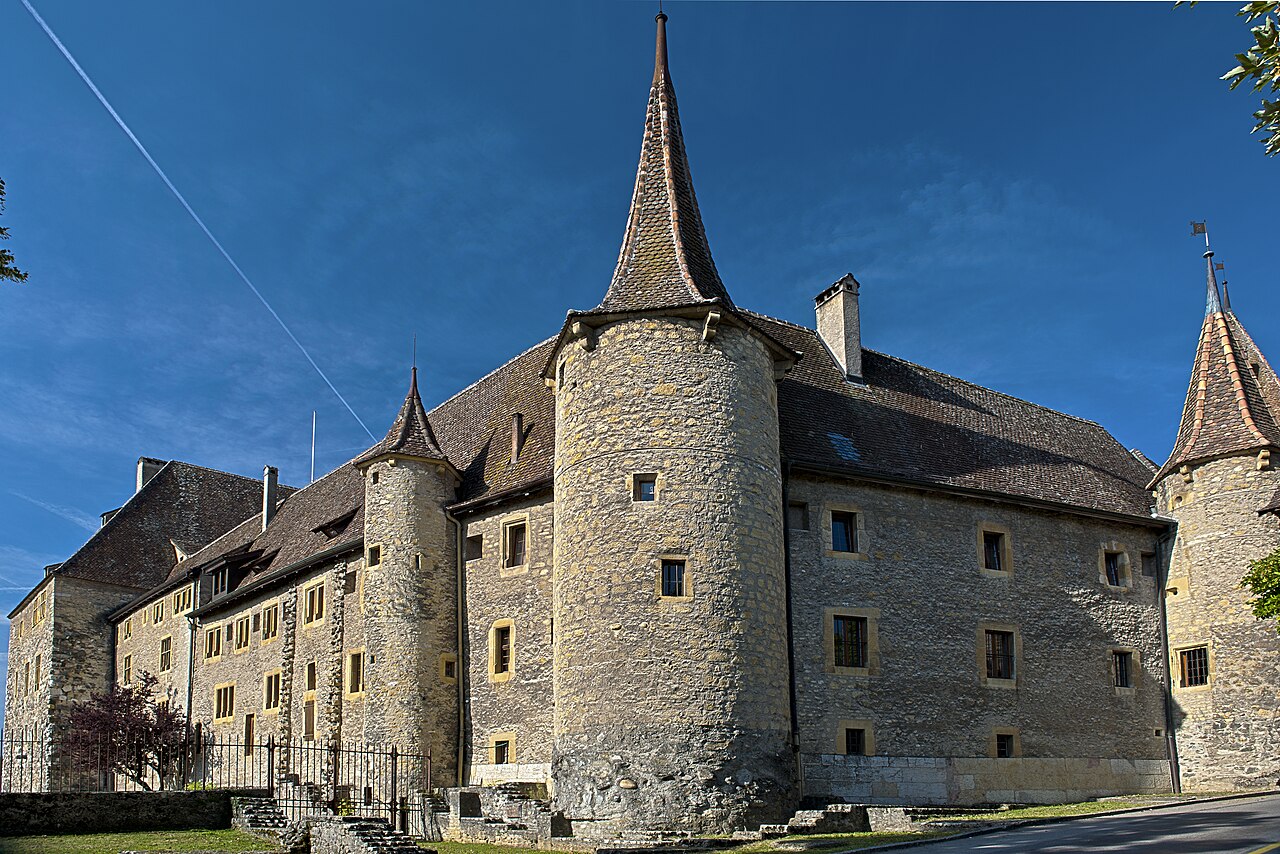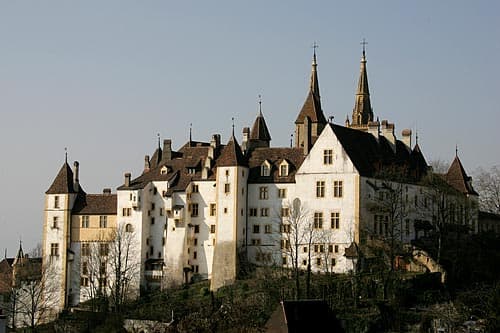
Neuchatel Castle
Neuchatel Castle stands prominently on a rocky hilltop overlooking the city of Neuchatel in Switzerland, offering a commanding view over the surrounding landscape, including Lake Neuchatel and the Seyon River. Its name, meaning "new castle", reflects its foundational role in the city's history and identity. The castle's origins trace back to the early 11th century, when it was likely constructed shortly before 1011 by King Rodolphe III of Burgundy as a royal residence and fortress to control strategic trade and travel routes.
The castle's location on a rocky promontory between the lake and the Seyon River was chosen for its natural defensive advantages and control over waterways that were vital for commerce and military movement. This site later became the nucleus around which the city of Neuchatel developed. The castle's original name, Novum Castellum, evolved through various linguistic transformations over centuries, reflecting the region's complex cultural influences, including Latin, Greek, French, and Germanic languages.
Historical significance and early origins
The first documented mention of Neuchatel Castle dates to 1011, when King Rodolphe III gifted the fortress to his wife, Irmengarde. This act is notable as it provides the earliest written reference to the castle and the city itself. After the death of Rodolphe III and the incorporation of Burgundy into the Holy Roman Empire, the castle passed under the control of German-speaking noble families connected to imperial authority.
By the mid-12th century, the lords of Fenis, later known as the lords of Neuchatel, established the castle as their principal seat. They undertook significant construction, including the conversion of the original royal hall into a Romanesque residential wing. This wing remains one of the rare surviving examples of civil Romanesque architecture in Switzerland, characterized by its three-level structure, fireplaces, decorative windows, and openwork detailing.
Medieval expansions and architectural evolution
Throughout the 13th and 14th centuries, the castle grew in size and importance as the lords of Neuchatel rose in rank to counts. They expanded the complex with new buildings to the north and east, shaping the layout around a large central courtyard. In the mid-14th century, Count Louis added a new hall north of the original, establishing a courtyard configuration that largely persists today.
The castle underwent further transformation in the 15th century under the ownership of the houses of Fribourg and Hochberg. It was remodeled into a spacious urban residence featuring stair towers, a chapel constructed between 1438 and 1450 on the west side, and a northern wing housing ceremonial rooms such as the great hall, kitchen, and treasury. A panoramic gallery was added to the south in 1488, adorned with the coats of arms of twelve Swiss cantons, commemorating their occupation of Neuchatel during the early 16th century conflicts.
The grand western gate, built between 1496 and 1498, is a notable defensive feature with two large towers topped by machicolations and an overhanging gallery. This gate exemplifies the military architectural style of the period and reflects the Hochberg family's status.
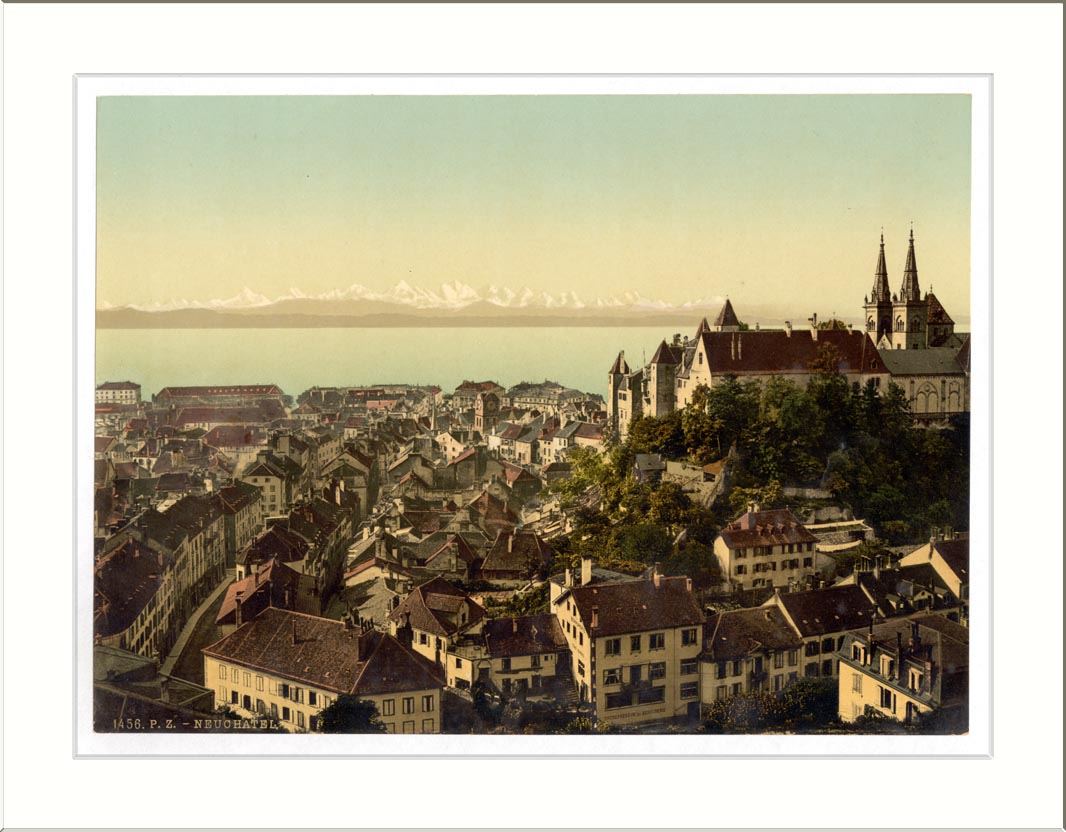
Photo by Snapshots Of The Past • CC BY-SA 2.0
Later history and political changes
By the 16th century, the comital family line ended, and the castle passed by marriage to the Orléans-Longueville family. Though they rarely resided there, governors were appointed to manage the castle, which increasingly served administrative and judicial functions. Minor architectural additions from this period include a stair turret and a small defensive balcony added circa 1600.
Neuchatel's political allegiance shifted multiple times over the centuries. It was influenced by the Habsburgs, Burgundy, and France before becoming the personal property of Frederick I of Prussia in 1707. The castle's role as a sovereign residence diminished, with administrative functions predominating. During the Napoleonic era, its poor condition and difficult access further reduced its importance, with other residences preferred for sovereign use.
In 1814, Neuchatel became a Swiss canton while retaining its status as a Prussian principality, leading to internal political tensions. The republican revolution of 1848 resulted in the castle's takeover by revolutionary forces and its establishment as the seat of the cantonal government, a role it continues to fulfill today.
Architectural features and preservation
The castle complex includes various buildings arranged around a large courtyard and a smaller southern courtyard. The Romanesque residential wing from the 12th century is among the oldest surviving parts, showcasing rare civil Romanesque architectural elements such as fireplaces, decorative windows, and openwork masonry.
The 15th-century renovations introduced urban residential features, including stair towers and ceremonial halls. The chapel, restored in the late 20th century, retains rich decorative elements. The Salle des États occupies the site of the original royal hall, featuring 17th-century heraldic paintings and traces of monumental staircases. The Council of State Hall evolved from a 12th-century belvedere, with Gothic flamboyant vaulting and painted coats of arms from the 15th century.
The castle's defensive structures include the grand western gate with machicolated towers and an overhanging gallery. The tower of Diesse, originally from the 12th century, was rebuilt in 1715. The donjon and Prison Tower contain fragments dating back to the 10th century, underscoring the site's long military history.
Archaeological restoration and modern use
Extensive archaeological restoration efforts in the 20th century, led by Charles-Henri Matthey, conserved the castle's ancient masonry and distinguished Romanesque remains from later additions. The castle was declared a historic monument in 1905, and subsequent restorations refreshed key historic rooms and facades. The facades were whitewashed with ochre-yellow framing to evoke the castle's 15th to 17th-century appearance.
Today, Neuchatel Castle remains the seat of the cantonal government, housing the cantonal executive council, the legislative assembly, and judicial courts. Its continuous use as a center of power and administration makes it a living monument reflecting centuries of Swiss history.
Relationship with the collegiate church
Adjoining the castle is the collegiate church, whose construction began at the end of the 12th century and was completed in 1276. The church's three apses, visible from the castle gates, exemplify Romanesque architectural beauty. Of the church's three main towers, only the south clock tower is original, while the spire and north tower were rebuilt in 1869.
The church contains a cenotaph from 1373 honoring the counts of Neuchatel, further linking the castle and church as focal points of regional power and heritage.
Visiting Neuchatel Castle
Visitors to Neuchatel Castle can explore the extensive courtyards, Romanesque residential wing, and the richly decorated ceremonial halls. The castle's location on a hilltop offers panoramic views of the city and lake. Access is available from Rue de la Collégiale or through the cloisters adjoining the collegiate church.
The castle's combination of medieval architecture, political history, and ongoing governmental use makes it a unique destination for those interested in Swiss heritage and castle architecture.
Frequently asked questions (FAQ)
- How do I visit Neuchatel Castle?
- The castle is open to the public during designated hours, with access points from Rue de la Collégiale and the cloisters. Guided tours may be available to explore its historical and architectural features.
- What is the historical importance of Neuchatel Castle?
- It was founded in the early 11th century by King Rodolphe III of Burgundy, serving as a royal residence, noble seat, and later as an administrative center for the canton.
- When was the castle built?
- The original royal hall dates to the early 11th century, with major expansions in the 12th to 15th centuries.
- Can I see Romanesque architecture at Neuchatel Castle?
- Yes, the 12th-century Romanesque residential wing is a rare example of civil Romanesque architecture in Switzerland, preserved and restored for visitors.
- Is the castle still used today?
- Yes, it houses the cantonal executive, legislative, and judicial offices, maintaining its role as a center of power.
- What are the best times to visit?
- Spring through autumn offer pleasant weather and the best views of the lake and city from the castle hilltop.
- Are there nearby attractions?
- The adjoining collegiate church and the city of Neuchatel itself offer rich cultural and historical experiences for visitors.
- What are the ticket prices and opening hours?
- Information varies seasonally; visitors should check official sources for current details.
Photo gallery


Information
Website
Visit websiteSources & official resources
Verify the information above using these authoritative references.
Loading map...
Visitor reviews
No reviews yet. Been here? Write the first review and help other travelers!
Write the first reviewVisited this castle? Share your experience
Your review helps other travelers and adds first-hand knowledge to our encyclopedia.