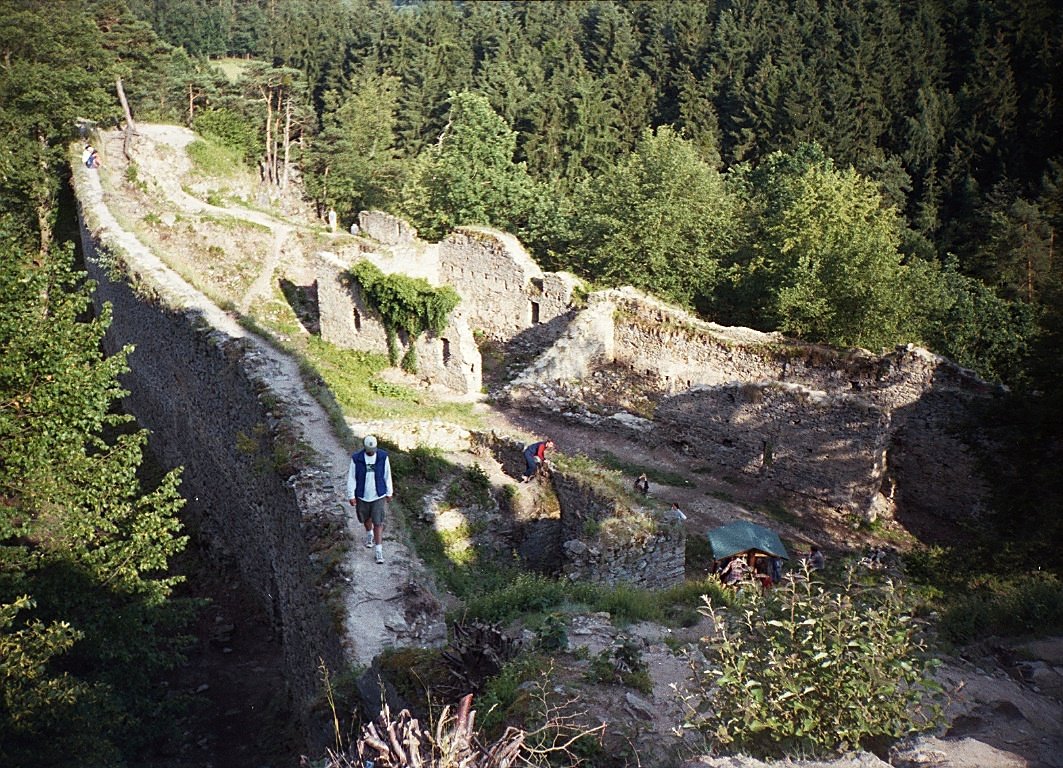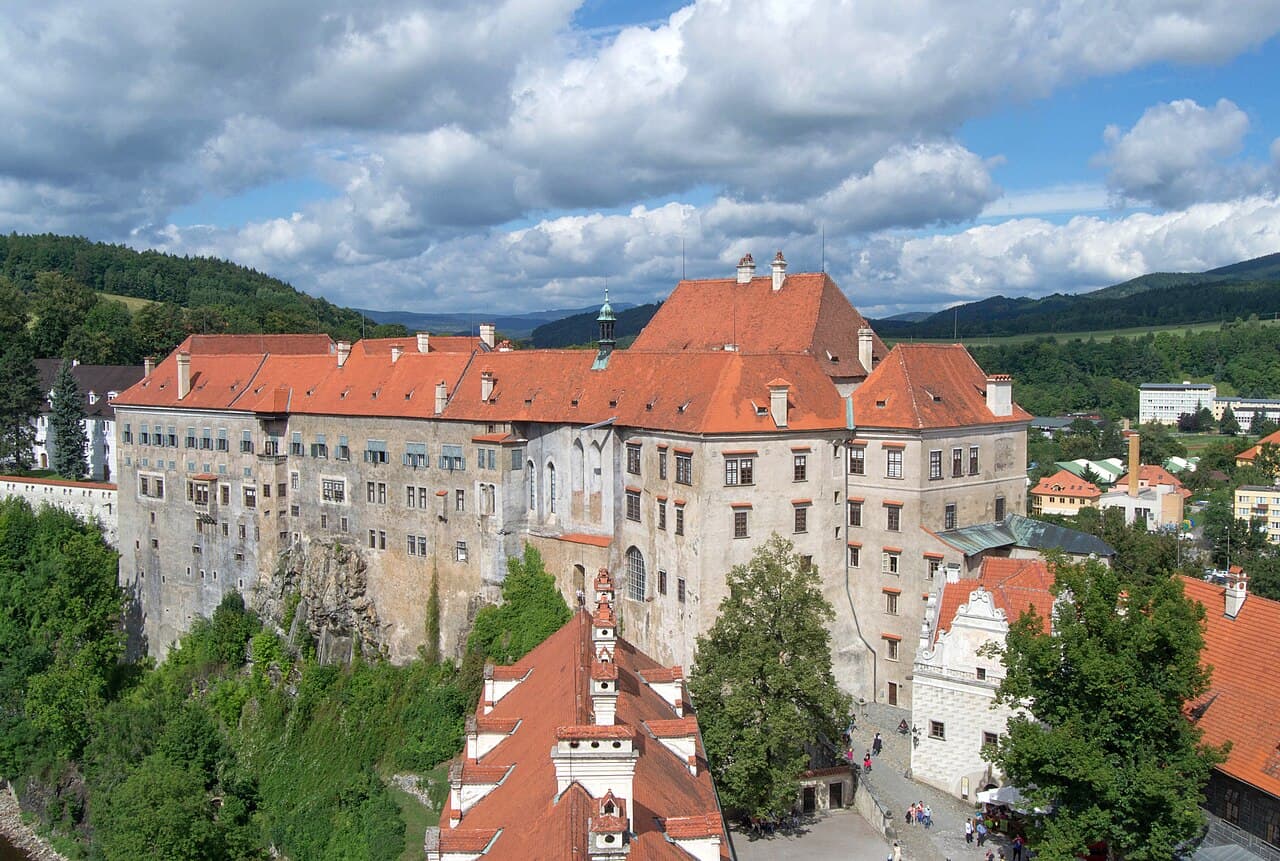
The Bear Moat at Český Krumlov Castle
Český Krumlov Castle is a monumental medieval fortress in the South Bohemian Region of Czechia, renowned for its extensive complex and rich architectural heritage. Founded in 1240 by the Vítkovci family, a branch of the influential Rosenberg family, the castle evolved over centuries to become the second largest castle complex in the country, surpassed only by Prague Castle. It uniquely combines Gothic, Renaissance, and Baroque architectural elements, reflecting its dynamic history and the tastes of its noble owners.
Strategically perched on a steep rocky promontory overlooking the Vltava River and the Polečnice stream, the castle's location provided natural defense advantages. These were enhanced by a system of man-made fortifications, including thick walls, towers, and notably the Bear Moat. This deep, water-filled moat was a critical defensive feature protecting the castle's lower sections and remains a distinctive aspect of the castle's fortification system.
Origins and high medieval development
The castle's origins date to the early 13th century when the Vítkovci family established the initial fortress. The first documented mention of Český Krumlov Castle is from 1253, associated with Vítek of Krumlov. The original structure featured a rectangular palace and a prominent round bergfried tower approximately 11.6 meters in diameter, typical of medieval defensive architecture designed for surveillance and protection.
After the Krumlov branch of the Vítkovci family died out in 1302, the castle passed to the Rožmberk family. Under Jindřich I of Rožmberk, the Lower Castle underwent significant expansion. His son, Petr I of Rožmberk, initiated the construction of the Upper Castle in the early 14th century, which was later rebuilt by Oldřich II of Rožmberk in the 15th century. This period saw the addition of new defensive towers and residential palaces, blending military functionality with noble residence.
Renaissance enhancements and imperial ties
The 16th century brought major Renaissance transformations under Vilém of Rožmberk. He commissioned extensive building projects that introduced Renaissance architectural features, enriching the castle's aesthetic and functional qualities. Financial difficulties led to the sale of the castle to Emperor Rudolf II, who gifted it to his illegitimate son, Julius Caesar (Juan d’Austria), thereby linking Český Krumlov to the imperial Habsburg dynasty.
Baroque renovations and cultural flourishing
In 1622, Emperor Ferdinand II granted the castle estate to the Eggenberg family. The Eggenbergs undertook significant Baroque renovations, including the construction of the Český Krumlov Baroque Theatre around 1680. This theatre is one of the world's most completely preserved Baroque theatres, retaining original stage machinery, costumes, and decorative elements, offering visitors a rare glimpse into 17th-century theatrical art.
Following the extinction of the Eggenberg male line in 1717, ownership passed to the Schwarzenberg family. They continued Baroque remodeling, particularly in the late 18th century, aligning the castle’s interiors and exteriors with the elegant Viennese Baroque style. Although the Schwarzenbergs later shifted their main residence to Hluboká Castle, Český Krumlov remained a significant cultural and historical landmark.
Architectural layout and notable features
Upper and lower castle complexes
The castle complex is divided into two main parts: the Upper Castle and the Lower Castle. The Upper Castle occupies a narrow rocky ridge and is protected by two square towers guarding the main entrance. It houses the Rožmberk Palace, which contains Renaissance halls with preserved wooden ceilings and a collection of 16th and 17th-century Flemish tapestries. The castle chapel of St. George, originally built in the early 14th century and later remodeled in Baroque style, features a star-vaulted sacristy and decorative tracery windows.
The Lower Castle is accessed by crossing the Bear Moat bridge and includes functional buildings such as the Renaissance stables, salt house, and the Gothic Máselnice tower. The courtyard is decorated with Renaissance sgraffito and fountains dating from the 16th and 17th centuries, enhancing the castle’s historic ambiance.
Artistic and architectural highlights
The castle contains the Masquerade Hall, renowned for its 1748 illusionistic paintings depicting a masked ball with 135 life-sized figures, a unique example of Baroque artistic creativity. The Eggenberg Hall houses a ceremonial golden coach used in historic diplomatic missions. The Cloak Bridge, built in 1764, is a five-story covered passageway connecting the Upper Castle with the theatre and gardens, showcasing innovative Baroque architectural solutions.
Historical and cultural significance
Český Krumlov Castle was declared a national monument in 1989 and inscribed on the UNESCO World Heritage List in 1992. Its preservation allows visitors to explore a comprehensive historical narrative spanning from medieval fortifications through Renaissance refinement to Baroque grandeur.
The castle’s Baroque theatre remains operational, hosting performances that continue the tradition of 18th-century theatrical arts. The surrounding gardens and the Belaria pavilion, decorated with frescoes, provide insight into the leisure and artistic pursuits of the castle’s noble inhabitants.
Today, Český Krumlov Castle stands as a significant architectural and cultural monument, reflecting the region’s complex history, noble lineage, and artistic evolution. Its extensive fortifications, including the Bear Moat, remain a distinctive feature that illustrates medieval defensive strategies and the castle’s adaptation through centuries of political and cultural change.
Frequently asked questions (FAQ)
- How do I visit Český Krumlov Castle and its bear moat?
- Český Krumlov Castle is open to visitors daily during the tourist season, typically from 9:00 to 17:00. The Bear Moat is accessible via the Lower Castle area, with guided tours available to explore its historical significance and architecture.
- What is the historical significance of the Bear Moat at Český Krumlov Castle?
- The Bear Moat served as a key defensive feature of the castle, protecting the Lower Castle from invaders. It also housed live bears historically, symbolizing strength and nobility, adding to the castle's unique character.
- When was the Český Krumlov Baroque Theatre built and why is it important?
- The Baroque Theatre was constructed around 1680 under the Eggenberg family. It is one of the best-preserved Baroque theatres worldwide, retaining original stage machinery, costumes, and décor, making it a rare cultural treasure.
- Can I explore the different architectural styles present at Český Krumlov Castle?
- Yes, the castle showcases a blend of Gothic, Renaissance, and Baroque architectural styles. Visitors can see medieval fortifications, Renaissance palaces, and Baroque renovations throughout the complex.
- Is the castle accessible for visitors with mobility challenges?
- While parts of Český Krumlov Castle are accessible, the steep terrain and historic structures may present challenges. Some areas have limited wheelchair access, so visitors with mobility needs should check in advance for specific accommodations.
Photo gallery

Information
Sources & official resources
Verify the information above using these authoritative references.
Loading map...
Visitor reviews
No reviews yet. Been here? Write the first review and help other travelers!
Write the first reviewVisited this castle? Share your experience
Your review helps other travelers and adds first-hand knowledge to our encyclopedia.