Maškovec Castle
Maškovec castle stands as a remarkable example of a medieval hill castle in the Czech Republic, perched strategically above the Vltava River. Constructed in the mid-14th century by the noble family of Újezd, it played a significant role in controlling trade routes and asserting regional power during a turbulent period of Bohemian history.
Located near the municipalities of Kamenný Újezd and Boršov nad Vltavou, the castle was built on a natural promontory at an elevation of approximately 440 meters above sea level. Its position atop a vertical rock face overlooking a deep meander of the Vltava River provided commanding views and formidable natural defenses. The castle’s design capitalized on the steep cliffs that drop sharply to the river on one side and a sloping valley on the southeast, making direct assault difficult.
Historical background and ownership
The first documented mention of Maškovec castle dates to 1380, when Buzek of Újezd used his title in association with the fortress. The lords of Újezd were connected by marriage and alliance to prominent noble families such as the Bavors of Strakonice, the lords of Drahonice, and the knights of Pořešín, reflecting the castle’s importance within the noble network of southern Bohemia.
During the Hussite Wars—a period of religious and political upheaval in Bohemia—the castle was owned by Racek, son of Buzek, who initially supported the Hussite cause but later became a vassal of the powerful Rožmberk family. By 1425, the castle was recorded as the residence of Jan of Drahonice. The Újezd lineage maintained control until the mid-1420s, but the ongoing conflicts and economic strain led to the disappearance of their line from historical records, signaling the castle’s decline.
In 1455, Jindřich IV of Rožmberk acquired Maškovec, incorporating it into the expanding Rožmberk estates. The castle was soon abandoned as it was considered redundant within the larger holdings of the Rožmberks. By 1493, Maškovec was officially recorded as a ruin.
In the 19th century, specifically between 1823 and 1841, much of the remaining masonry was dismantled by Pachner of Ebendorf, a local estate owner who repurposed the stones for construction in nearby villages. This quarrying significantly reduced the visible remains of the castle.
Strategic importance and cultural notes
Maškovec castle’s location was chosen to oversee the Cáhlovská trade route, an important medieval path for merchants and travelers. The castle’s lords exerted control by compelling merchants to pass through the village below, often imposing tolls or other forms of economic pressure to increase their revenues. This control over trade routes was a common source of income and influence for medieval castles.
An interesting cultural anecdote from 1427 recounts that after the castle’s partial abandonment, Jan Pryndl, a parish priest from Újezd, sought refuge within the remaining structures of Maškovec. During his stay, he completed a manuscript copy of the Golden Legend, a widely read medieval collection of saints’ lives authored by Jacobus de Voragine. This highlights the castle’s role not only as a military stronghold but also as a place of refuge and cultural activity.
Architectural features and layout
Maškovec was constructed as a single-unit fortress, designed to exploit the natural topography for defense. The castle was situated on a rocky promontory with a vertical rock face overlooking the Vltava River, providing a natural barrier on one side. The southeast side slopes steeply towards a small valley carved by a stream, adding another layer of natural defense.
To protect the more accessible approaches from the northwest and northeast, the castle builders constructed ramparts and ditches. Notably, the northeast side featured a double set of these defensive earthworks, indicating heightened concern for defense on that front. The use of earthworks combined with natural rock formations was typical of hill castles designed to maximize defensive potential with limited masonry.
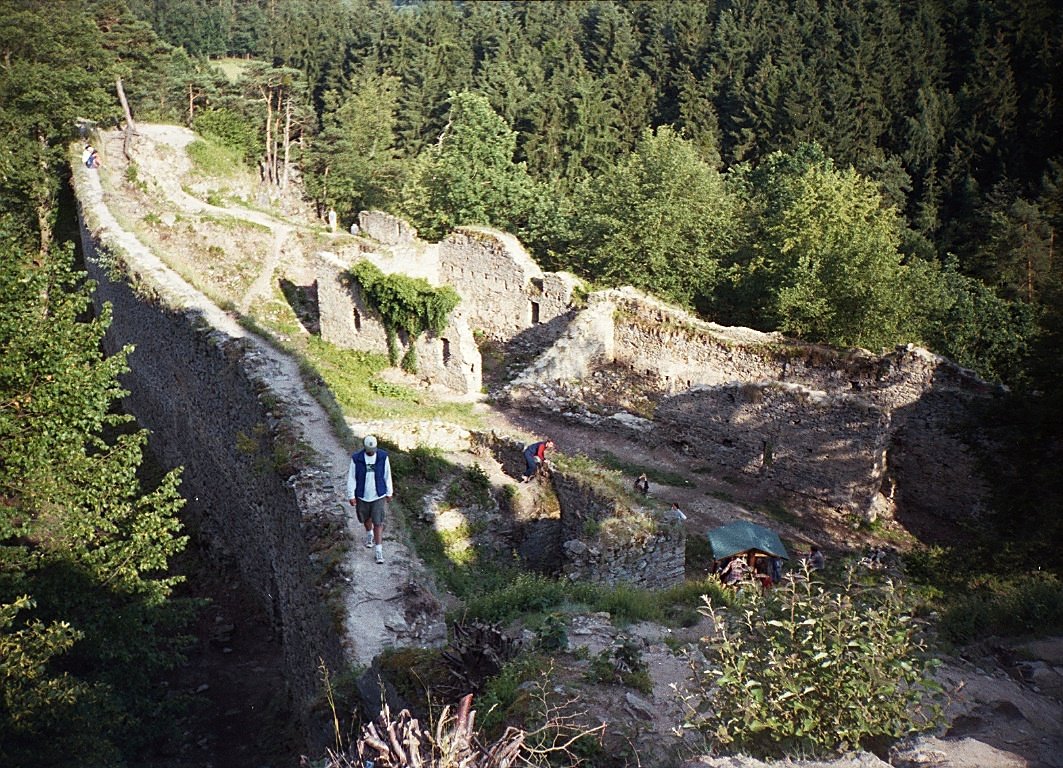
The surviving remains include a section of the outer rampart on the northwest side, which helps visitors visualize the castle’s former fortifications. On the rocky outcrop above the river, fragments of a building corner remain, adjacent to a depression interpreted as the footprint of a vaulted cellar. This cellar likely served as a subterranean storage or utility space, essential for sustaining the castle’s inhabitants during sieges or harsh winters.
Additional smaller wall fragments near the western corner along the rock edge provide further clues to the castle’s original layout. The castle’s rock face plunges approximately 35 meters into the valley below, a dramatic natural feature that now attracts rock climbers. The area is marked by four known climbing routes, blending historical heritage with modern recreational use.
Current status and visitor information
Today, Maškovec castle is recognized for its cultural and historical significance and has been protected as a cultural monument since 1963. Although much of the original masonry was removed in the 19th century, the site retains important archaeological features and offers spectacular views over the Vltava River and the surrounding landscape.
Access to the castle ruins is via a marked hiking trail connecting Boršov nad Vltavou and Zlatá Koruna. Visitors should be aware that the terrain around the ruins is challenging and potentially dangerous due to steep slopes and unstable rock formations. Proper footwear and caution are advised when exploring the site.
Maškovec castle remains a poignant reminder of medieval Bohemia’s complex history, noble rivalries, and strategic military architecture. Its ruins, set amidst striking natural scenery, continue to attract historians, hikers, and rock climbers alike.
Frequently asked questions (FAQ)
- When was Maškovec castle built and by whom?
- Maškovec castle was built in the mid-14th century by the lords of Újezd, a noble family connected to several prominent Bohemian houses.
- What is the current condition of Maškovec castle?
- Today, Maškovec castle is in ruins, with much of its masonry removed in the 19th century, but some earthworks and structural traces remain visible.
- How can visitors access Maškovec castle?
- Visitors can reach the castle ruins via a marked hiking trail between Boršov nad Vltavou and Zlatá Koruna, but should be cautious due to the challenging terrain.
- Why was Maškovec castle strategically important?
- The castle controlled the Cáhlovská trade route, allowing its lords to regulate merchant traffic and collect tolls, enhancing their economic and political influence.
- Is it possible to climb near Maškovec castle?
- Yes, the rock face beneath the castle ruins is used for rock climbing and features four known climbing routes, attracting climbers to the area.
Information
Loading map...
Visitor reviews
No reviews yet. Been here? Write the first review and help other travelers!
Write the first reviewVisited this castle? Share your experience
Your review helps other travelers and adds first-hand knowledge to our encyclopedia.