Dívčí kámen
Dívčí kámen castle, located near the municipality of Křemže in the South Bohemian Region of Czechia, stands as a remarkable example of a medieval hill castle with deep historical roots extending into prehistoric times. This site uniquely combines evidence of early human settlement with the architectural and military developments of the High and Late Middle Ages. Its enduring presence on the landscape reflects centuries of cultural and strategic significance.
Prehistoric origins and early fortifications
The history of Dívčí kámen begins well before the medieval era, with archaeological findings indicating continuous human activity from the Eneolithic period through the Early Bronze Age. The site was initially occupied by early communities who constructed a fortified hillfort attributed to the Unetice culture. This culture is renowned for its early use of bronze and complex social structures. The hillfort's dry-stone ramparts and strategic location on a rocky elevation provided natural defense advantages.
Subsequent cultural layers reveal occupation by peoples of the Hallstatt and La Tène periods, both significant Iron Age cultures in Central Europe. These inhabitants left behind a wealth of artifacts including bronze tools, jewelry such as bracelets linked to the Straubing culture, and evidence of metalworking activities like slag and crucibles. The presence of amber bead necklaces further attests to the site's role in prehistoric trade and craftsmanship.
Medieval construction and the rožmberk era
The medieval chapter of Dívčí kámen castle commenced in the mid-14th century, when King Charles IV granted a royal charter in 1349 permitting the influential Rožmberk brothers—Jošt, Petr, Jan, and Oldřich—to erect a fortress on the site. Construction took place over the next decade, and by 1383, the castle was documented under the German name Maidstein. The fortress served both military and administrative roles for the Rožmberk family, a powerful noble house in Bohemia.
During the turbulent Hussite Wars, Dívčí kámen proved its defensive strength by withstanding a siege in 1420 led by the famed Hussite commander Jan Žižka. Although the nearby town suffered destruction, the castle itself remained intact. The fortress also played a notable political role; in 1394, it functioned as the prison for King Wenceslaus IV, underscoring its strategic importance.
Following the wars, the castle came under the control of Oldřich II of Rožmberk in 1426, who chose it as his residence during his later years. The Rožmberks continued to maintain and strengthen the castle's defenses through the late 15th century, with detailed records from 1470 listing the garrison's armaments and personnel. However, by the early 16th century, maintenance ceased under Petr IV of Rožmberk, leading to the castle's gradual abandonment and official desertion by 1541.
Architectural features and defensive structures
Dívčí kámen castle exemplifies Gothic fortress architecture adapted to its hilltop terrain. The castle's highest point features a rectangular core containing two three-story palaces arranged around an internal courtyard. Access to this courtyard was via a vaulted passage through the eastern palace. Each palace floor contained three rooms with flat ceilings and large windows facing the courtyard, balancing defensive needs with residential comfort.
A distinctive feature is the small oriel chapel located on the third floor of the western palace, notable for its ribbed vaulting, a hallmark of Gothic ecclesiastical architecture. Surrounding the core was an outer defensive wall known as a parkán, characteristic of Rožmberk castles and similar to the design seen at Helfenburk. This wall enclosed the core on all sides except the entrance, enhancing the fortress's security.
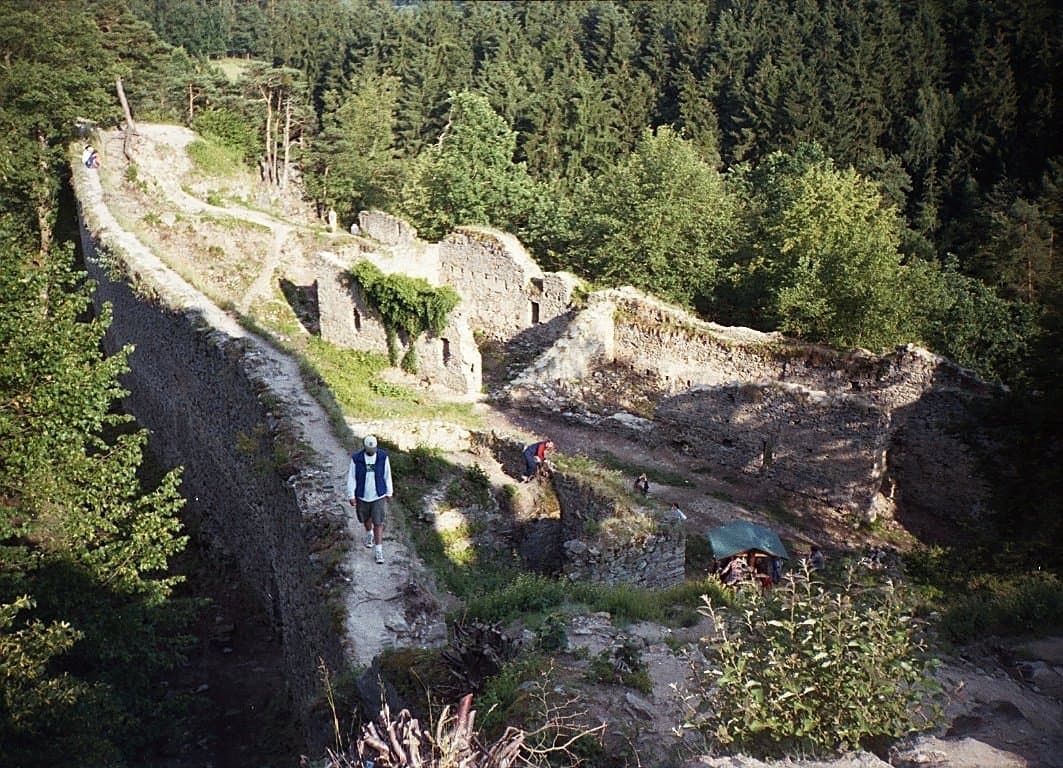
Beneath the core lay a roughly triangular outer bailey, featuring a round tower positioned on rock at its eastern tip. Access to this bailey was controlled by a fortified road with two successive gates: the first a tower gate connected to the parkán by a defensive wall, and beyond the bailey, a third tower gate provided additional defense. The surrounding latrán (suburb) was enclosed by a defensive wall encircling the hilltop, much of which remains visible today, although the exact layout of the associated settlement is unclear.
In response to the growing threat of artillery during the late Hussite period and into the mid-15th century, the castle's defenses were augmented with two rectangular artillery bastions on the northern side of the parkán and a third positioned south of the third gate tower. These bastions are among the earliest examples in the region of fortifications designed specifically to resist cannon fire, marking an important evolution in military architecture.
Archaeological discoveries and preservation
Archaeological excavations at Dívčí kámen have uncovered significant prehistoric artifacts, including bronze axes, bracelets associated with the Straubing culture, and amber bead necklaces. Evidence of bronze casting, such as slag and crucibles, highlights the site's long-standing role as a center for metalworking. These findings enrich our understanding of the cultural continuity and technological advancements spanning from prehistoric times through the medieval period.
Despite centuries of stone removal and neglect, the castle's ruins remain a prominent feature in the landscape. The surviving stone walls, towers, and defensive structures provide valuable insights into Gothic fortress design and the adaptations made in response to evolving military technologies. Since the 18th century, the site has passed through various ownerships, including the Schwarzenberg family and later the state, which designated the area as a nature reserve in 1951.
Today, Dívčí kámen is owned by the municipality of Křemže and managed commercially with restricted public access. It remains an important cultural and historical landmark, attracting interest from historians, archaeologists, and visitors fascinated by its rich past and architectural heritage.
The castle's role in regional history and culture
Dívčí kámen castle played a multifaceted role in the history of South Bohemia. As a military stronghold, administrative center, and noble residence, it was integral to the power dynamics of the region, especially under the Rožmberk family. Its endurance through the Hussite Wars and its adaptation to emerging artillery threats reflect the castle's strategic importance and the shifting nature of medieval warfare.
Moreover, the site's prehistoric significance adds a unique dimension to its cultural value, illustrating a continuous human presence and the evolution of settlement patterns over millennia. The castle and its surroundings form part of the broader historical landscape of Czechia, contributing to the understanding of medieval fortifications and prehistoric cultures in Central Europe.
Frequently asked questions (FAQ)
- How do I visit Dívčí kámen castle?
- Dívčí kámen castle is under commercial management with restricted public access. Visitors should check local tourism information and contact the municipality of Křemže for current visiting opportunities and guided tours.
- What is the historical significance of Dívčí kámen castle?
- Dívčí kámen castle is significant for its combination of prehistoric settlement and medieval Gothic fortress architecture. It was a key stronghold for the Rožmberk family and withstood a siege during the Hussite Wars.
- When was Dívčí kámen castle built?
- The castle was constructed in the mid-14th century, following a royal charter granted by King Charles IV in 1349, with completion by the late 14th century.
- What architectural features distinguish Dívčí kámen castle?
- Notable features include a rectangular core with two three-story palaces, a vaulted courtyard passage, a rib-vaulted oriel chapel, a surrounding parkán wall, and early artillery bastions added in the 15th century.
- Is Dívčí kámen castle accessible for visitors with mobility issues?
- Due to its hilltop location and ruinous condition, accessibility is limited. Visitors with mobility issues should inquire in advance about facilities and guided visit options.
- Why is Dívčí kámen castle important for archaeology?
- The site has yielded prehistoric artifacts such as bronze tools and evidence of metalworking, providing valuable insights into early European cultures and continuous settlement through the Bronze and Iron Ages.

Information
Sources & official resources
Verify the information above using these authoritative references.
Loading map...
Visitor reviews
No reviews yet. Been here? Write the first review and help other travelers!
Write the first reviewVisited this castle? Share your experience
Your review helps other travelers and adds first-hand knowledge to our encyclopedia.