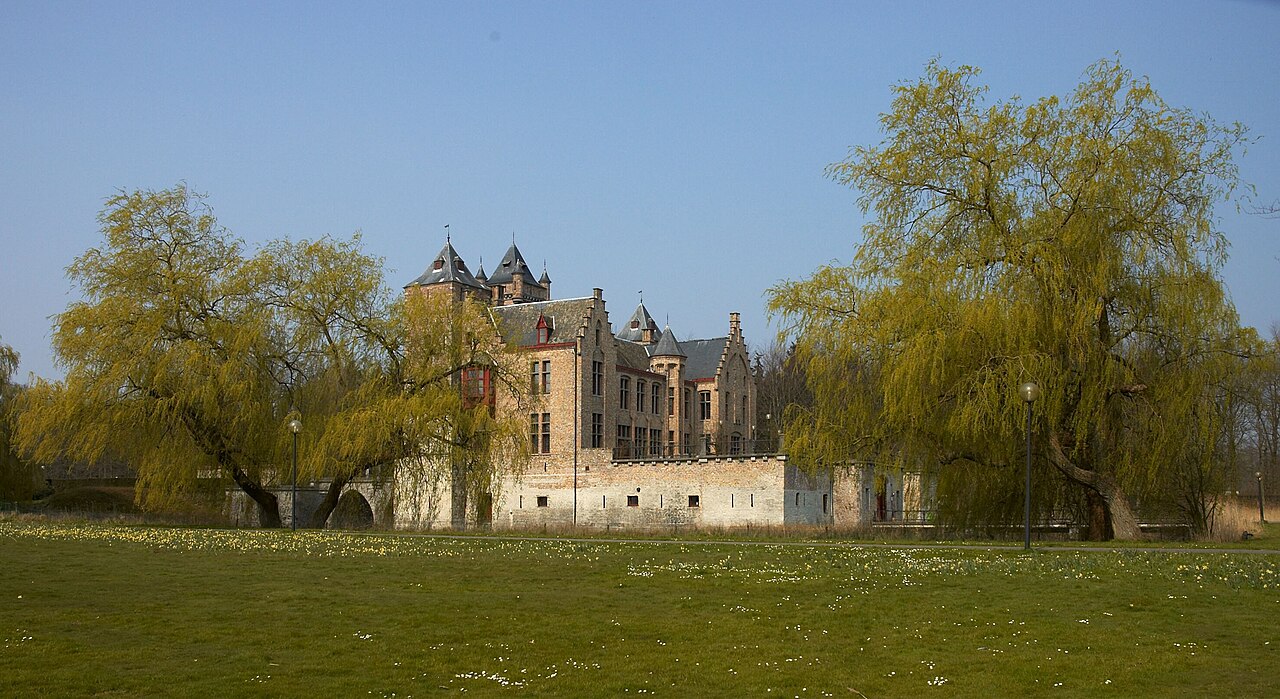
Ten Torre Castle
Ten Torre Castle, locally known as Kasteel Ten Torre, is a distinguished hill castle located south of the village of Beernem in the province of West Flanders, within the Flemish region of Belgium. The name 'Ten Torre' translates from Flemish as 'at the tower,' reflecting the site's longstanding association with a prominent tower or fortified structure. The castle's origins date back to at least the mid-14th century, with its first recorded mention in 1353, although the appearance of the original medieval castle remains undocumented.
Medieval origins and early history
The earliest records indicate that by 1657, the estate comprised a castle with distinct upper and lower courts, signifying a fortified residence of some importance. The property was acquired in 1700 by Jacques Robert de la Villette, whose family expanded their influence in the Brugse Vrije region through additional land purchases. In 1724, through marriage, the castle passed to the Arrazola de Oñate family, who maintained ownership throughout the 18th century. During this time, the castle was situated on an almost square plot surrounded by a broad moat and a secondary ring-shaped pond, creating a layered aquatic defense and ornamental feature.
18th-century renovations and estate development
Marc-Albert Arrazola de Oñate undertook renovations shortly before his death in 1778, overseeing a well-cultivated landscape that included a variety of fruit trees and wild acacias, as documented in an 1788 park inventory. The estate, encompassing over 100 hectares locally and additional lands elsewhere, was a significant landholding. Following his death, the castle provided refuge during the turbulent political climate of the 1790s. Ownership then passed through family lines to Marie Thérèse Arrazola de Oñate and her husband Renon le Bailly de Tilleghem, notable for their wealth and connections, including hosting figures such as Napoleon Bonaparte and the Duke of Istria. For them, Ten Torre served primarily as a summer retreat.
19th-century reconstruction and architectural transformation
Between 1843 and 1848, Hector le Bailly de Tilleghem undertook a major rebuilding of Ten Torre Castle on the original foundations, marking a significant phase in the castle's architectural evolution. To facilitate construction, a brick kiln was established nearby, enabling the use of locally produced bricks that contributed to the castle's robust and regionally authentic character. The rebuilt structure retained the castle's historic footprint while updating it for contemporary residential use.
Restoration by stefaan mortier and stylistic influences
In 1895, the castle underwent further transformation under the ownership of Joseph de Meester de Ravenstein. The architect Stefaan Mortier, inspired by the French architect Viollet-le-Duc, led a restoration that introduced several distinctive features. These included raising the roof and adding an imposing entrance porch with a loggia and an open gallery, enhancing the castle's façade with elegance and openness. One of the corner towers was converted into a watchtower, offering panoramic views and shifting the castle's character from purely defensive to more picturesque and leisurely.
20th-century history and wartime impact
During World War I, the de Meester de Ravenstein family abandoned Ten Torre Castle due to the advancing conflict, fleeing to the Netherlands in 1914. The castle remained unoccupied until 1917, when German officers took residence, with rumors suggesting that Field Marshall Rupprecht of Bavaria, the German Crown Prince, may have stayed there. The castle was again occupied by German forces during World War II and sustained damage in 1945 from Allied fire and subsequent German actions during the liberation.
Architectural features and landscape
The castle is built upon an almost square plot, originally fortified by a wide moat and a secondary ring-shaped pond, creating a layered water defense system that also served ornamental purposes. The 19th-century reconstruction preserved the foundational layout while introducing brick construction that emphasized durability and local materials. The later additions by Mortier, including the raised roof, entrance loggia, open gallery, and converted watchtower, reflect a blend of functional and aesthetic considerations, merging the castle's medieval roots with Romantic Neo-Gothic stylistic elements.
The surrounding park was expanded and landscaped during the late 19th century, with the moat enlarged to complement the castle's new appearance. The estate's grounds historically included cultivated orchards and diverse tree species, enhancing its status as a refined country residence.
Current status and accessibility
Today, Ten Torre Castle remains a private property, owned and used as a luxurious holiday residence available exclusively for group rentals. It is not open to public visitation and cannot be viewed from the public road, preserving its privacy and exclusivity. Despite this, the castle is recognized for its architectural charm and historical significance within the region.
Frequently asked questions (FAQ)
- How do I visit Ten Torre Castle?
- Ten Torre Castle is private property and is not open to the public. It can only be visited by groups renting it as a holiday residence, and it is not visible from public roads.
- What is the historical significance of Ten Torre Castle?
- Ten Torre Castle dates back to at least the 14th century and has been associated with prominent local families, including the Arrazola de Oñate and le Bailly de Tilleghem families. It reflects architectural developments from medieval fortifications to 19th-century Romantic Neo-Gothic renovations.
- When was Ten Torre Castle rebuilt?
- The castle was significantly rebuilt between 1843 and 1848 by Hector le Bailly de Tilleghem on the original foundations, with further restorations in 1895 by architect Stefaan Mortier.
- Can I see Ten Torre Castle from nearby roads?
- No, the castle is not visible from public roads as it is surrounded by private grounds and is maintained as a private residence.
- What architectural style is Ten Torre Castle?
- Ten Torre Castle exhibits Romantic Neo-Gothic architectural features, especially following the 1895 restoration by Stefaan Mortier inspired by Viollet-le-Duc.
Information
Sources & official resources
Verify the information above using these authoritative references.
Loading map...
Visitor reviews
No reviews yet. Been here? Write the first review and help other travelers!
Write the first reviewVisited this castle? Share your experience
Your review helps other travelers and adds first-hand knowledge to our encyclopedia.