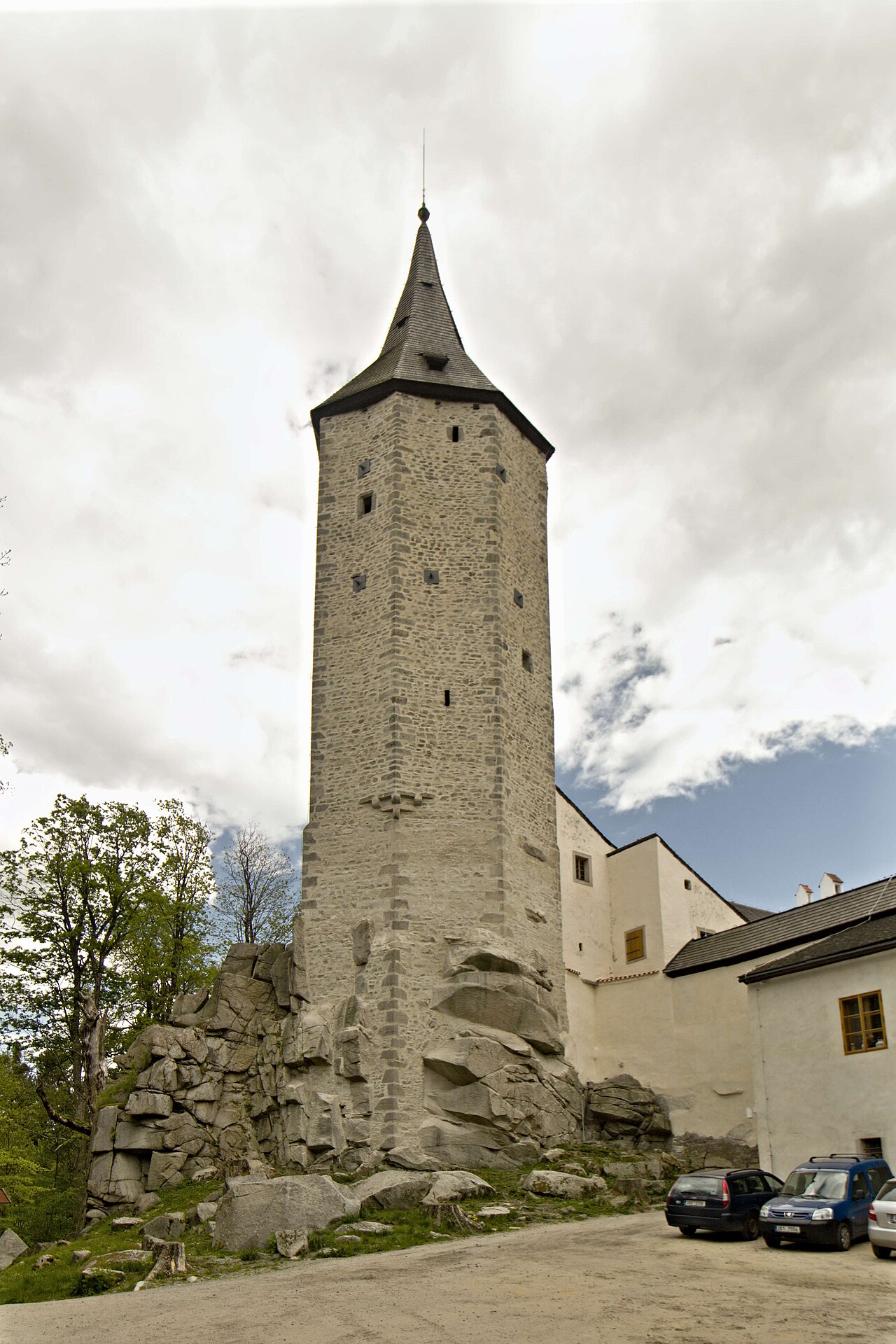
Telc Castle
Telč castle, located in the historic town of Telč in the Czech Republic, is a remarkable example of a Renaissance château that evolved from a medieval Gothic water castle. Originally constructed in the second half of the 14th century by the noble lords of Hradec, the castle was strategically designed as a fortified residence surrounded by water, enhancing its defensive capabilities. This early Gothic fortress was built following the destruction of an earlier stronghold by fire in 1387, establishing a new seat for the Hradec family. Over the centuries, the castle underwent significant architectural transformations that reflect the changing tastes and political fortunes of its owners.
The medieval origins and Gothic fortifications
The initial construction of Telč castle focused on creating a robust water castle with a fortified courtyard, defensive walls, and towers equipped with arrow slits. The castle’s core included a two-story palace featuring a chapel dedicated to St. George with rib-vaulted ceilings, a hallmark of Gothic ecclesiastical architecture. In the late 15th century, the castle's fortifications were enhanced under Jindřich IV of Hradec, who added a new gate-tower and strengthened the defenses to protect against the turbulent political climate of the era, including the Hussite Wars. The castle briefly fell to Hussite forces in 1423 but was restored to the Hradec family and hosted Emperor Sigismund in 1437, underscoring its regional importance.
Renaissance transformation under Zachariáš of Hradec
The mid-16th century marked a profound shift in the castle’s architectural style and function. Zachariáš of Hradec, influenced by his travels to Italy and his marriage to Kateřina of Waldstein, commissioned an extensive Renaissance remodeling between 1550 and 1580. This transformation was led by Italian architects, including Antonín Vlach and Baldassare Maggi, who introduced Renaissance elements such as vaulted ceilings, sgraffito façades, and richly decorated state apartments. The original Gothic structures were integrated into a new layout centered on three main courtyards, combining defensive features with elegant residential palaces.
Architectural highlights of the Renaissance phase
- The Golden Hall in the Northern Palace, renowned for its coffered ceiling and ornate decoration, exemplifies Renaissance artistic achievement.
- The All Saints funerary chapel, built in 1580 within the Southern Palace, features a polygonal apse and elaborate stucco ornamentation.
- The castle’s façades were adorned with sgraffito decorations and coats of arms celebrating the union of Zachariáš and Kateřina.
- Arcaded corridors and covered passages unified the palaces, enhancing both aesthetic appeal and functional connectivity.
Later history and cultural significance
Ownership of Telč castle passed through several noble families, including the Slavata, Liechtenstein-Kastelkorn, and Podstatský-Liechtenstein families. During the early 17th century, the Slavata family played a key role in reinforcing Catholic influence in the region amidst religious conflicts. The castle’s interiors contain historically significant rooms such as the Knights’ Hall, the Banquet Hall (which served as a theater in the 19th century), and the Blue Hall, featuring a painting of the 1618 Prague Defenestration, linking the site to pivotal Bohemian history.
Jesuit influence and Baroque additions
The arrival of the Jesuits in the 17th century brought religious and architectural developments to Telč, including the construction of the Church of the Name of Jesus between 1666 and 1667, designed by Domenico Orsi. The town square was further embellished in the 18th century with the addition of the column of the Virgin and a decorative fountain, reflecting Baroque artistic trends.
Gardens and parkland
The château is surrounded by one of the oldest Renaissance gardens in the Czech Republic, established in the 1570s. This garden features arcades with niches that once held busts of rulers and stucco reliefs, including a notable depiction of Neptune riding a chariot drawn by four horses. Adjacent to the garden lies a large park created mainly in the 19th century, which includes rare exotic trees, a network of streams and footpaths, and a neoclassical greenhouse housing a collection of citrus trees centered on a fountain.
Preservation and current status
Following World War II, Telč castle was confiscated by the state and recognized for its cultural and historical importance. It was declared a national cultural monument in 1995 and has been part of the UNESCO World Heritage site encompassing the historic center of Telč since 1992. Recent conservation efforts between 2020 and 2023 have focused on restoring original paintings, plasterwork, and structural elements such as the Knights’ Hall ceiling. Modern fire protection systems were installed, and the castle’s park paths, fountains, and arcades were carefully renovated to ensure the preservation of this architectural treasure for future generations.
Today, Telč castle stands as a testament to the rich cultural heritage and architectural evolution from a medieval fortress to a Renaissance noble residence, attracting visitors interested in history, art, and architecture.
Frequently asked questions (FAQ)
- When was Telč castle originally built?
- Telč castle was originally constructed in the second half of the 14th century by the lords of Hradec following a fire that destroyed the earlier fortress on the site.
- What architectural styles are prominent in Telč castle?
- Telč castle prominently features Gothic architecture in its original structures, with a significant Renaissance transformation in the 16th century led by Italian architects.
- Is Telč castle open to the public for visits?
- Yes, Telč castle is open to visitors. It operates under the management of a state museum and offers guided tours showcasing its historical and architectural significance.
- What are the highlights to see inside Telč castle?
- Visitors should not miss the Golden Hall with its richly decorated coffered ceiling, the Knights’ Hall, the Banquet Hall, and the Blue Hall, which features a painting of the 1618 Prague Defenestration.
- What is the significance of the Renaissance gardens at Telč castle?
- The Renaissance gardens at Telč castle, established in the 1570s, are among the oldest in the Czech Republic and feature arcades with stucco reliefs and symbolic sculptures, reflecting Renaissance artistic ideals.
Information
Sources & official resources
Verify the information above using these authoritative references.
Loading map...
Visitor reviews
No reviews yet. Been here? Write the first review and help other travelers!
Write the first reviewVisited this castle? Share your experience
Your review helps other travelers and adds first-hand knowledge to our encyclopedia.