Štamberk Castle

Štamberk castle: medieval hill fortress in Czechia
Řásná, Czech Republic
High Medieval (11th–13th c.)
Ruins

Štamberk castle is a notable example of a medieval hill castle situated in the Czech Republic, specifically in the municipality of Řásná. Built in the 1280s by the nobleman Jaroslaw of Sternberg, the fortress was strategically positioned on a hill known as Vrch at an elevation of 695 meters above sea level. This location provided commanding views over the surrounding landscape, including, on clear days, the distant peaks of the Lower Austrian Alps.

The castle was originally constructed to serve as a border watchpoint on royal land during the High medieval period. Jaroslaw of Sternberg, who was the burgrave of Bítov and the highest cup-bearer in the Kingdom of Bohemia, established Štamberk to oversee and protect the border region. The castle's role was both military and administrative, controlling several nearby villages and parts of towns within its estate.

Historical background and ownership

The first documentary mention of Štamberk dates to 1356, when Štěpán of Březnice sold the castle to Heinrich II of Neuhaus. Over the following decades, ownership passed through prominent noble families, including the Neuhaus and Kravař lineages. These families managed the castle and its surrounding lands, maintaining its significance as a local administrative center.

Štamberk's history was dramatically altered during the Hussite Wars in the early 15th century. In 1423, the castle was attacked and destroyed by forces led by Jan Hvězda of Vícemilice. The fortress was never rebuilt after this destruction, marking the end of its military and administrative functions.

Architectural features and layout

Štamberk castle was constructed primarily from local stone, consistent with 13th-century military architecture in the region. The fortress was designed to take advantage of its elevated position, with defensive walls and a prominent tower forming the core of its fortifications.

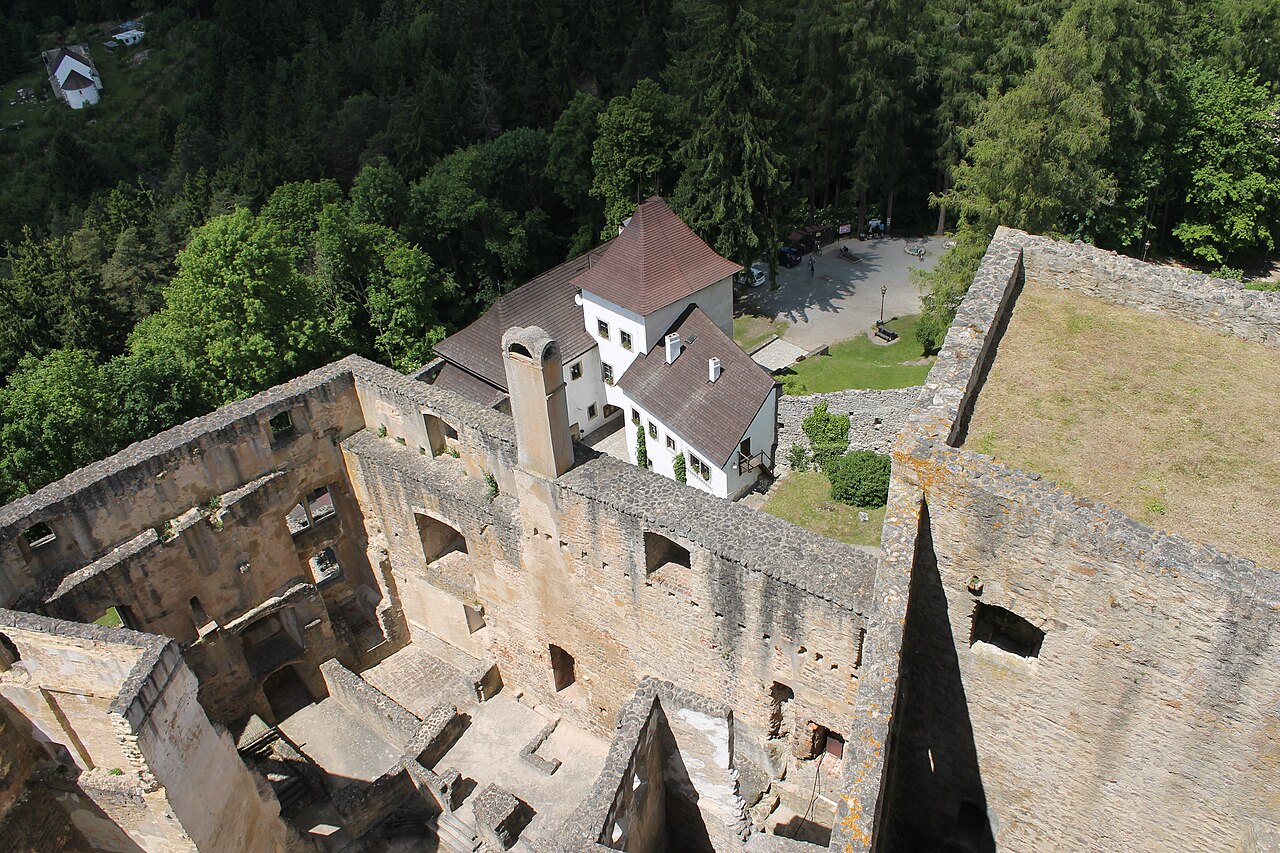
Today, the most visible remains include fragments of the stone walls and a significant portion of the tower wall. Recent archaeological excavations between 2020 and 2023 have revealed more about the castle's original layout, including the extent of its courtyard and defensive structures. A wooden shelter has been erected on the former courtyard to protect the site and visitors.

Defensive structures

The castle's walls were thick and robust, designed to withstand sieges typical of the medieval period. The tower, likely serving as a keep or donjon, was a key defensive element, overseeing the approaches to the castle and providing a last refuge during attacks.

Modern conservation and public access

Beginning in 2020, concerted efforts have been made to stabilize and conserve Štamberk's ruins. These efforts included the partial reconstruction of the tower wall segment to prevent further deterioration and the installation of visitor facilities such as the wooden shelter.

Štamberk is now recognized as a cultural monument of the Czech Republic, ensuring legal protection for the site. While the castle remains in ruins, it continues to attract visitors interested in medieval history, architecture, and scenic views. The site offers a tangible connection to the turbulent history of the Bohemian borderlands during the High medieval and early Late medieval periods.

Geographical and cultural significance

Situated on the southern slope of Vrch hill, Štamberk castle's location was chosen for its strategic vantage point. The panoramic views allowed early warning of any approaching threats and enabled control over the surrounding territory. The castle's position near the border of the Kingdom of Bohemia underscores its importance in regional defense and administration.

Today, Štamberk stands as a symbol of medieval fortification architecture in Czechia. Its ruins provide insight into the construction techniques and defensive strategies of the 13th and 14th centuries. The site also enriches the cultural heritage of the region, offering educational opportunities and a destination for cultural tourism.

Frequently asked questions (FAQ)

When was Štamberk castle built and by whom?
Štamberk castle was built in the 1280s by Jaroslaw of Sternberg, a nobleman and burgrave of Bítov in the Kingdom of Bohemia.
What led to the destruction of Štamberk castle?
The castle was destroyed in 1423 during the Hussite Wars by forces led by Jan Hvězda of Vícemilice and was never rebuilt.
What remains of Štamberk castle today?
Today, visitors can see fragments of stone walls and a partially reconstructed tower wall, along with a wooden shelter marking the former courtyard.
Is Štamberk castle accessible to the public?
Yes, the ruins are accessible to visitors and are protected as a cultural monument, with conservation efforts ongoing to preserve the site.
What is the significance of Štamberk castle's location?
The castle is strategically located on a hill providing wide views over the surrounding area, including views of the Lower Austrian Alps on clear days.

Information

Hill Castle

Sources & official resources

Verify the information above using these authoritative references.

Loading map...

Visitor reviews

No reviews yet. Been here? Write the first review and help other travelers!

Write the first review

Visited this castle? Share your experience

Your review helps other travelers and adds first-hand knowledge to our encyclopedia.
Write a review

(5/5)

0/2000 characters

Your review will be visible after admin approval

Nearby castles

5.5 km
Roštejn Castle — Czech Republic castle

Roštejn Castle

Doupě, Czech Republic

Roštejn Castle stands as a remarkable example of a late Gothic hill castle nestled in the Bohemian-Moravian Highlands of Czechia. Founded in the first half of the 14th century by the medieval Bohemian nobility, specifically the Lords of Hradec, it was strategically positioned to protect the nearby town of Telč and to mark the boundary between the estates of Třešť and Telč. The castle’s name derives from the Vítkovci noble family, whose emblem featured a five-petaled rose; the German term "Rosenstein" meaning "rose stone" evolved into the Czech "Roštejn." Historical significance and ownership The earliest written document mentioning Roštejn Castle dates to 1353, associating it with the influential Vítkovci family. Over the centuries, the castle changed hands among prominent noble families, including the Slavata family of Košumberk, the Liechtensteins of Kastelkorn, and later the Podstatský-Liechtenstein line. These transitions reflect the castle’s importance within the regional aristocracy and its role in the political landscape of Bohemia. In the 16th century, under the ownership of Zachariáš of Hradec, Roštejn underwent significant transformation from a purely defensive fortress into a Renaissance-style hunting residence. This period marks the first documented mention of the surrounding game park, which was likely used for hunting activities since medieval times, underscoring the castle’s dual function as both a stronghold and a noble leisure estate. Roštejn’s history also includes dramatic events such as the 1915 lightning strike that caused a devastating fire in the castle’s prominent tower, nearly destroying the structure. This event led to extensive restoration efforts beginning in 1958, culminating in the castle’s reopening to the public in 1969. Architectural features and layout Perched on a rugged hill at an elevation of 677 meters above sea level, Roštejn Castle offers commanding views of the surrounding Bohemian-Moravian Highlands and, on clear days, even the distant Austrian Alps. The castle’s design reflects its late Gothic origins, with construction primarily in stone, which has contributed to its status as one of the best-preserved castles of this type in the region. One of the castle’s most striking architectural features is its seven-sided Gothic tower, which rises approximately 45 meters high. This tower dominates the castle’s silhouette and historically served both defensive and observational purposes. Visitors today can access the tower, allowing them to appreciate the strategic vantage point it provided. The castle’s internal spaces are richly decorated with late Renaissance wall paintings. The Armorial Hall features coats of arms that celebrate the heraldic traditions of its noble owners, while the Botanical Hall displays decorative motifs inspired by plant life, reflecting Renaissance artistic sensibilities. The Forester’s Study contains artistic depictions of horses, linking to the castle’s heritage as a hunting residence. The Chapel of St. Eustace within the castle complex is dedicated to the patron saint of hunters. This chapel holds historical significance as a predecessor to chapels honoring St. Hubert, another figure closely associated with hunting traditions. Collections and cultural heritage Roštejn Castle’s former residential quarters have been preserved and now house collections of period objects that illustrate the lifestyle and customs of its past inhabitants. These include porcelain, pewter items, hunting weapons, furniture, and stoneware. These artifacts provide visitors with a tangible connection to the castle’s history and the daily life of the nobility. The surrounding historic game park continues to function as a deer enclosure, maintaining the estate’s long-standing tradition of hunting and wildlife management. This park is home to several species of hoofed game, underscoring Roštejn’s enduring association with nature and hunting culture. Restoration and modern use After the fire in 1915, Roštejn underwent a lengthy period of restoration beginning in 1958, which preserved many of its original features. The castle reopened to the public in 1969 and has since expanded its exhibitions to include themes such as ghosts, nature, hunting, and forestry. Interactive areas designed especially for children have been incorporated, enhancing the educational experience. Between 2017 and early 2021, a major renovation project restored the castle’s roof, tower masonry, and several interior elements, including oil paintings, historic furniture, stucco ceilings, altars, and wall decorations. This extensive restoration, which required an investment exceeding 70 million CZK, has ensured the castle’s preservation for future generations. Roštejn has also served as a filming location for various fairy tale movies and other productions, further cementing its cultural significance and appeal as a historic site.

Late Medieval (14th–15th c.)
Details
6 km

Telc Castle

Telč, Czech Republic

Telč castle, located in the historic town of Telč in the Czech Republic, is a remarkable example of a Renaissance château that evolved from a medieval Gothic water castle. Originally constructed in the second half of the 14th century by the noble lords of Hradec, the castle was strategically designed as a fortified residence surrounded by water, enhancing its defensive capabilities. This early Gothic fortress was built following the destruction of an earlier stronghold by fire in 1387, establishing a new seat for the Hradec family. Over the centuries, the castle underwent significant architectural transformations that reflect the changing tastes and political fortunes of its owners. The medieval origins and Gothic fortifications The initial construction of Telč castle focused on creating a robust water castle with a fortified courtyard, defensive walls, and towers equipped with arrow slits. The castle’s core included a two-story palace featuring a chapel dedicated to St. George with rib-vaulted ceilings, a hallmark of Gothic ecclesiastical architecture. In the late 15th century, the castle's fortifications were enhanced under Jindřich IV of Hradec, who added a new gate-tower and strengthened the defenses to protect against the turbulent political climate of the era, including the Hussite Wars. The castle briefly fell to Hussite forces in 1423 but was restored to the Hradec family and hosted Emperor Sigismund in 1437, underscoring its regional importance. Renaissance transformation under Zachariáš of Hradec The mid-16th century marked a profound shift in the castle’s architectural style and function. Zachariáš of Hradec, influenced by his travels to Italy and his marriage to Kateřina of Waldstein, commissioned an extensive Renaissance remodeling between 1550 and 1580. This transformation was led by Italian architects, including Antonín Vlach and Baldassare Maggi, who introduced Renaissance elements such as vaulted ceilings, sgraffito façades, and richly decorated state apartments. The original Gothic structures were integrated into a new layout centered on three main courtyards, combining defensive features with elegant residential palaces. Architectural highlights of the Renaissance phase The Golden Hall in the Northern Palace, renowned for its coffered ceiling and ornate decoration, exemplifies Renaissance artistic achievement. The All Saints funerary chapel, built in 1580 within the Southern Palace, features a polygonal apse and elaborate stucco ornamentation. The castle’s façades were adorned with sgraffito decorations and coats of arms celebrating the union of Zachariáš and Kateřina. Arcaded corridors and covered passages unified the palaces, enhancing both aesthetic appeal and functional connectivity. Later history and cultural significance Ownership of Telč castle passed through several noble families, including the Slavata, Liechtenstein-Kastelkorn, and Podstatský-Liechtenstein families. During the early 17th century, the Slavata family played a key role in reinforcing Catholic influence in the region amidst religious conflicts. The castle’s interiors contain historically significant rooms such as the Knights’ Hall, the Banquet Hall (which served as a theater in the 19th century), and the Blue Hall, featuring a painting of the 1618 Prague Defenestration, linking the site to pivotal Bohemian history. Jesuit influence and Baroque additions The arrival of the Jesuits in the 17th century brought religious and architectural developments to Telč, including the construction of the Church of the Name of Jesus between 1666 and 1667, designed by Domenico Orsi. The town square was further embellished in the 18th century with the addition of the column of the Virgin and a decorative fountain, reflecting Baroque artistic trends. Gardens and parkland The château is surrounded by one of the oldest Renaissance gardens in the Czech Republic, established in the 1570s. This garden features arcades with niches that once held busts of rulers and stucco reliefs, including a notable depiction of Neptune riding a chariot drawn by four horses. Adjacent to the garden lies a large park created mainly in the 19th century, which includes rare exotic trees, a network of streams and footpaths, and a neoclassical greenhouse housing a collection of citrus trees centered on a fountain. Preservation and current status Following World War II, Telč castle was confiscated by the state and recognized for its cultural and historical importance. It was declared a national cultural monument in 1995 and has been part of the UNESCO World Heritage site encompassing the historic center of Telč since 1992. Recent conservation efforts between 2020 and 2023 have focused on restoring original paintings, plasterwork, and structural elements such as the Knights’ Hall ceiling. Modern fire protection systems were installed, and the castle’s park paths, fountains, and arcades were carefully renovated to ensure the preservation of this architectural treasure for future generations. Today, Telč castle stands as a testament to the rich cultural heritage and architectural evolution from a medieval fortress to a Renaissance noble residence, attracting visitors interested in history, art, and architecture.

Late Medieval (14th–15th c.)
Details
23.6 km
Landštejn Castle — Czech Republic castle

Landštejn Castle

Staré Město pod Landštejnem, Czech Republic

Landštejn Castle stands as a remarkable example of a medieval hill castle strategically positioned near the border between Czechia and Austria. Its origins trace back to the early 13th century, making it a significant fortress in the region's medieval landscape. The castle's construction was likely commissioned by King Přemysl Otakar I to secure important trade routes and defend the border against Austrian expansion, particularly countering the nearby Zöbingen family stronghold. The earliest documentary mention of Landštejn dates to 1231, when Hartlieb of Landštejn was recorded as castellan, confirming the castle's role as a defensive and administrative center. Initially part of the Margraviate of Moravia, it came under direct Bohemian control after 1222. The castle soon became the seat of the noble Vítkovci family, who took the title Lords of Landštejn. Prominent figures such as Sezema (1261–1282) and Vilém I (d. 1356) were instrumental in regional politics and the protection of trade routes. After Vilém I's death, the castle reverted to royal ownership. In 1381, King Wenceslaus IV granted Landštejn to the Krajířové z Krajku family, under whose stewardship the castle underwent significant expansion and renovation. This period introduced late Gothic and Renaissance architectural elements, reflecting evolving styles and military needs. The castle's strategic importance persisted during the Hussite Wars, notably enduring a siege in 1420 led by the Hussite commander Jan Žižka. Archaeological evidence reveals intense combat and fire damage from this siege. Ownership of Landštejn shifted among various noble families through the 16th and 17th centuries, including the Stephan von Eyczing, David Neumayer, the Mohrovs of Lichtenegg, the Khuen of Belasy, the Černín family, and finally the Herbersteins until 1816. The castle suffered structural damage, including a lightning strike in the mid-17th century that affected a Romanesque tower, and a devastating fire in 1771 that led to its abandonment and partial dismantling for building materials. Following World War II, the castle ruins were confiscated from the Sternbach family in 1945. Neglect caused further deterioration until volunteer-led clearing efforts began in the 1960s. Large-scale restoration commenced in 1972, with reopening to the public by 1990. Today, Landštejn is protected as a cultural monument managed by the National Heritage Institute. Architectural features and layout The original pentagonal layout of Landštejn Castle is enclosed by a robust defensive stone wall punctuated by square towers at the northern and eastern corners. The eastern tower functioned as a bergfried, a tall, typically uninhabited defensive tower overseeing the main southeast entrance. The northern tower served residential purposes and housed a small Romanesque chapel with an apse, integrated into its thick walls. This chapel was accessible from the castle's main palace situated between the two towers. The palace retains an outer wall featuring corbels that once supported a wooden gallery for internal communication. A smaller building occupied the southern corner of the castle grounds, though its original function remains uncertain. Defensive expansions in the 14th century included an outer bailey (parkán) and a forecourt to bolster protection against increasing military threats. A new residential tower was erected outside the southeast wall, and the original main gate was replaced by a new entrance in the southwest wall. The Krajíř family significantly enhanced the castle by rebuilding the old palace and adding wings around the courtyard, refurbishing living quarters in the Renaissance style. Some interior walls were decorated with sgraffito, a plaster technique creating layered artistic designs. Fortifications were reinforced with polygonal bastions in the northern and eastern outer bailey, while the southwest side featured three open semicircular bastions topped with battlements for mounting defensive weapons, exemplifying advanced late medieval military architecture. Access to the forecourt was secured through two tower gates, complemented by an encompassing moat and an earthen rampart for layered defense. Around 1520, a new defensive wall with a shooting gallery was constructed, featuring two semicircular open bastions and a polygonal earth bastion on the southeast side. These additions reflected evolving military design aimed at resisting artillery attacks. Below the castle core lies an extensive network of cellars, currently closed for reconstruction. The original well near the western wall was replaced with a deeper 27-meter well within the courtyard, ensuring water supply during sieges. In 1495, a new chapel dedicated to Saint George was built in the eastern palace wing, adding to the castle's religious significance. Historical significance and military role Landštejn Castle played a crucial role in controlling borderlands and trade routes between Bohemia and Austria. Its position allowed oversight of key transit corridors, making it a focal point in regional conflicts and power struggles. The castle's repeated sieges and ownership changes reflect its strategic importance through the High and Late Middle Ages. The siege by Jan Žižka during the Hussite Wars underscores the castle's military resilience and the intensity of religious and political upheavals in 15th-century Bohemia. Despite suffering damage, the castle remained a symbol of noble power and defense. Restoration and current status After centuries of decline following the 18th-century fire and abandonment, Landštejn Castle faced further decay in the 20th century. Post-World War II confiscation and neglect left the ruins vulnerable until community and governmental efforts initiated preservation. Restoration beginning in the 1970s focused on stabilizing structures and making the site accessible to visitors. Today, visitors can explore the preserved Romanesque chapel, climb the large rectangular tower known as Velká věž via a wooden staircase, and enjoy panoramic views extending to the Lower Austrian Alps on clear days. The castle remains an important cultural monument, offering insights into medieval architecture, military history, and noble life in Czech borderlands. Visitor information and accessibility Landštejn Castle is open to the public with guided tours available, providing detailed historical context and architectural insights. The site is managed by the National Heritage Institute, ensuring ongoing preservation and educational outreach. Visitors are advised to check seasonal opening hours and ticket prices before planning their visit. The castle's hilltop location involves some steep walking paths, so appropriate footwear and moderate physical fitness are recommended. The site is suitable for history enthusiasts, architecture scholars, and tourists interested in medieval fortifications and Bohemian heritage. Nearby attractions The surrounding region offers additional cultural and natural attractions, including the historic town of Jindřichův Hradec and the scenic landscapes of the Bohemian Forest. These sites complement a visit to Landštejn Castle, enriching the experience of Czechia's rich medieval past and natural beauty.

High Medieval (11th–13th c.)
Details