Roštejn Castle
Roštejn Castle stands as a remarkable example of a late Gothic hill castle nestled in the Bohemian-Moravian Highlands of Czechia. Founded in the first half of the 14th century by the medieval Bohemian nobility, specifically the Lords of Hradec, it was strategically positioned to protect the nearby town of Telč and to mark the boundary between the estates of Třešť and Telč. The castle’s name derives from the Vítkovci noble family, whose emblem featured a five-petaled rose; the German term "Rosenstein" meaning "rose stone" evolved into the Czech "Roštejn."
Historical significance and ownership
The earliest written document mentioning Roštejn Castle dates to 1353, associating it with the influential Vítkovci family. Over the centuries, the castle changed hands among prominent noble families, including the Slavata family of Košumberk, the Liechtensteins of Kastelkorn, and later the Podstatský-Liechtenstein line. These transitions reflect the castle’s importance within the regional aristocracy and its role in the political landscape of Bohemia.
In the 16th century, under the ownership of Zachariáš of Hradec, Roštejn underwent significant transformation from a purely defensive fortress into a Renaissance-style hunting residence. This period marks the first documented mention of the surrounding game park, which was likely used for hunting activities since medieval times, underscoring the castle’s dual function as both a stronghold and a noble leisure estate.
Roštejn’s history also includes dramatic events such as the 1915 lightning strike that caused a devastating fire in the castle’s prominent tower, nearly destroying the structure. This event led to extensive restoration efforts beginning in 1958, culminating in the castle’s reopening to the public in 1969.
Architectural features and layout
Perched on a rugged hill at an elevation of 677 meters above sea level, Roštejn Castle offers commanding views of the surrounding Bohemian-Moravian Highlands and, on clear days, even the distant Austrian Alps. The castle’s design reflects its late Gothic origins, with construction primarily in stone, which has contributed to its status as one of the best-preserved castles of this type in the region.
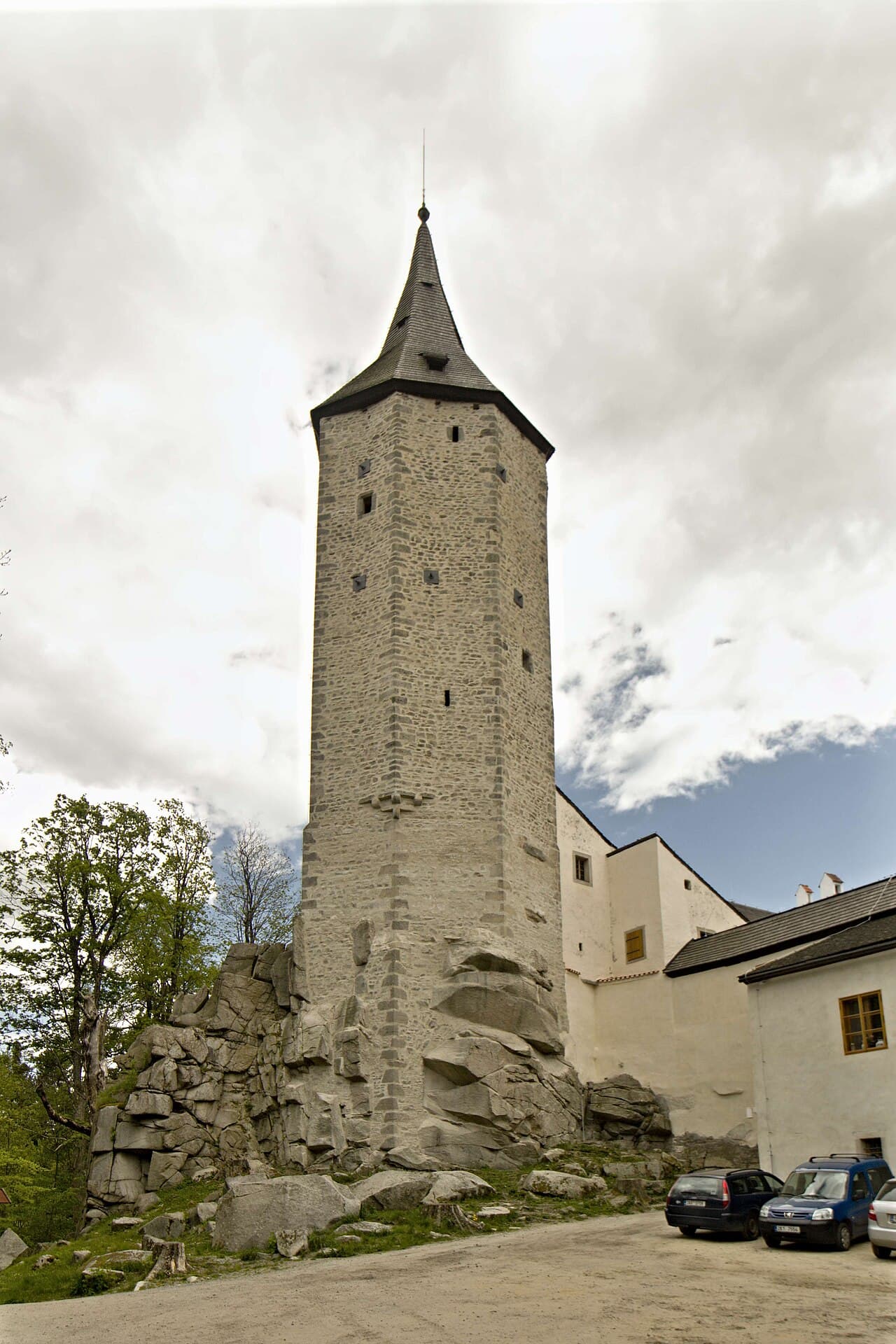
One of the castle’s most striking architectural features is its seven-sided Gothic tower, which rises approximately 45 meters high. This tower dominates the castle’s silhouette and historically served both defensive and observational purposes. Visitors today can access the tower, allowing them to appreciate the strategic vantage point it provided.
The castle’s internal spaces are richly decorated with late Renaissance wall paintings. The Armorial Hall features coats of arms that celebrate the heraldic traditions of its noble owners, while the Botanical Hall displays decorative motifs inspired by plant life, reflecting Renaissance artistic sensibilities. The Forester’s Study contains artistic depictions of horses, linking to the castle’s heritage as a hunting residence.
The Chapel of St. Eustace within the castle complex is dedicated to the patron saint of hunters. This chapel holds historical significance as a predecessor to chapels honoring St. Hubert, another figure closely associated with hunting traditions.
Collections and cultural heritage
Roštejn Castle’s former residential quarters have been preserved and now house collections of period objects that illustrate the lifestyle and customs of its past inhabitants. These include porcelain, pewter items, hunting weapons, furniture, and stoneware. These artifacts provide visitors with a tangible connection to the castle’s history and the daily life of the nobility.
The surrounding historic game park continues to function as a deer enclosure, maintaining the estate’s long-standing tradition of hunting and wildlife management. This park is home to several species of hoofed game, underscoring Roštejn’s enduring association with nature and hunting culture.
Restoration and modern use
After the fire in 1915, Roštejn underwent a lengthy period of restoration beginning in 1958, which preserved many of its original features. The castle reopened to the public in 1969 and has since expanded its exhibitions to include themes such as ghosts, nature, hunting, and forestry. Interactive areas designed especially for children have been incorporated, enhancing the educational experience.
Between 2017 and early 2021, a major renovation project restored the castle’s roof, tower masonry, and several interior elements, including oil paintings, historic furniture, stucco ceilings, altars, and wall decorations. This extensive restoration, which required an investment exceeding 70 million CZK, has ensured the castle’s preservation for future generations.
Roštejn has also served as a filming location for various fairy tale movies and other productions, further cementing its cultural significance and appeal as a historic site.
Frequently asked questions (FAQ)
- What is the historical significance of Roštejn Castle?
- Roštejn Castle, built in the 13th century, served as a strategic fortification and noble residence. It played a crucial role in the defense of the region and showcases the architectural evolution of medieval Czech castles.
- When was Roštejn Castle last renovated?
- The last significant renovation of Roštejn Castle took place in the late 20th century, allowing it to be preserved and opened to the public. Ongoing restoration efforts continue to maintain its historical integrity and share its story with visitors.
- Can I visit Roštejn Castle year-round?
- Yes, Roštejn Castle is open to visitors year-round, although opening hours may vary seasonally. It’s advisable to check the official website or contact the castle administration for the most current visiting times.
- What are the ticket prices for visiting Roštejn Castle?
- Ticket prices for Roštejn Castle vary based on age and group size, with discounts often available for students and seniors. Typically, tickets range from a modest fee for adults to reduced prices for children and groups, making it accessible for all.
- Is Roštejn Castle accessible for people with disabilities?
- Roštejn Castle has made efforts to improve accessibility for visitors with disabilities. However, due to its historic structure, some areas may still present challenges, so it’s recommended to inquire about specific accommodations when planning your visit.
- What is the best time to visit Roštejn Castle?
- The best time to visit Roštejn Castle is during the spring and early autumn months when the weather is mild and the surrounding nature is at its most beautiful. Additionally, visiting during these seasons often allows guests to enjoy various outdoor events and activities hosted at the castle.
- Are there any nearby attractions to explore after visiting Roštejn Castle?
- Yes, there are several nearby attractions, including the picturesque town of Doupě and the beautiful natural landscapes of the Bohemian-Moravian Highlands. Exploring these areas can enhance your visit and provide a deeper appreciation of the region's history and culture.
- What architectural features should I look for at Roštejn Castle?
- Roštejn Castle features a blend of Gothic and Renaissance architectural styles, with notable elements such as its imposing towers and intricate stonework. Be sure to admire the castle’s defensive structures and the well-preserved interiors that reflect its historical significance.
Photo gallery

Information
Website
Visit websiteSources & official resources
Verify the information above using these authoritative references.
Loading map...
Visitor reviews
No reviews yet. Been here? Write the first review and help other travelers!
Write the first reviewVisited this castle? Share your experience
Your review helps other travelers and adds first-hand knowledge to our encyclopedia.


