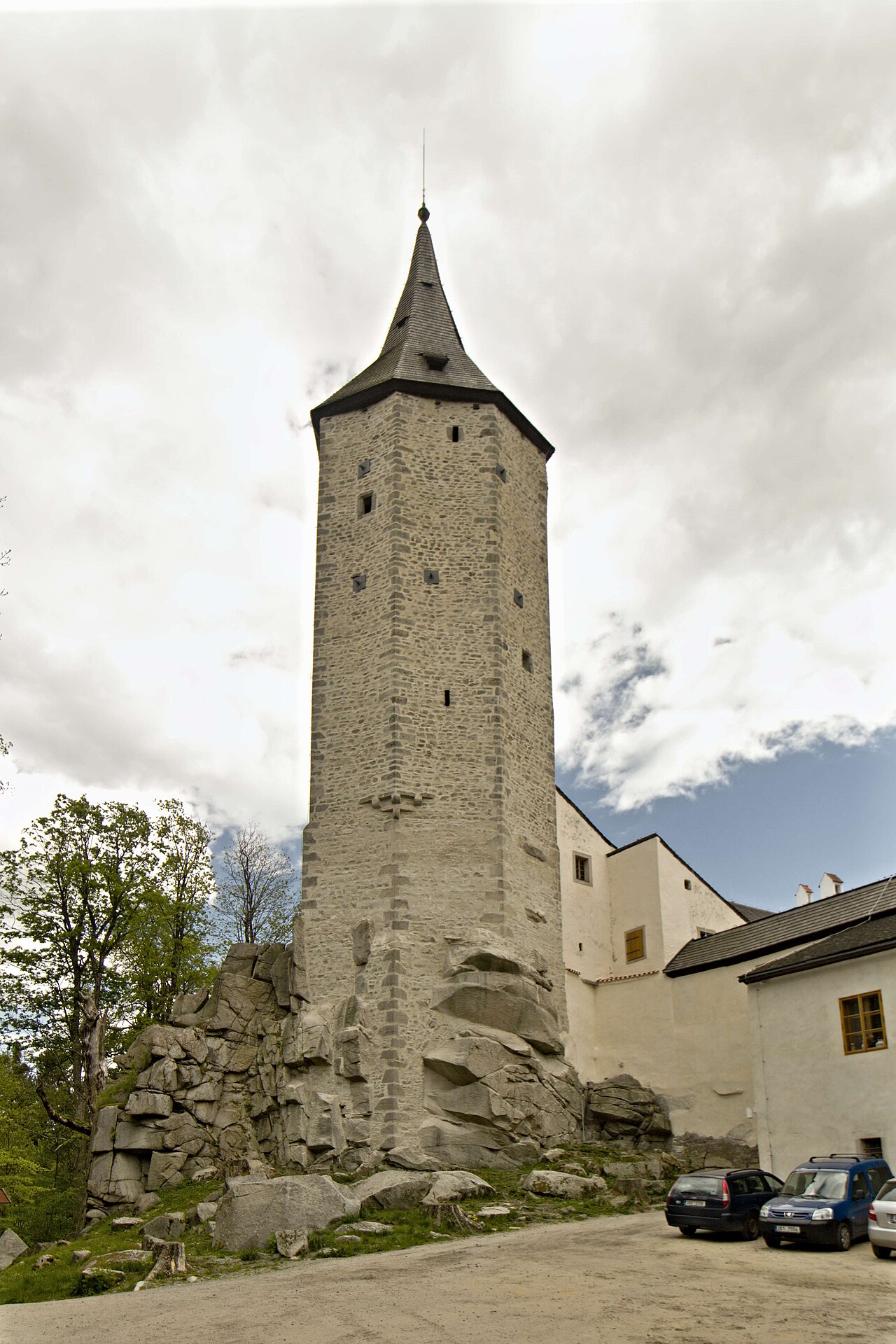
Brtnice Castle
Brtnice Castle is a significant historic fortress located in the municipality of Brtnice, Czechia. Perched on a prominent promontory overlooking the left bank of the Brtnice River, near the town center, this hill castle has a rich architectural and historical legacy spanning from the late Middle Ages through the Renaissance and Baroque periods. Its origins trace back to the 14th century or earlier, with archaeological evidence indicating the presence of medieval walls predating the documented fortress construction before 1436.
Medieval origins and early fortifications
The castle was initially established by the noble Czech family of Valdštejn as a defensive stronghold shortly after the destruction of nearby Rokštejn Castle during the Hussite Wars. The original fortress was characterized by a curtain wall and a semicircular tower on its northeastern side but notably lacked towers at its inception. By the late 15th century, the castle expanded to include a southern outer bailey featuring a large rectangular tower, which was later adapted for domestic purposes during the Renaissance.
Renaissance transformation and architectural evolution
Significant remodeling in the late 16th century gave Brtnice Castle its distinctive three-courtyard layout, confirmed by dated stone inscriptions from 1593 or 1604. The Renaissance period brought notable enhancements, including the raising and remodeling of the eastern palace wing in the third courtyard and the addition of a two-story loggia on the northern wing. These features reflect the influence of Baldassare Maggi de Ronio, an architect renowned for his work in Moravia. The southern outer bailey's large rectangular tower, once capped with a tent roof and an onion-shaped lantern, was a dominant architectural feature until its destruction by fire in 1760.
Baroque modifications and later changes
Following the pivotal Battle of White Mountain in 1620, the castle changed ownership to the Italian Collalto family in 1622. The Collaltos introduced Renaissance and early Baroque improvements, guided by imperial architect Giovanni Battista Pieroni and builder Giovanni Petruzzi. Stucco decorations and architectural upgrades from this era enhanced the castle's aesthetic and functional qualities. After a major fire in 1760, reconstruction efforts gave the castle much of its present form, although many Baroque features were lost or altered.
19th-century renovations and neo-gothic influences
The 19th century saw further architectural interventions, including vaulting staircases, reconstructing bastions, and adding covered vaulted corridors. In 1842, builder Jan Rathauský introduced neo-Gothic facades to the western and southern wings of the second courtyard, elevating the western wing by adding an upper floor and extending it northward over a former moat. These renovations contributed to the castle's eclectic stylistic character, blending medieval, Renaissance, Baroque, and neo-Gothic elements.
Architectural features and interior highlights
The castle's elongated plan is organized around three sequential courtyards, each with distinctive defensive and residential structures. The first courtyard features a four-sided tower with battlements, the castle's most recognizable landmark. Defensive bastions and semicircular bastions reinforce the castle's fortifications. Inside, the eastern palace wing houses a richly decorated first-floor hall with elaborate stucco work and eleven large oil paintings by Karel František Tepper, depicting ceremonial entries of Habsburg rulers between 1630 and 1723. Some original stucco and painted decorations by Baldassare Maggi survive, alongside furnishings such as a marble-inlaid billiard table from the First Republic period.
Historical significance and preservation challenges
Brtnice Castle served as the administrative center for the Collalto family's extensive estates during the 18th and 19th centuries, overseeing numerous manors and forestry operations. After World War II, the castle was confiscated by the state under a Czechoslovak presidential decree, leading to a period of neglect and deterioration. Since political changes after 1989, ownership disputes and partial public access have marked the castle's recent history. Restoration efforts by Opus Moraviae and the Zámek Brtnice association have focused on archaeological research and structural repairs, though the castle remains in a fragile condition due to water damage, unauthorized renovations, and the partial loss of medieval walls.
Archaeological discoveries and ongoing conservation
Recent archaeological investigations in 2022 uncovered ancient walls in the third courtyard, shedding light on the castle's medieval origins. Conservation work continues to address structural vulnerabilities, particularly water retention in the cellar areas and the preservation of Gothic elements. These efforts aim to safeguard Brtnice Castle's architectural heritage and promote its cultural significance as a landmark of Czech history.
Frequently asked questions (FAQ)
- How do I get to Brtnice Castle?
- Brtnice Castle is located in the town of Brtnice in the Vysočina Region of Czechia. It is accessible by car and local public transport, with the castle situated near the town center on a prominent hill above the Brtnice River.
- What is the historical significance of Brtnice Castle?
- Brtnice Castle has a rich history dating back to the late Middle Ages, originally built by the Valdštejn family and later owned by the Collalto family. It reflects architectural styles from Gothic to Renaissance and Baroque and served as an administrative center for local estates.
- Can I visit the interior of Brtnice Castle?
- Partial public access to Brtnice Castle has been available since 2011. Visitors can explore some of the courtyards and interior halls, including the eastern palace wing with its stucco decorations and historic paintings.
- When was Brtnice Castle built?
- The castle's origins date to the late Middle Ages, with some walls possibly from the 14th century. The main fortress was constructed before 1436, with significant Renaissance remodeling in the late 16th century.
- What architectural styles are represented at Brtnice Castle?
- Brtnice Castle showcases a mixture of architectural styles, including Gothic elements from its medieval origins, Renaissance modifications, Baroque improvements, and 19th-century neo-Gothic renovations.
- Is Brtnice Castle suitable for visitors with limited mobility?
- Due to its historic structure and uneven terrain, some areas of Brtnice Castle may be challenging for visitors with limited mobility. It is advisable to check accessibility details before visiting.
- What are the opening hours and ticket prices for Brtnice Castle?
- Opening hours and ticket prices vary seasonally and by event. It is recommended to check the official website or contact local tourist information for the most current visitor information.
Information
Website
Visit websiteSources & official resources
Verify the information above using these authoritative references.
Loading map...
Visitor reviews
No reviews yet. Been here? Write the first review and help other travelers!
Write the first reviewVisited this castle? Share your experience
Your review helps other travelers and adds first-hand knowledge to our encyclopedia.