Taymouth Castle
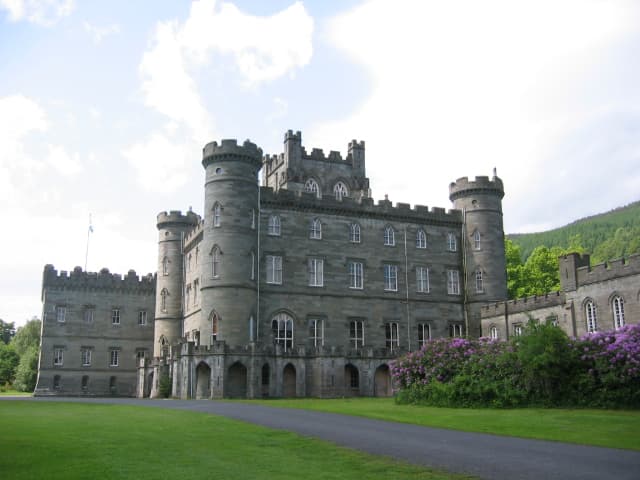
Taymouth Castle stands prominently on the south bank of the River Tay, approximately one mile from Loch Tay, nestled in the heart of the Grampian Mountains in Scotland. This grand estate occupies a commanding position surrounded on three sides by natural landmarks: mountain ranges, the river, and the loch, creating a dramatic and scenic setting. The castle itself is located to the north-east of the village of Kenmore in Perth and Kinross, within an estate encompassing some 450 acres (180 hectares) of parkland and woodland.
The current Taymouth Castle was constructed in the early 19th century on the site of the much older Balloch Castle, originally built in 1552 as the seat of the powerful Campbell clan. The old Balloch Castle was demolished by the Campbells of Breadalbane to make way for a new, larger structure that would reflect their status and wealth. The stone for the new castle was quarried locally at Bolfracks, giving the building its distinctive blue-grey hue.
Architectural style and design
Taymouth Castle is an exemplar of the neo-Gothic architectural style, popular in the early 19th century among the British aristocracy for its romantic evocation of medieval forms. The castle was built on a lavish scale, with an emphasis on grandeur and intricate detail. Its design incorporates many hallmark features of the neo-Gothic movement, including pointed arches, battlements, turrets, and ornate stone carvings.
The interior of the castle is particularly notable for its extravagant decoration. The public rooms showcase the finest craftsmanship of the 19th century, featuring elaborate carvings, intricate plasterwork, and detailed murals. Panels of medieval stained glass and Renaissance woodwork were integrated into the interiors, adding layers of historic artistry and richness to the décor. Much of this original decoration has survived, providing a rare glimpse into the opulence of aristocratic life during this period.
Notable artisans and features
The magnificent central staircase, which connects all four storeys of the castle's central tower, was designed by Francis Bernasconi, widely regarded as the greatest plasterwork designer of his era. Bernasconi's work is renowned for its finesse and artistic complexity, and the staircase stands as a testament to his skill. The ceilings of many rooms were painted by Cornelius Dixon, whose murals add further artistic value to the interiors.
Historical significance and heritage status
Taymouth Castle holds a significant place in Scottish heritage. It is a Category A listed building, recognizing its national architectural and historic importance. The surrounding grounds are included in the Inventory of Gardens and Designed Landscapes, the official national listing of significant gardens in Scotland. Historic Environment Scotland has graded the castle as 'outstanding' in several categories, including art, history, architecture, and scenic value.
The estate is also noted for its horticultural significance. It is believed that some of the first larches brought to Scotland from the Tyrol region were planted here, and the remnants of the castle's historic pinetum and large trees contribute to its botanical importance.
Condition and recent developments
Despite its grandeur, Taymouth Castle has faced challenges in recent decades. The castle has been empty since around 1982 due to its deteriorating condition. Twelve buildings or structures on the estate are recorded on the Buildings at Risk Register for Scotland, highlighting the urgent need for conservation.
In 2019, the estate was acquired by the Discovery Land Company, an American firm with plans to restore and redevelop the property. Their vision transformed the castle into a luxury private members’ clubhouse, with the main building divided into nine suites for shared ownership. This redevelopment included restoration of the historic fabric alongside modern amenities, ensuring the castle's survival and continued use.
The restoration project, led by developer Michael Meldman, was completed in November 2024. During the renovation, the castle and its golf course were closed to the public. The adaptive reuse of the castle as a private club aims to preserve its architectural integrity while providing a new function suited to contemporary luxury lifestyles.
Location and landscape setting
The castle's setting is one of its defining features. Positioned on a hill overlooking the River Tay and close to Loch Tay, the estate benefits from spectacular views and a varied landscape. The surrounding parklands and woodlands create a natural buffer, enhancing the sense of seclusion and grandeur. The estate is bordered by mountain ranges on two sides and the confluence of the rivers Lyon and Tay on the fourth, making it a unique geographical site.
This dramatic landscape has influenced the castle's design and its historical role as a seat of power and prestige for the Campbells of Breadalbane. The estate's size and natural resources also supported extensive gardens and hunting grounds, typical of aristocratic estates of the period.
Frequently asked questions (FAQ)
- What are the visiting hours for Taymouth Castle?
- Taymouth Castle is currently a private members' club and is not open for general public tours. Visitors should check for any special events or public access opportunities announced by the owners.
- When was Taymouth Castle originally built?
- The current Taymouth Castle was constructed in 1806 on the site of the older Balloch Castle, which dated back to 1552.
- What architectural style is Taymouth Castle built in?
- Taymouth Castle is built in the neo-Gothic style, featuring characteristic elements like turrets, battlements, and ornate stonework.
- Is Taymouth Castle accessible to the public?
- As of now, Taymouth Castle operates as a private members' club and is not generally accessible to the public, although the estate grounds may have limited access during special events.
- Why is Taymouth Castle historically significant?
- Taymouth Castle is significant for its architectural grandeur, its role as the seat of the Campbell clan, and its well-preserved 19th-century interiors showcasing fine craftsmanship.
Photo gallery

Photo by Dudesleeper at English Wikipedia•Public domain
Information
Current owner
Discovery Land Company
Loading map...
Visitor reviews
No reviews yet. Been here? Write the first review and help other travelers!
Write the first reviewVisited this castle? Share your experience
Your review helps other travelers and adds first-hand knowledge to our encyclopedia.