Garth Castle
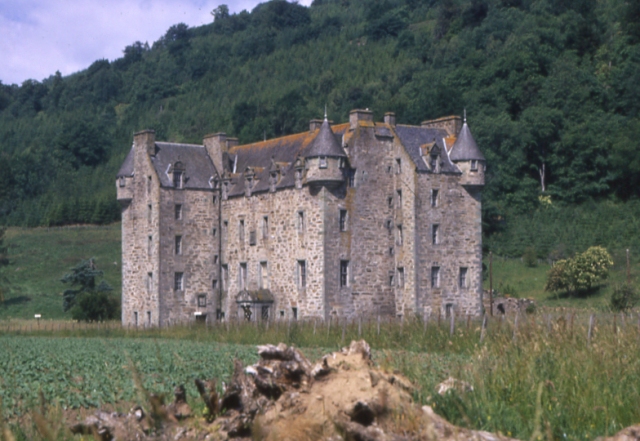
Garth Castle is a notable medieval hill castle located near Aberfeldy in Scotland, United Kingdom. Constructed in 1384 by Alexander Stewart, 1st Earl of Buchan, a grandson of the famed Scottish King Robert the Bruce, the castle exemplifies late 14th-century Scottish fortified architecture. Its strategic position atop a grassy knoll flanked by two deep ravines provided natural defenses enhanced by the surrounding waterways, tributaries to the Keltnie burn and ultimately the River Lyon.
Historical background and stewart dynasty association
The castle's earliest and most significant occupant was Alexander Stewart, often known as the Wolf of Badenoch. He held the stronghold until his death in 1396. The castle remained under the stewardship of the Stewart family for over a century, serving as a noble residence for successive lairds of Forthergill. Notable figures included Neil Stewart, the second laird who died at Garth Castle in 1499, his son Neil Stewart II, called "The Red" Neil, and John Stewart, the fourth laird. During this period, the castle functioned primarily as a fortified home rather than a military fortress.
Military significance and decline
In the mid-17th century, Garth Castle played a role in the Royalist uprising known as Glencairn’s rising. In 1654, Colonel Henry Wogan and a small force of thirty men used the castle as a base against Cromwell's forces. The castle endured a siege involving cannon fire, which severely damaged the drawbridge and set the roof ablaze. After its capture, the castle was abandoned and left in a ruinous state for over three centuries, reflecting the turbulent political and military upheavals of the time.
Architectural features and construction details
Garth Castle is a classic example of a donjon-style tower house, a fortified keep typical in medieval Scotland. Its square plan rises to approximately 60 feet (18 meters) in height, with walls constructed from a combination of large, unshaped boulders and finely quarried stone blocks. The thickness of the walls varies between 6.5 feet (2.0 meters) and 12 feet (3.7 meters), providing formidable defense against siege weaponry.
The castle's location on a promontory surrounded by steep ravines and fast-flowing streams added to its natural defense, making it difficult for attackers to approach. The original roof, destroyed during the 1654 siege, has not been fully reconstructed, but the main walls have been stabilized and partially restored to preserve the castle's imposing silhouette.
Defensive elements
The castle’s defensive design includes thick masonry walls and a drawbridge, which was a critical feature for controlling access across the natural moat formed by the ravines. The elevation provided extensive views over the surrounding landscape, allowing early detection of approaching enemies. The combination of natural and man-made defenses made Garth Castle a stronghold suitable for both residence and military use in its era.
Restoration and modern history
After centuries of neglect, Garth Castle underwent significant stabilization and repair beginning in the late 19th century. In 1880, Scottish shipping magnate Donald Currie acquired the estate and initiated conservation efforts focused on the castle's walls, respecting the original medieval construction techniques.
In the 1960s, the castle was purchased by Mr. Fry of the Fry’s chocolate company, who intended to use it as a holiday home. Restoration work was initially undertaken by local architects but later completed by the English architect Leonard Manasseh, who ensured the repairs maintained the castle's historic character. These efforts have preserved the castle as a significant architectural and historical landmark.
Geographical setting and natural defenses
The castle’s site is dominated by a small grassy knoll nearly encircled by two deep ravines. These ravines contain fast-flowing streams that converge just south of the castle, feeding into the Keltnie burn and eventually the River Lyon. This natural topography provided a formidable defensive advantage, making direct assault challenging and enhancing the castle's security.
Relationship to local waterways
The waterways surrounding Garth Castle not only served defensive purposes but also contributed to the local ecosystem and the castle's self-sufficiency. Access to fresh water and natural barriers were critical considerations in the castle’s siting, reflecting medieval military architectural principles.
Frequently asked questions (FAQ)
- How do I get to Garth Castle?
- Garth Castle is located in the scenic countryside of the United Kingdom. You can reach it by car via the M4 motorway, or by public transport, with the nearest train station being a short taxi ride away. Be sure to check local bus routes for convenient connections as well.
- What is the historical significance of Garth Castle?
- Garth Castle dates back to the 12th century and has played a vital role in the region's history. Originally built as a defensive structure, it has witnessed numerous historical events and changes in ownership. Today, it stands as a testament to medieval architecture and heritage.
- When was Garth Castle last renovated?
- Garth Castle underwent significant renovations in the late 20th century, with ongoing conservation efforts to preserve its historical integrity. These renovations have ensured that visitors can enjoy the castle's rich history while exploring its beautifully restored features. Regular maintenance is conducted to keep the castle in top condition.
- Can I take guided tours of Garth Castle?
- Yes, guided tours of Garth Castle are available for visitors, providing an in-depth look at its history and architecture. Tours are typically led by knowledgeable guides who share fascinating stories and insights. It's recommended to book in advance, especially during peak tourist seasons.
- Why is Garth Castle considered an architectural gem?
- Garth Castle showcases a blend of medieval and Gothic architectural styles, featuring impressive stonework and intricate detailing. Its unique design elements, such as soaring towers and fortified walls, reflect the craftsmanship of the era. The castle's aesthetic appeal makes it a popular subject for photographers and history enthusiasts alike.
- Is it possible to host events at Garth Castle?
- Yes, Garth Castle offers facilities for hosting various events, including weddings and corporate gatherings. Its stunning backdrop and historical ambiance create a memorable setting for any occasion. Interested parties should contact the castle management for more information on availability and services.
- What are the opening hours for Garth Castle?
- Garth Castle is typically open to visitors from 10 AM to 5 PM during the tourist season, which runs from April to October. It is advisable to check the official website for any seasonal variations or special closures. Early arrival is recommended to fully enjoy the site.
- What are the ticket prices to enter Garth Castle?
- Ticket prices for Garth Castle vary depending on age and group size, with discounts available for children and seniors. As of the latest information, adult tickets are priced at £10, while children under 12 can enter for free. Special family packages are also offered to encourage visits.
- What nearby attractions can I visit after Garth Castle?
- After exploring Garth Castle, visitors can enjoy nearby attractions such as the beautiful Garth Woods and the historic town of Brecon. Additionally, the Brecon Beacons National Park offers stunning landscapes and outdoor activities for nature lovers. Make a day of it by incorporating these sites into your itinerary.
Information
Loading map...
Visitor reviews
No reviews yet. Been here? Write the first review and help other travelers!
Write the first reviewVisited this castle? Share your experience
Your review helps other travelers and adds first-hand knowledge to our encyclopedia.