Menzies Castle
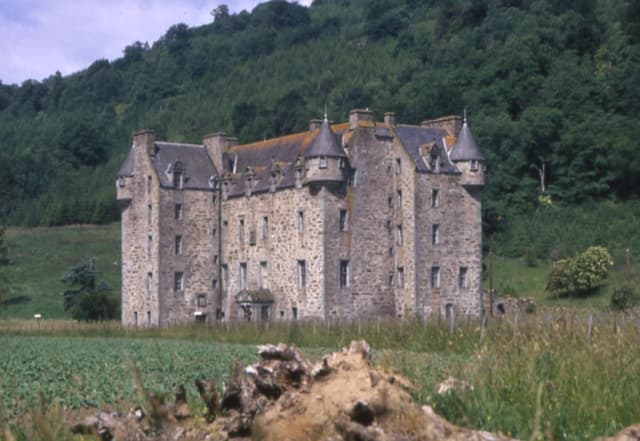
Castle Menzies stands as a prominent example of a 16th-century Scottish Z-plan hill castle, located near the village of Weem, close to Aberfeldy in Scotland. As the ancestral seat of the Clan Menzies and the Menzies Baronets for over five centuries, the castle embodies a rich heritage intertwined with the turbulent history of the Scottish Highlands. Its strategic position within a valley surrounded by hills, approximately 89 meters above sea level, provided both defensive advantages and scenic views of the surrounding landscape.
Constructed shortly after the destruction of the nearby Weem Castle around 1502, Castle Menzies was built during the Renaissance period in the 16th century. The castle's architecture reflects a transitional phase between the rugged medieval fortresses and the more refined, lightly defensible châteaux that emerged later. Its design follows the classic Z-plan layout, featuring a main rectangular block with two diagonally opposed towers, combining strong defensive capabilities with residential comfort.
Architectural features and construction details
Structural design and materials
The castle's walls are primarily constructed from random rubble stone, originally finished with harling—a traditional roughcast protective coating common in Scottish castles to safeguard against harsh weather. Key architectural elements such as quoins (cornerstones), turrets, and the surrounds of doors and windows are crafted from finely carved blue freestone, a durable and weather-resistant material sourced locally. This stone also appears in nearby clan monuments and the Old Kirk of Weem, further cementing the connection between the castle and its estate.
19th-century additions and renovations
In 1840, a significant expansion was undertaken with the addition of a new west wing, designed by the renowned architect William Burn. This extension included a large Victorian ballroom, which remains one of the castle's most notable features. The stones used for this wing were quarried from the south side of Loch Tay, linking the castle's fabric to the surrounding geography. While an 18th-century wing was later demolished due to severe decay during restoration efforts after 1957, the Victorian ballroom was preserved and refurbished as The Dewar Room, serving as a central space for events and gatherings.
Historical significance and notable events
Clan heritage and early history
Castle Menzies has been the ancestral home of the chiefs of Clan Menzies for more than 500 years, symbolizing the clan's enduring legacy in Scottish history. The castle's construction followed the destruction of the earlier Weem Castle, emphasizing the clan's resilience and determination to maintain their stronghold in the region.
In 1571, a marriage stone was installed above the original entrance by James Menzies to commemorate his marriage to Barbara Stewart, daughter of the 3rd Earl of Atholl. This union linked the Menzies family to prominent Scottish nobility, highlighting the castle's role as a seat of power and influence.
Notable incidents and jacobite connections
The castle witnessed dramatic events such as the 1598 rescue of Donald Menzies by John Dow MacWilliam (MacGregor), who broke into the stronghold to free the prisoner. This incident reflected the complex clan rivalries and alliances of the time, especially as those involved later became household servants to John Murray of Tullibardine.
During the Jacobite rising of 1745, Bonnie Prince Charlie stayed at Castle Menzies for two nights in 1746 while en route to the Battle of Culloden. This brief episode connected the castle to one of the most significant conflicts in Scottish history.
19th-century residents and events
Between 1855 and 1858, the castle was home to Duleep Singh, the last Maharajah of the Sikh Empire, following his exile from Punjab. Under the guardianship of Sir John Spencer Login and Lady Login, who leased the castle for him, Singh's residence added a unique chapter to the castle's history, intertwining Scottish and Indian narratives.
A fire in April 1878 caused damage to the roof, but the blaze was contained before spreading extensively. The incident had a profound impact on the family, coinciding with the death of Lady Menzies shortly thereafter, possibly due to the stress from the event.
20th-century decline and restoration
After the death of Sir Neil Menzies, 8th Baronet, in 1910 without heirs, the castle's contents, including valuable historical documents like a letter from Mary Queen of Scots and papers signed by Charles I, were auctioned in 1913. The estate was sold in 1918 and changed hands again in 1930, leading to a period of decline.
Restoration efforts led by the Menzies Clan Society began after 1957, focusing on preserving the castle's structural integrity and historical significance. This included removing a dangerously decayed 18th-century wing while maintaining the Victorian ballroom. The castle was granted Category A listed status in 1971, recognizing its national importance, and its grounds were added to Scotland's Inventory of Gardens and Designed Landscapes in 1987.
Subsequent repairs, supported by grants, have revitalized the castle, culminating in the establishment of the Menzies Charitable Trust in 1994 to oversee the castle, its gardens, and the nearby St Cuthbert’s Old Kirk of Weem, which houses family monuments and funeral hatchments.
Castle grounds and notable features
The chieftains stone
Among the castle grounds lies the historic Chieftains Stone, also known as the Menzies Stone. Weighing approximately 115 kilograms, this rounded and smoothly finished lifting stone has long been a traditional test of strength and endurance, reflecting the clan’s warrior heritage.
Landscape and setting
Castle Menzies is situated in a picturesque valley surrounded by hills, near the town of Pitlochry, approximately 13.4 kilometers to the northeast. The castle's elevated position and natural surroundings enhance its defensive qualities as well as its aesthetic appeal, making it a notable landmark within the Scottish Highlands.
Architectural and cultural legacy
Castle Menzies exemplifies the evolution of Scottish castle architecture from fortified medieval strongholds to more comfortable and stylistically refined residences. Its combination of rugged random rubble walls with finely carved blue freestone details highlights the craftsmanship and material culture of the Renaissance period in Scotland.
The castle's preservation and restoration efforts underscore its importance as a cultural and historical monument. The integration of Victorian elements, such as the ballroom designed by William Burn, demonstrates the adaptability of the structure to changing tastes and functions over centuries.
Today, Castle Menzies stands not only as a testament to the Clan Menzies legacy but also as an enduring symbol of Scottish heritage, architectural innovation, and the complex history of the Highlands.
Frequently asked questions (FAQ)
- How do I get to Menzies Castle?
- Menzies Castle is located near Aberfeldy in Scotland, easily accessible by car or public transport. The nearest train station is in Pitlochry, from where you can take a bus or taxi to reach the castle.
- What is the historical significance of Menzies Castle?
- Menzies Castle dates back to the 16th century and has been the ancestral home of the Menzies family for over 800 years. It played a significant role in Scottish history, particularly during the medieval and Jacobite eras.
- When was Menzies Castle built?
- Menzies Castle was constructed in the late 16th century, with its architecture reflecting the Renaissance style. Over the years, it has undergone various renovations to preserve its historical charm.
- Can I visit Menzies Castle?
- Yes, Menzies Castle is open to the public for tours, allowing visitors to explore its rich history and stunning architecture. It is advisable to check the official website for current visiting hours and any special events before planning your visit.
- Why is Menzies Castle a popular destination?
- Menzies Castle attracts visitors for its impressive architecture, beautiful gardens, and rich historical narrative. Its connection to Scottish heritage and picturesque location make it a favorite among history enthusiasts and nature lovers alike.
- Is it possible to host events at Menzies Castle?
- Yes, Menzies Castle offers facilities for hosting various events, including weddings and corporate gatherings. The unique setting and historical ambiance make it a memorable choice for special occasions.
- What are the opening hours of Menzies Castle?
- Menzies Castle typically opens from April to October, with specific hours varying by season. Visitors should confirm the exact opening times on the official website or by contacting the castle directly.
- Are there nearby attractions to visit?
- Yes, the area surrounding Menzies Castle is rich in attractions, including the scenic Loch Tay and the historic town of Aberfeldy. Outdoor activities such as hiking and fishing are also popular in the region.
- What are the ticket prices for visiting Menzies Castle?
- Ticket prices for Menzies Castle vary depending on the type of tour and age group. Discounts may be available for children, students, and seniors, so it’s best to check the official website for the latest pricing information.
Photo gallery

Information
Website
Visit websiteSources & official resources
Verify the information above using these authoritative references.
Loading map...
Visitor reviews
No reviews yet. Been here? Write the first review and help other travelers!
Write the first reviewVisited this castle? Share your experience
Your review helps other travelers and adds first-hand knowledge to our encyclopedia.