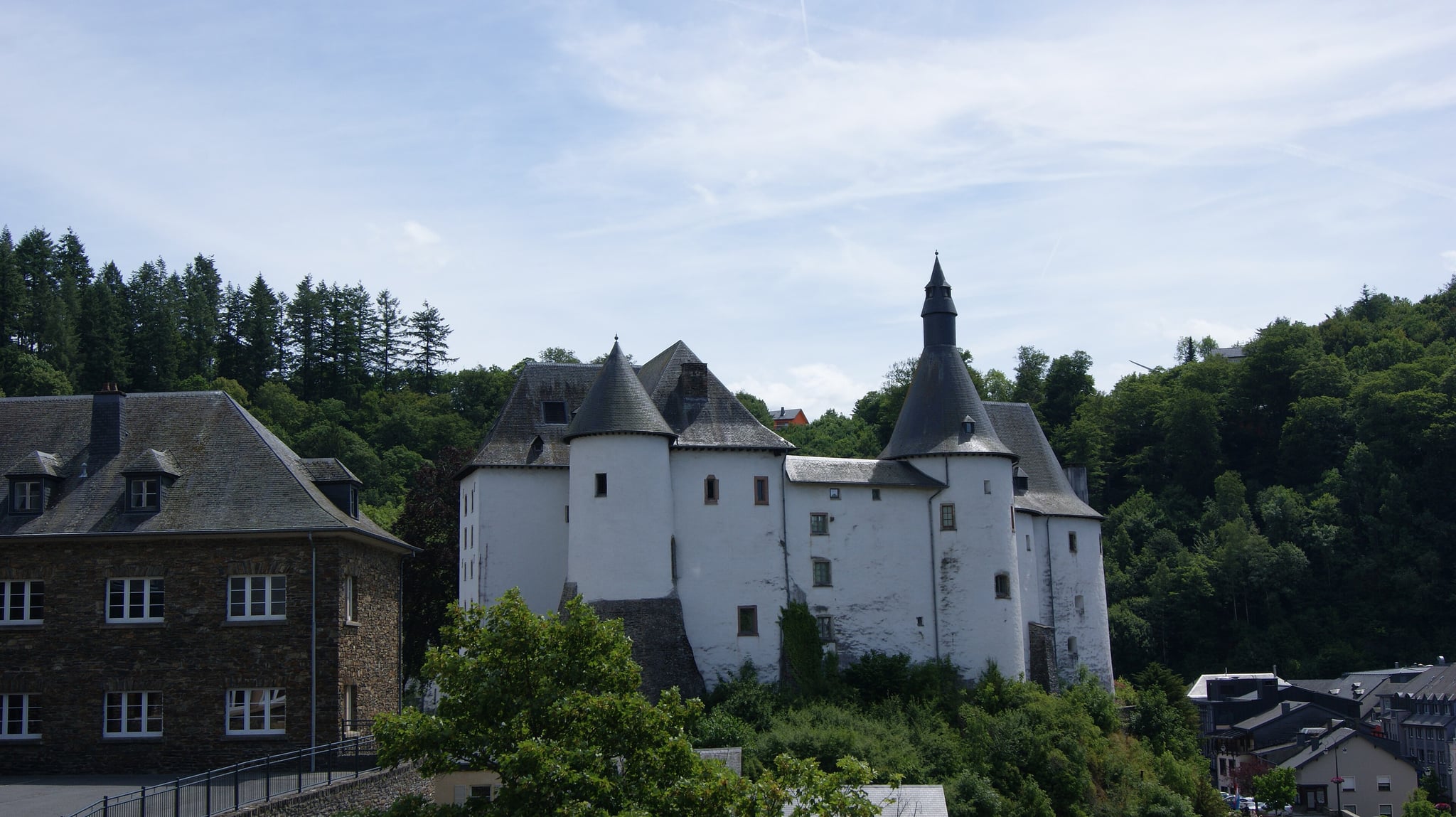
Tavigny Castle

Tavigny Castle in Houffalize, Belgium
Houffalize, Belgium
High Medieval (11th–13th c.)
Partially Restored

Tavigny Castle, located in Houffalize, Belgium, is a historic fortress dating back to the 11th century, placing it firmly in the high medieval period. Originally constructed as a refuge tower, this castle evolved over centuries into a seignorial residence, reflecting shifts in architectural styles and defensive needs. Its enduring presence offers valuable insights into medieval fortification and noble residence development in the region.

Early construction and defensive features

The core of Tavigny Castle is believed to have been a refuge tower, a common form of fortification during the high medieval period. This tower formed the central part of the castle and was characterized by walls approximately 10 meters long and 2 meters thick. These robust walls were pierced with numerous arrow slits, enabling defenders to repel attackers while remaining protected. The design reflects typical medieval defensive architecture aimed at withstanding sieges and raids.

Architectural elements of the refuge tower

The refuge tower's thick walls and narrow apertures were essential for defense, allowing archers to fire arrows with minimal exposure. The tower's strategic construction prioritized security, serving as a last line of defense for inhabitants during conflicts. Its rectangular or square footprint was typical of refuge towers, designed to be both imposing and functional.

Ownership and historical context

The lordship of Tavigny initially belonged to a family bearing the same name, indicating a localized noble lineage. By 1360, ownership had transferred to the Ouren family, a prominent noble house from the duchy of Luxembourg. This change in ownership situates the castle within the broader political and social dynamics of medieval Luxembourg and the Ardennes region, reflecting the shifting allegiances and territorial controls of the time.

Transformation into a seignorial residence

Over time, Tavigny Castle underwent significant architectural modifications that transformed it from a purely defensive structure into a more comfortable noble residence. The central tower became enclosed within curtain walls featuring round towers at the corners, enhancing both defense and residential functionality. This enclosure created a courtyard and added layers to the castle's fortifications.

Evolution of windows and living spaces

One of the most notable changes was the replacement of narrow arrow slits with large picture windows, signaling a shift from martial defense to residential comfort and aesthetic appeal. These windows allowed more light into the interior chambers, improving habitability and reflecting Renaissance and early modern influences. The castle's appearance evolved into a Louis XIII style ensemble, characterized by symmetry, classical proportions, and elegant window designs.

Architectural style and significance

The castle's architectural evolution illustrates a transition from high medieval military architecture to a more refined early modern noble residence. The integration of round towers at the corners of the curtain walls enhanced defense while also contributing to the castle's aesthetic. The Louis XIII style elements, including the large windows and refined masonry, reflect broader European trends in castle modernization during the 17th century.

Current condition and cultural importance

Today, Tavigny Castle remains a significant monument in the Ardennes region, embodying centuries of architectural and historical development. Its preservation allows visitors to explore the layered history of medieval fortifications and noble residences. The castle's thick walls, towers, and windows offer tangible connections to the past, illustrating the adaptation of medieval castles to changing times and tastes.

Visiting Tavigny Castle

Visitors to Tavigny Castle can appreciate its robust medieval features alongside later architectural enhancements. The castle's location in Houffalize provides access to the scenic Ardennes landscape, enriching the experience of exploring this historic site. While specific visitor information such as opening hours and ticket prices may vary, the castle remains an important cultural attraction in the region.

Frequently asked questions about Tavigny Castle

  • When was Tavigny Castle built? Tavigny Castle dates back to the 11th century, making it a high medieval structure originally designed as a refuge tower.
  • What architectural styles are present at Tavigny Castle? The castle features high medieval defensive architecture combined with later modifications in the Louis XIII style, including large picture windows and round towers.
  • Who originally owned Tavigny Castle? The castle was initially owned by a family named Tavigny before passing to the Ouren family from the duchy of Luxembourg in 1360.
  • Can visitors tour Tavigny Castle? While specific details vary, Tavigny Castle is accessible to visitors interested in medieval architecture and history, often included in regional heritage tours.
  • What makes Tavigny Castle architecturally significant? Its combination of thick defensive walls, arrow slits, and later residential adaptations exemplifies the evolution of castles from fortresses to noble homes.
  • Where is Tavigny Castle located? The castle is situated in Houffalize, in the Ardennes region of Belgium.
  • Is Tavigny Castle well preserved? The castle retains many original features and modifications, reflecting a condition between well preserved and partially restored.

Frequently asked questions (FAQ)

How do I get to Tavigny Castle?
Tavigny Castle is located in Houffalize, Belgium, and can be accessed by car or public transportation. If driving, follow local signs directing you to the castle, and ample parking is usually available nearby.
What is the historical significance of Tavigny Castle?
Tavigny Castle dates back to the 12th century and is a remarkable example of medieval architecture. It has played a crucial role in the region's history, serving as a defensive stronghold during various conflicts.
When was Tavigny Castle built?
The construction of Tavigny Castle began in the early 12th century, making it one of the oldest castles in the area. Over the centuries, it has undergone several renovations and restorations, preserving its historical integrity.
Can I take a guided tour of Tavigny Castle?
Yes, guided tours are available at Tavigny Castle, providing visitors with in-depth knowledge of its history and architecture. It is recommended to book your tour in advance to ensure availability.
Is it possible to hold events at Tavigny Castle?
Tavigny Castle is a picturesque venue that can accommodate various events, including weddings and corporate gatherings. For more information on bookings and services, please contact the castle management directly.
What are the opening hours for Tavigny Castle?
Tavigny Castle is generally open to visitors from 10 AM to 6 PM during the peak season, with varying hours in the off-season. Always check the official website for the most current opening times before your visit.
What are the ticket prices for visiting Tavigny Castle?
Ticket prices for Tavigny Castle vary based on age and group size, with discounts available for children and seniors. It's advisable to purchase tickets online for convenience and to avoid queues upon arrival.
What is the best time to visit Tavigny Castle?
The best time to visit Tavigny Castle is during the spring and summer months when the weather is pleasant, and the surrounding gardens are in bloom. Additionally, special events and festivals often take place during this time, enhancing the visitor experience.
Are there any nearby attractions to Tavigny Castle?
Yes, Tavigny Castle is located near several attractions, including the picturesque town of Houffalize and beautiful hiking trails in the Ardennes. Visitors can easily explore the area for a more enriching experience.

Information

Hill Castle

Loading map...

Visitor reviews

No reviews yet. Been here? Write the first review and help other travelers!

Write the first review

Visited this castle? Share your experience

Your review helps other travelers and adds first-hand knowledge to our encyclopedia.

Write a review

(5/5)

0/2000 characters

Your review will be visible after admin approval

Nearby castles

6.1 km

Steinbach Castle

Gouvy, Belgium

Steinbach Castle in Gouvy, Belgium, is a historic fortress with origins tracing back to the 11th century. Its foundations and basement are constructed from durable schist stone, a material characteristic of the region's medieval architecture. The castle's façade prominently displays a carved stone escutcheon featuring three scallops and three sickles, symbolizing the heraldic ties to the Steinbach and Limerlé families as well as the Grumelscheid lineage. The medieval origins and family legacy The Steinbach family rose to prominence in the region when they acquired lordship over Rouvroy and Limerlé in 1451. This noble lineage maintained control over these territories until the late 18th century, playing a significant role in local governance and regional affairs. The castle itself, while rooted in medieval construction, underwent significant transformations over the centuries, reflecting changing architectural styles and historical circumstances. Architectural evolution and Austrian influence Following a devastating fire in 1750 that reduced much of the original structure to ruins, Steinbach Castle was rebuilt under the guidance of Albert Starck, an Austrian architect active during the Austrian reign over this part of Europe. Starck's influence is evident in the castle's Austrian-style architecture, which incorporates robust 1.5-meter thick schist stone walls and elegant Louis XV interior design. The main entrance, made from Recht stone, is detailed with the escutcheon of the Beurthé family, adding to the castle’s heraldic richness. The castle complex includes wings added in the early 19th century that served as farmhouses, carefully designed to preserve the castle's privacy by providing separate access. These farm buildings still contain a functional 16th-century wood oven, which remains in use today, illustrating the blend of historical preservation and ongoing utility. Historical significance during the 20th century Steinbach Castle played a notable role during the Second World War, particularly in the Battle of the Bulge. It served as a temporary headquarters for Leon Degrelle and his government, as well as a field hospital for both German and US forces. This dual use highlights the castle's strategic importance and its place in the complex military history of the Ardennes region. Preservation and current status The castle remained in the hands of the Steinbach family descendants until 2014, when it was sold to new owners who use it as a second residence. All buildings on the site are protected as national monuments, ensuring the preservation of their historical and architectural value for future generations. Notably, the castle’s tower is adorned with elephant-shaped flags bearing family escutcheons and the building date, a unique decorative feature symbolizing the castle’s heritage. Architectural features and materials The use of schist stone throughout the castle, from its thick defensive walls to the interior floors, is a defining characteristic that provides both durability and a distinctive aesthetic. The combination of medieval foundations with 18th-century Austrian architectural elements creates a unique blend that distinguishes Steinbach Castle from other regional fortresses. The castle’s layout, including the separate farm wings, reflects practical considerations of privacy and functionality typical of aristocratic estates in the period. The escutcheons and heraldry The stone escutcheons carved into the castle’s façade are rich in symbolism. The three scallops represent the Steinbach and Limerlé families, while the three sickles symbolize the Grumelscheid family, reflecting the intertwined noble lineages that shaped the castle’s history. These heraldic emblems serve as visual markers of the castle’s identity and its owners’ status. Interior design and layout The interior floors, crafted from schist stone, complement the castle’s robust exterior. The Louis XV style interiors introduce an element of refined elegance, contrasting with the fortress-like exterior walls. This style includes ornate decorative motifs typical of the mid-18th century, emphasizing comfort and aesthetic appeal alongside defensive functionality. Steinbach castle in the context of Belgian heritage As a protected national monument, Steinbach Castle is an important part of Belgium’s cultural heritage. Its layered history from the High Medieval period through the 18th century rebuild and its role in World War II provide valuable insights into the region’s social and political evolution. The castle’s preservation allows visitors and historians alike to explore the architectural and historical narratives embedded in its walls. Visiting and cultural significance While currently a private residence, the castle’s protected status underscores its potential for educational and cultural tourism. Its unique architectural features and historical associations make it a point of interest for scholars of medieval and early modern European architecture, as well as those interested in military history.

High Medieval (11th–13th c.)
Details
13.6 km

Rolley Castle

Rolley, Belgium

Rolley Castle, also known as Château de Rolley, is located in the hamlet of Rolley, north of Bastogne, in the province of Luxembourg, within Belgium's Wallonia region. This medieval fortress has a history that traces back to the 11th century, making it one of the older castles in the region, although its first recorded mention dates from the 13th century. Early origins and medieval ownership The castle was initially constructed likely in the 11th century as a fortified residence for the Lords of Boulland (also spelled Bollands), a noble family prominent in the area. The structure originally served defensive and residential purposes typical of high medieval castles, designed to assert control over local lands and protect against rival factions. Rolley Castle's first documented reference appears in the 13th century, confirming its existence and importance during the high medieval period. The castle remained in the hands of the Boulland family until 1578, after which it passed through various noble families, often by inheritance through the female line. This chain of ownership reflects the common medieval practice of property transfer through marriage alliances. Architectural evolution and 18th-century rebuilding By the early 18th century, Rolley Castle underwent significant rebuilding around 1733. This reconstruction likely introduced elements of the architectural styles prevalent at the time, possibly incorporating baroque influences, although the core medieval structure remained integral to the castle's form. The rebuilding would have modernized the castle's living quarters and defensive features to suit contemporary needs. In 1752, the castle passed to a family unrelated to the original Boulland lineage, marking a new chapter in its ownership history. The castle's architectural fabric from this period reflects the transition from a purely defensive stronghold to a more comfortable noble residence. 20th-century history and world war ii significance In the early 1900s, the Maus family acquired Rolley Castle, and they remain its owners to this day. During World War II, the castle played a remarkable role in the resistance and Allied efforts. The occupants of Rolley Castle sheltered British and American airmen, helping them evade capture and return safely across Allied lines. In 1944, Rolley Castle served as the headquarters of the American Army during the Battle of the Bulge. Several senior US Army officers, including General George S. Patton, convened at the castle in December 1944, underscoring its strategic importance during this critical phase of the war. Current use and visitor experience Today, Rolley Castle is preserved as a well-maintained historic site and has been adapted for modern use as holiday apartments. Visitors can experience the castle's unique blend of medieval and later architectural features while staying on the premises. This adaptive reuse allows guests to appreciate the castle's historical ambiance firsthand. The castle's location in the scenic Luxembourg province offers visitors access to the rich cultural heritage and natural beauty of the Wallonia region. Rolley Castle stands as a testament to centuries of European history, from medieval nobility to pivotal moments in 20th-century warfare.

High Medieval (11th–13th c.)
Details
14.9 km
Clervaux Castle — Luxembourg castle

Clervaux Castle

Clervaux, Luxembourg

Clervaux Castle, also known locally as Burg Clerf, is a prominent hill castle located on a rocky spur overlooking the town of Clervaux in northern Luxembourg. Founded in the 12th century by Gerard I of Sponheim, brother of the Count of Vianden, it stands as a testament to medieval fortification and noble residence architecture. The castle's strategic position atop a rocky outcrop at 365 meters above sea level, surrounded on three sides by the bend of the River Clerve, provided a formidable natural defense and control over the surrounding region. The earliest parts of the castle date back to its founding in the early 1100s, with the first written record appearing in 1126. Initially, the castle likely served as a Vogtei—a protective administrative center possibly linked to the nearby Abbey of Stavelot—reflecting its dual role in both secular and ecclesiastical governance during the High Medieval period. Over the centuries, the castle passed through several noble families, including the Meysenburgs, the Counts of Vianden, the Brandenburg family, and later the de Heu and von Eltz families, each leaving their mark on the castle’s structure and function. Architectural evolution and fortifications The castle's core consists of multiple wings arranged around an inner courtyard, with exterior walls up to 2.1 meters thick, showcasing the robust medieval defensive architecture. The oldest surviving structures include the Burgundian Tower and the Pigeon Tower on the west side, both predating 1400. These towers exemplify the castle’s original medieval military architecture. In the early 15th century, the Brandenbourg Tower was added on the south side, accompanied by a Gothic south wing with extensive cellars. This wing currently houses three of the castle’s museums, blending historical architecture with modern cultural functions. The large palace and rounded towers likely date from around 1400, built during the prosperous era of the Lords of Brandenburg who significantly enlarged and fortified the castle. Between 1595 and 1597, under the ownership of Gottfried von Eltz, the castle’s defenses were strengthened in response to the threats posed by the ongoing Eighty Years’ War. The fortifications were reinforced to protect against potential sieges and attacks during this turbulent European conflict. In the 17th century, the castle underwent significant transformations under the de Lannoy family, who held it for nearly 240 years. They added numerous residential and industrial buildings, including reception halls and the large Knights’ Hall decorated in the Spanish style of Flanders, constructed in 1634 by Claude of Lannoy. The outer bailey was expanded to create an economic courtyard with stables, barns, and a chapel relocated from the Pigeon Tower. Defensive additions from this period include a gatehouse and the semi-circular Hexenturm or Witch Tower. By the 18th century, new stables were built, and parts of the outer bailey were dismantled in the late 19th century, with stones repurposed to build a nearby palace. This reflected changing architectural tastes and the castle’s evolving role from fortress to residence. Historical significance and ownership transitions Clervaux Castle’s history is marked by its changing ownership and roles. After the founding Sponheim family, it passed to the Meysenburgs and then to a branch of the Counts of Vianden in the early 1400s. The Brandenburg family’s tenure in the 15th century saw major fortifications and expansions. Later, the castle was owned by the de Heu and von Eltz families, who further enhanced its defenses and residential comfort. In 1617, the castle came into the hands of the de Lannoy family through marriage, who transformed it into a more comfortable palace-like residence while maintaining its defensive character. The castle briefly became a battlefield during the Klöppelkrieg in 1798, a peasant uprising against French occupation, highlighting its strategic importance amid regional conflicts. By 1927, Clervaux Castle had entered private bourgeois ownership and was adapted to house a hotel and museum, marking a shift from noble residence to public cultural use. However, during the Battle of the Bulge in December 1944, German forces heavily shelled the castle, causing a fire that destroyed much of the structure and left it in ruins. Post-war restoration and modern use After World War II, the Luxembourg government purchased Clervaux Castle and undertook a comprehensive restoration project completed in 1994. This meticulous reconstruction preserved the castle’s historic layout and architectural features, restoring its medieval appearance while adapting it for contemporary use. Today, the castle serves multiple functions. It houses the commune's administrative offices, integrating municipal services within its historic walls. It also hosts several museums that attract visitors interested in history, art, and photography. Museum of Luxembourg castles The south wing of the castle contains a unique museum featuring detailed scale models of 22 major Luxembourg castles at a 1:100 scale. These models illustrate the rich fortress heritage of Luxembourg, providing educational insights into the region’s medieval and early modern defensive architecture. Battle of the Ardennes museum The old kitchen area in the Brandenbourg House has been converted into a museum dedicated to the Battle of the Ardennes, also known as the Battle of the Bulge. This museum displays artifacts such as documents, weapons, and uniforms, mainly from private collections, offering a poignant reminder of the castle’s destruction and the wider conflict’s impact on the region. The family of man photographic exhibition One of the castle’s most internationally renowned attractions is the permanent exhibition "The Family of Man", curated by Edward Steichen. This photographic exhibition, displayed on two upper floors, features original black-and-white prints mounted on wooden panels arranged to replicate the 1955 Museum of Modern Art installation. Since 1994, the exhibition has been a cultural highlight and was recognized by UNESCO’s Memory of the World Register in 2003, underscoring its global significance. Architectural features and layout Clervaux Castle occupies an oval-shaped site with multiple wings arranged around an inner courtyard. Its exterior walls are notably thick, up to 2.1 meters, reflecting its defensive purpose. The castle’s medieval character is evident in its towers, battlements, and gatehouses, which have been carefully preserved or reconstructed. The oldest surviving towers, the Burgundian and Pigeon Towers, provide insight into the castle’s original defensive structures. The Brandenbourg Tower and the adjacent Gothic south wing represent the castle’s expansion during the 15th century. The northern wing, built during the Renaissance, replaced smaller earlier buildings and features a square stair tower and the ornately decorated Knights’ Hall. The outer bailey, expanded in the 17th century, served as an economic courtyard with stables, barns, and a chapel. Defensive features such as the gatehouse and Hexenturm highlight the castle’s layered fortifications designed to withstand various threats over centuries. Visiting clervaux castle Clervaux Castle is open to visitors and offers a rich experience combining history, architecture, and art. Visitors can explore the medieval architecture, the museums dedicated to Luxembourg’s castles and the Battle of the Ardennes, and the acclaimed photographic exhibition "The Family of Man." The castle’s location in the scenic town of Clervaux makes it a popular destination for those interested in Luxembourg’s cultural heritage. Its blend of historical authenticity and modern cultural functions makes Clervaux Castle a unique site that connects Luxembourg’s medieval past with contemporary artistic and historical narratives.

High Medieval (11th–13th c.)
Details