Clervaux Castle
Clervaux Castle, also known locally as Burg Clerf, is a prominent hill castle located on a rocky spur overlooking the town of Clervaux in northern Luxembourg. Founded in the 12th century by Gerard I of Sponheim, brother of the Count of Vianden, it stands as a testament to medieval fortification and noble residence architecture. The castle's strategic position atop a rocky outcrop at 365 meters above sea level, surrounded on three sides by the bend of the River Clerve, provided a formidable natural defense and control over the surrounding region.
The earliest parts of the castle date back to its founding in the early 1100s, with the first written record appearing in 1126. Initially, the castle likely served as a Vogtei—a protective administrative center possibly linked to the nearby Abbey of Stavelot—reflecting its dual role in both secular and ecclesiastical governance during the High Medieval period. Over the centuries, the castle passed through several noble families, including the Meysenburgs, the Counts of Vianden, the Brandenburg family, and later the de Heu and von Eltz families, each leaving their mark on the castle’s structure and function.
Architectural evolution and fortifications
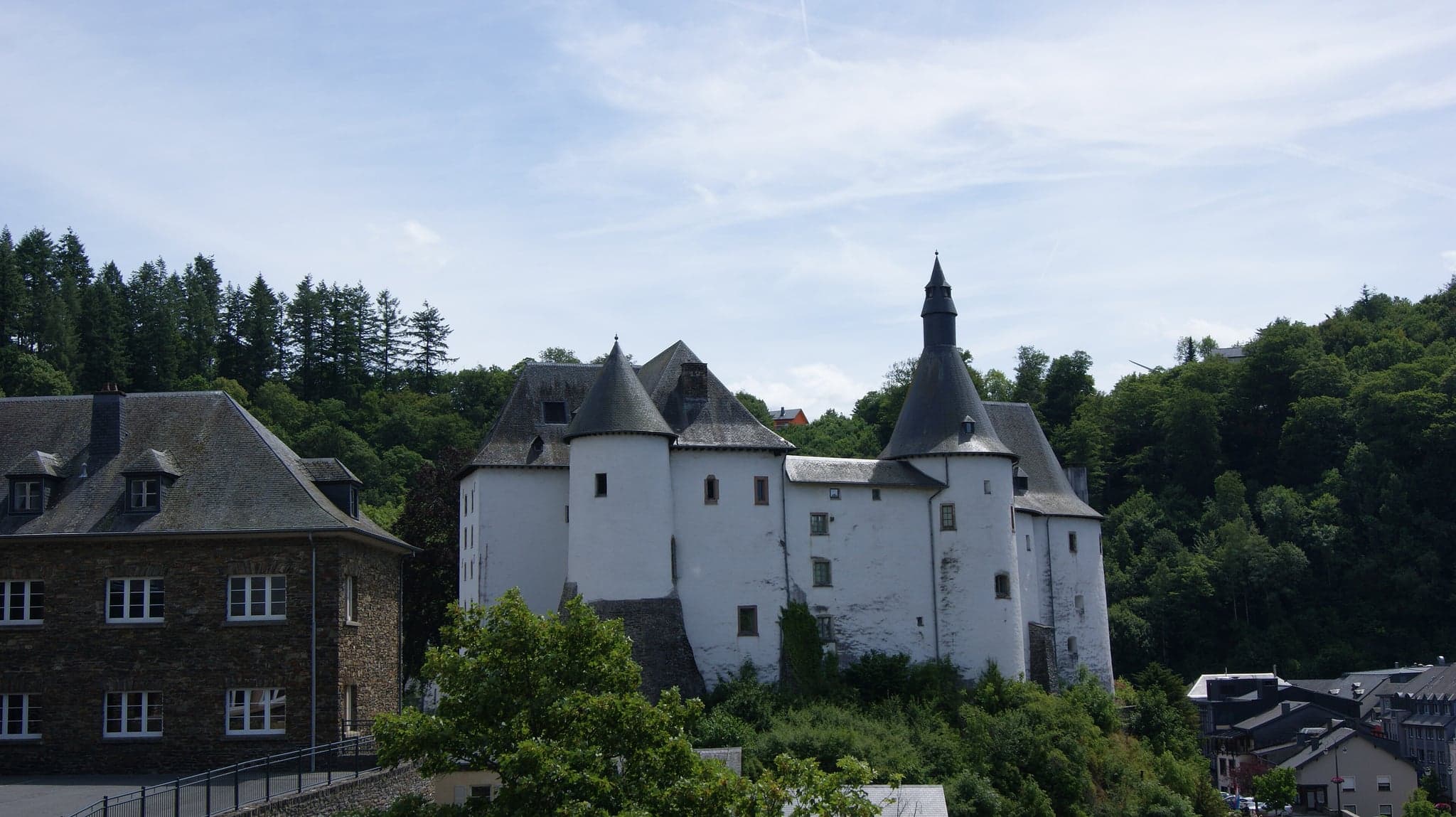
The castle's core consists of multiple wings arranged around an inner courtyard, with exterior walls up to 2.1 meters thick, showcasing the robust medieval defensive architecture. The oldest surviving structures include the Burgundian Tower and the Pigeon Tower on the west side, both predating 1400. These towers exemplify the castle’s original medieval military architecture.
In the early 15th century, the Brandenbourg Tower was added on the south side, accompanied by a Gothic south wing with extensive cellars. This wing currently houses three of the castle’s museums, blending historical architecture with modern cultural functions. The large palace and rounded towers likely date from around 1400, built during the prosperous era of the Lords of Brandenburg who significantly enlarged and fortified the castle.
Between 1595 and 1597, under the ownership of Gottfried von Eltz, the castle’s defenses were strengthened in response to the threats posed by the ongoing Eighty Years’ War. The fortifications were reinforced to protect against potential sieges and attacks during this turbulent European conflict.
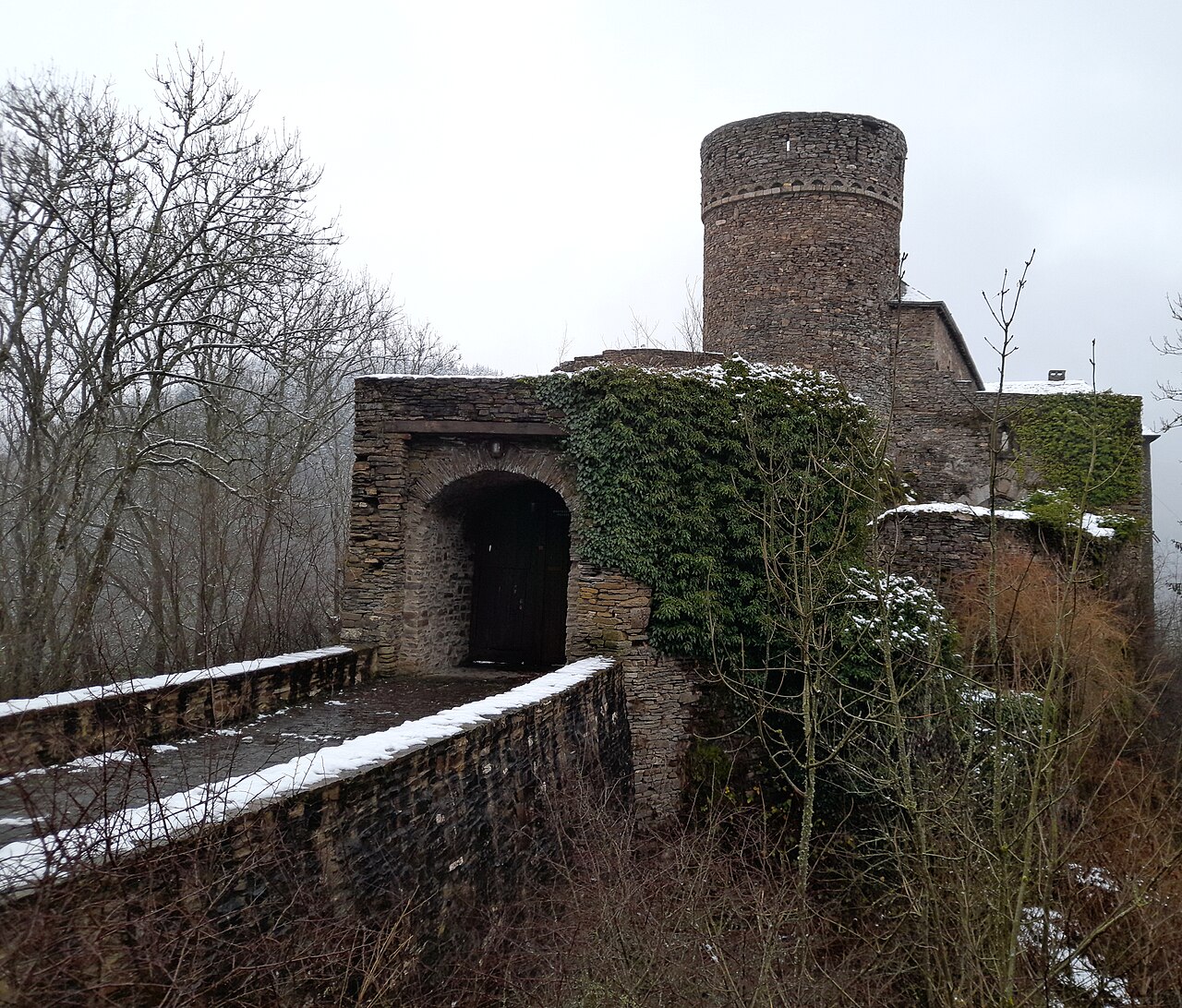
In the 17th century, the castle underwent significant transformations under the de Lannoy family, who held it for nearly 240 years. They added numerous residential and industrial buildings, including reception halls and the large Knights’ Hall decorated in the Spanish style of Flanders, constructed in 1634 by Claude of Lannoy. The outer bailey was expanded to create an economic courtyard with stables, barns, and a chapel relocated from the Pigeon Tower. Defensive additions from this period include a gatehouse and the semi-circular Hexenturm or Witch Tower.
By the 18th century, new stables were built, and parts of the outer bailey were dismantled in the late 19th century, with stones repurposed to build a nearby palace. This reflected changing architectural tastes and the castle’s evolving role from fortress to residence.
Historical significance and ownership transitions
Clervaux Castle’s history is marked by its changing ownership and roles. After the founding Sponheim family, it passed to the Meysenburgs and then to a branch of the Counts of Vianden in the early 1400s. The Brandenburg family’s tenure in the 15th century saw major fortifications and expansions. Later, the castle was owned by the de Heu and von Eltz families, who further enhanced its defenses and residential comfort.
In 1617, the castle came into the hands of the de Lannoy family through marriage, who transformed it into a more comfortable palace-like residence while maintaining its defensive character. The castle briefly became a battlefield during the Klöppelkrieg in 1798, a peasant uprising against French occupation, highlighting its strategic importance amid regional conflicts.
By 1927, Clervaux Castle had entered private bourgeois ownership and was adapted to house a hotel and museum, marking a shift from noble residence to public cultural use. However, during the Battle of the Bulge in December 1944, German forces heavily shelled the castle, causing a fire that destroyed much of the structure and left it in ruins.

Photo by LGphotoOP • CC BY-SA 3.0 lu
Post-war restoration and modern use
After World War II, the Luxembourg government purchased Clervaux Castle and undertook a comprehensive restoration project completed in 1994. This meticulous reconstruction preserved the castle’s historic layout and architectural features, restoring its medieval appearance while adapting it for contemporary use.
Today, the castle serves multiple functions. It houses the commune's administrative offices, integrating municipal services within its historic walls. It also hosts several museums that attract visitors interested in history, art, and photography.
Museum of Luxembourg castles
The south wing of the castle contains a unique museum featuring detailed scale models of 22 major Luxembourg castles at a 1:100 scale. These models illustrate the rich fortress heritage of Luxembourg, providing educational insights into the region’s medieval and early modern defensive architecture.
Battle of the Ardennes museum
The old kitchen area in the Brandenbourg House has been converted into a museum dedicated to the Battle of the Ardennes, also known as the Battle of the Bulge. This museum displays artifacts such as documents, weapons, and uniforms, mainly from private collections, offering a poignant reminder of the castle’s destruction and the wider conflict’s impact on the region.
The family of man photographic exhibition
One of the castle’s most internationally renowned attractions is the permanent exhibition "The Family of Man", curated by Edward Steichen. This photographic exhibition, displayed on two upper floors, features original black-and-white prints mounted on wooden panels arranged to replicate the 1955 Museum of Modern Art installation. Since 1994, the exhibition has been a cultural highlight and was recognized by UNESCO’s Memory of the World Register in 2003, underscoring its global significance.
Architectural features and layout
Clervaux Castle occupies an oval-shaped site with multiple wings arranged around an inner courtyard. Its exterior walls are notably thick, up to 2.1 meters, reflecting its defensive purpose. The castle’s medieval character is evident in its towers, battlements, and gatehouses, which have been carefully preserved or reconstructed.
The oldest surviving towers, the Burgundian and Pigeon Towers, provide insight into the castle’s original defensive structures. The Brandenbourg Tower and the adjacent Gothic south wing represent the castle’s expansion during the 15th century. The northern wing, built during the Renaissance, replaced smaller earlier buildings and features a square stair tower and the ornately decorated Knights’ Hall.
The outer bailey, expanded in the 17th century, served as an economic courtyard with stables, barns, and a chapel. Defensive features such as the gatehouse and Hexenturm highlight the castle’s layered fortifications designed to withstand various threats over centuries.
Visiting clervaux castle
Clervaux Castle is open to visitors and offers a rich experience combining history, architecture, and art. Visitors can explore the medieval architecture, the museums dedicated to Luxembourg’s castles and the Battle of the Ardennes, and the acclaimed photographic exhibition "The Family of Man." The castle’s location in the scenic town of Clervaux makes it a popular destination for those interested in Luxembourg’s cultural heritage.
Its blend of historical authenticity and modern cultural functions makes Clervaux Castle a unique site that connects Luxembourg’s medieval past with contemporary artistic and historical narratives.
Frequently asked questions (FAQ)
- How do I get to Clervaux Castle?
- Clervaux Castle is easily accessible by car and public transport. If you're traveling by train, the Clervaux train station is just a short walk away from the castle, making it convenient for visitors relying on public transport.
- What is the historical significance of Clervaux Castle?
- Clervaux Castle dates back to the 12th century and has played a vital role in the region's history. It has survived various sieges and was restored in the 20th century, making it a symbol of resilience and a testament to Luxembourg's rich medieval heritage.
- When was Clervaux Castle built?
- Construction of Clervaux Castle began in the 12th century, and it has undergone numerous renovations and restorations over the centuries. The castle's architecture reflects various styles, showcasing its long history and evolution.
- Can I take guided tours of Clervaux Castle?
- Yes, guided tours are available for visitors who want to learn more about the castle's history and architecture. These tours are conducted in multiple languages and provide a deeper insight into the castle's significance and the stories it holds.
- Why is Clervaux Castle a popular tourist attraction?
- Clervaux Castle attracts visitors due to its stunning architecture, breathtaking views of the surrounding landscape, and rich history. Additionally, it houses exhibitions, including a notable photography collection, which adds to its appeal for tourists and art lovers alike.
- Is it possible to host events at Clervaux Castle?
- Yes, Clervaux Castle offers facilities for hosting private events such as weddings and corporate gatherings. Its picturesque setting and historical ambiance make it a unique venue for special occasions.
- What are the opening hours for Clervaux Castle?
- Clervaux Castle is typically open to the public from April to October, with specific hours varying by season. It is advisable to check the castle's official website for the most current opening times before your visit.
- What are the ticket prices for Clervaux Castle?
- Ticket prices for Clervaux Castle are generally affordable, with discounts available for students and groups. Children under a certain age can usually enter for free, making it a great family-friendly destination.
- What is the best time to visit Clervaux Castle?
- The best time to visit Clervaux Castle is during the spring and summer months when the weather is pleasant and the surrounding gardens are in full bloom. This is also when the castle hosts various events and exhibitions, enhancing the visitor experience.
- Are there any nearby attractions to visit while in Clervaux?
- Yes, visitors can explore the beautiful surrounding town of Clervaux, which features charming streets, local shops, and the Clervaux Abbey. Additionally, the picturesque Our Nature Park is close by, offering opportunities for hiking and enjoying nature.
Photo gallery


Information
Sources & official resources
Verify the information above using these authoritative references.
Loading map...
Visitor reviews
No reviews yet. Been here? Write the first review and help other travelers!
Write the first reviewVisited this castle? Share your experience
Your review helps other travelers and adds first-hand knowledge to our encyclopedia.