Tashichho Dzong
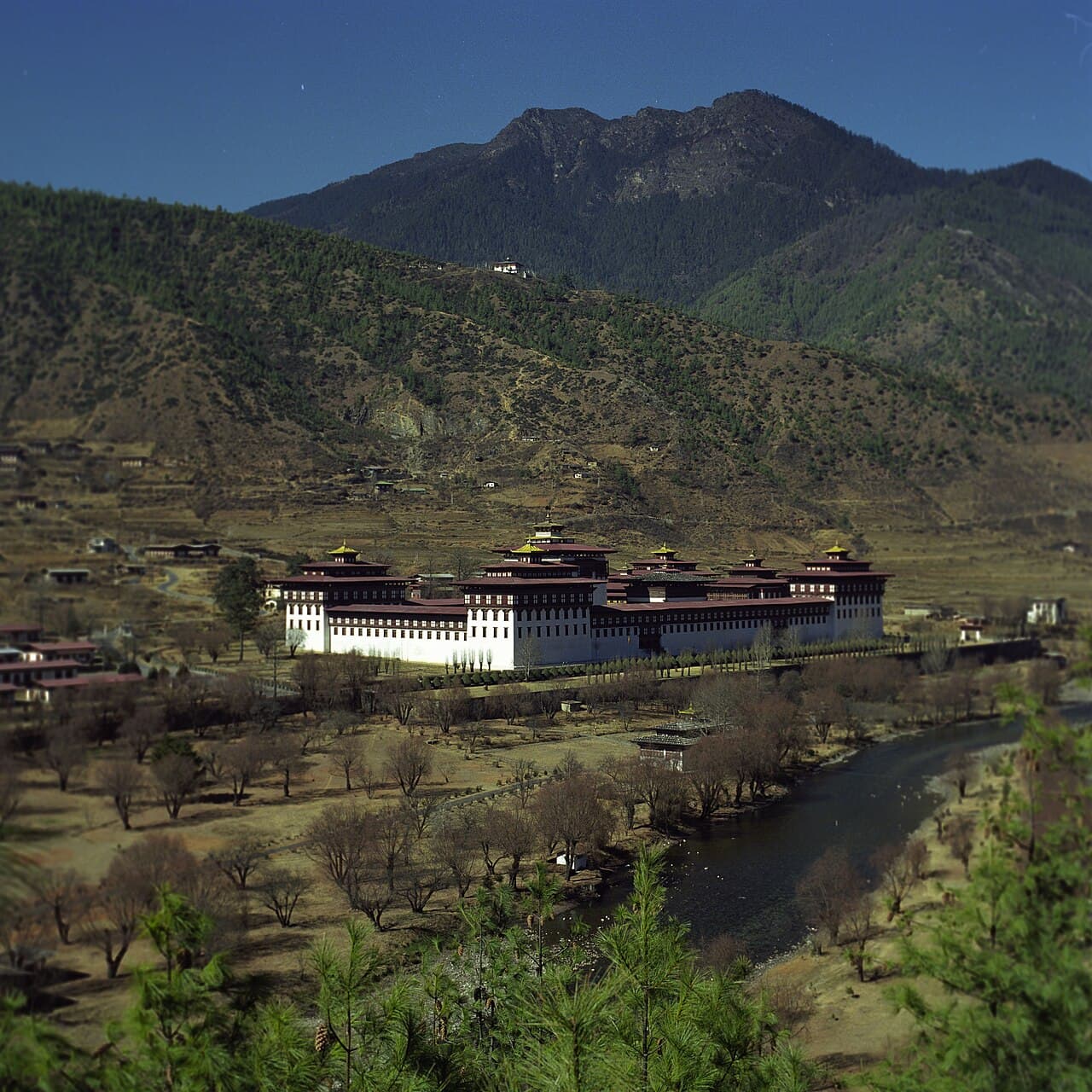
Tashichho Dzong (Dzongkha: བཀྲ་ཤིས་ཆོས་རྫོང), located on the northern edge of Thimphu, the capital city of Bhutan, is a prominent Buddhist monastery and fortress that stands on the western bank of the Wang Chu River. This impressive structure has served as a key religious and administrative center for centuries, symbolizing Bhutan's unique blend of spiritual and governmental authority. Known historically in British records as Tassisudon, the dzong has played a vital role in the country's political and religious history.
The fortress was originally constructed in the 13th century during the high medieval period, attributed to the first Dharma Raja, who was instrumental in founding the Lho-drukpa sect of Buddhism. This sect remains a distinctive religious tradition within Bhutan. The name Tashichho Dzong translates to "the fortress of auspicious doctrine," reflecting its spiritual significance. The dzong has traditionally been the seat of the Druk Desi, the head of Bhutan's civil government, a position that merged with the monarchy following the establishment of the Bhutanese kingdom in 1907. It also functions as the country's summer capital.
Architectural design and layout
The architectural composition of Tashichho Dzong is characteristic of Bhutanese fortress-monasteries, combining defensive features with religious and administrative functions. The main structure is prominently whitewashed and consists of a two-storied building with three-storied towers at each of its four corners. Each tower is crowned by triple-tiered golden roofs, which are iconic elements in Bhutanese dzong architecture and symbolize spiritual protection and prestige.
At the center of the dzong stands a large central tower known as the utse, which serves as the focal point of the complex. The utse often houses important religious relics and serves as a watchtower, emphasizing the fortress aspect of the dzong. The entire complex is enclosed within massive defensive walls, designed to protect against invasions and to demarcate the sacred space within.
Defensive features
Tashichho Dzong's design incorporates typical bastioned fortress elements, including thick stone walls and strategically placed towers for surveillance and defense. The elevated position overlooking the Wang Chu River adds a natural defensive advantage, allowing control over the surrounding valley and approach routes. The fortress layout facilitates both military defense and monastic seclusion, blending practicality with spiritual symbolism.
Religious and administrative functions
Beyond its military role, the dzong is a major religious center housing numerous Buddhist temples, shrines, and monks' quarters. It serves as the seat of the Je Khenpo, the chief abbot of Bhutan, and hosts important religious festivals such as the Thimphu Tsechu, a vibrant annual event featuring masked dances and rituals that attract visitors from across Bhutan and abroad.
Administratively, the dzong has been the seat of Bhutan's civil government since its foundation. The Druk Desi, the historical head of civil administration, operated from here before the monarchy was established. Today, it houses several government offices, including the throne room of the king during the summer months.
Historical significance and renovations
Throughout its history, Tashichho Dzong has undergone several reconstructions and renovations due to fires, earthquakes, and natural wear. The most significant rebuilding occurred in the mid-20th century, after a devastating fire in 1962, which led to extensive restoration efforts under the direction of the Bhutanese monarchy. These renovations preserved the traditional Bhutanese architectural style while reinforcing the fortress's structural integrity.
The dzong's role as a symbol of Bhutanese sovereignty and religious identity has been central since the establishment of the monarchy in 1907. It remains a living monument where the spiritual and political life of Bhutan converge, embodying the country's heritage and governance.
Cultural importance and tourism
Tashichho Dzong is not only a functional government and religious site but also a cultural landmark attracting tourists and scholars interested in Bhutanese history, architecture, and Buddhism. The annual Thimphu Tsechu festival held within its courtyards is a major draw, showcasing traditional Bhutanese arts, music, and dance.
Visitors to the dzong can explore its ornately decorated temples, courtyards, and monastic quarters, gaining insight into Bhutanese religious practices and architectural mastery. Its location in the capital city makes it accessible, and it remains an active center of Bhutanese life.
Visiting tips
While the dzong is open to visitors, certain areas may be restricted due to ongoing religious activities and government functions. Visitors should dress modestly and respect the sanctity of the site. Photography is often allowed in the courtyards but may be limited inside temples.
Frequently asked questions (FAQ)
- How do I get to Tashichho Dzong?
- Tashichho Dzong is located in Thimphu, Bhutan, and can be easily reached by taxi or local bus from the city center. The dzong is situated on the northern edge of Thimphu, making it a prominent landmark that is hard to miss.
- What is the historical significance of Tashichho Dzong?
- Tashichho Dzong, built in 1641, serves as the seat of the Bhutanese government and the central monastic body. It is not only an architectural marvel but also a symbol of Bhutanese culture and religion, housing the throne room of the king and various sacred temples.
- When was Tashichho Dzong built?
- The original structure of Tashichho Dzong was constructed in 1641 by Zhabdrung Ngawang Namgyal, the founder of Bhutan. It has undergone several renovations and expansions over the years, most notably in the 1990s, to preserve its historical and cultural integrity.
- Can I take photographs inside Tashichho Dzong?
- Photography is generally not allowed inside the religious areas of Tashichho Dzong, especially in the temples and during ceremonies. However, you can take photos of the exterior and the beautiful gardens surrounding the dzong.
- Why is Tashichho Dzong considered an architectural masterpiece?
- Tashichho Dzong is renowned for its stunning Bhutanese architecture, characterized by intricate woodwork, elaborate frescoes, and towering white walls. The dzong's design combines functionality with aesthetic appeal, making it a prominent example of traditional Bhutanese style.
- Is it possible to attend festivals at Tashichho Dzong?
- Yes, Tashichho Dzong hosts several important festivals throughout the year, including the Thimphu Tshechu, which features vibrant mask dances and cultural performances. Attending these festivals offers visitors a unique insight into Bhutanese traditions and religious practices.
- What are the opening hours for Tashichho Dzong?
- Tashichho Dzong is open to visitors from 9:00 AM to 5:00 PM, but it is advisable to check for any variations during holidays or festivals. The best time to visit is early in the morning or late afternoon when the light is perfect for photography.
- What are the ticket prices for Tashichho Dzong?
- Entry to Tashichho Dzong is free for Bhutanese citizens, while foreign nationals may need to pay a nominal fee. It is recommended to check with local authorities for the latest pricing and any special requirements for entry.
- What nearby attractions can I visit after Tashichho Dzong?
- After visiting Tashichho Dzong, you can explore the National Memorial Chorten, which is a short walk away, or visit the Buddha Dordenma statue that offers panoramic views of Thimphu. Both sites provide a deeper understanding of Bhutanese culture and spirituality.
Photo gallery

Information
Loading map...
Visitor reviews
No reviews yet. Been here? Write the first review and help other travelers!
Write the first reviewVisited this castle? Share your experience
Your review helps other travelers and adds first-hand knowledge to our encyclopedia.