Tantallon Castle
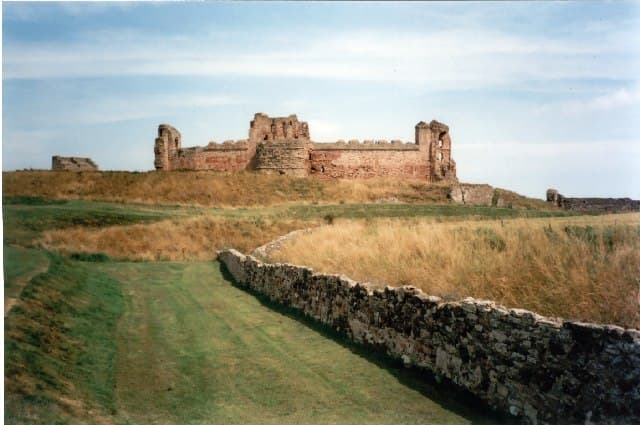
Tantallon Castle stands prominently on a coastal promontory in East Lothian, Scotland, overlooking the dramatic cliffs and the Firth of Forth. Built in the mid-14th century, this imposing fortress is renowned as the last great curtain wall castle constructed in Scotland during the late medieval period. Its strategic location atop steep sea cliffs provided natural defense on three sides, with a massive curtain wall sealing the landward approach. The castle's robust design, featuring thick red sandstone walls, multiple towers, and a fortified gatehouse, reflects the martial needs and architectural innovations of its era.
Founding and historical significance
Tantallon Castle was commissioned around 1350 by William Douglas, 1st Earl of Douglas, a key figure in Scottish nobility with close ties to King Robert the Bruce. The castle symbolized the Douglas family's rising power and served as a stronghold for the "Red Douglas" branch after the family split in 1380. For over three centuries, Tantallon remained the seat of this influential lineage, witnessing turbulent political struggles and military conflicts that shaped Scottish history.
The castle's history is marked by several significant sieges, notably in 1491 by King James IV during a rebellion led by Archibald Douglas, the "Bell-the-Cat" Earl of Angus, and again in 1528 by King James V. The latter siege was notable for its prolonged artillery bombardment, which caused substantial damage but ultimately failed to breach the castle's defenses. These events prompted important defensive upgrades, including reinforced towers and artillery embrasures, overseen by prominent architects such as George Sempill and John Scrimgeour.
Architectural features and defensive design
Location and layout
The castle occupies a roughly rectangular headland measuring approximately 50 by 90 meters, naturally protected on three sides by sheer sea cliffs. The only vulnerable approach from the southwest is secured by an imposing curtain wall approximately 90 meters long, over 15 meters high, and more than three meters thick. This wall incorporates vaulted staircases and chambers within its thickness, leading to a crenellated parapet walkway connecting the castle's main towers.
Towers and gatehouse
The Douglas Tower on the northwest side is a prominent circular keep about 12 meters in diameter and originally seven storeys tall. It housed the lord's private chambers, including a pit prison and vaulted garderobes. Adjacent to it lies the great hall, a large rectangular space measuring roughly 10 by 40 meters, which served as the social and administrative heart of the castle.
The eastern side features a distinctive D-shaped tower built to five storeys, later reduced to two with reinforced vaults after the 1528 siege. This tower was adapted for artillery defense, with large gun ports installed at basement level. The central gatehouse tower is square, about 13 meters wide and up to 24 meters tall, containing multiple floors of chambers and a heavily fortified entrance with a drawbridge, portcullis, and machicolations. Defensive bartizans overlook the courtyard, and a 16th-century spiral staircase provides access to the parapet.
Outer defenses and additional structures
Beyond the main curtain wall, the castle's outer court is enclosed by two deep rock-cut ditches, with evidence of earthworks and a surviving stone-faced embankment. A notable feature is the 17th-century dovecote shaped like a lectern, used historically for housing pigeons. Remnants of a triangular ravelin and smaller ditches further demonstrate the layered defensive strategy employed at Tantallon.
Sieges, warfare, and decline
Tantallon Castle endured multiple sieges reflecting the turbulent history of Scotland. The 1491 siege by James IV was brief, resulting in surrender with minimal damage. The 1528 siege by James V was more intense, with heavy artillery fire lasting 20 days, causing damage that led to significant repairs and upgrades afterward.
During the Rough Wooing in the 1540s, the castle remained a critical stronghold amid Anglo-Scottish conflicts. In 1639, it was captured by Covenanter forces during the Bishops' Wars, reflecting the religious and political upheavals of the time. The final siege occurred in 1651 during Oliver Cromwell's invasion of Scotland. After a twelve-day bombardment by Parliamentarian forces, the castle was breached and surrendered. This event marked the end of Tantallon as a functional fortress, leaving it in ruins.
Post-medieval history and preservation
Following its military obsolescence, Tantallon remained in the Douglas family until 1699 before passing to the Dalrymple family, who undertook some restoration efforts in the 19th century. The castle was transferred to the UK government in 1924 and is now managed by Historic Environment Scotland. It serves as a popular historic site open to the public, offering insights into medieval Scottish architecture and noble life.
During World War II, the castle's grounds were repurposed for military training, notably for RAF bomber crews practicing radar deception ahead of the Normandy invasion. In recent decades, Tantallon has also gained attention for reported paranormal activity, adding a layer of cultural intrigue to its rich history.
Visitor experience and cultural significance
Today, visitors to Tantallon Castle can explore the extensive ruins, including the massive curtain wall, surviving towers, the great hall remains, and the unique dovecote. The site’s dramatic setting overlooking the Bass Rock and the sea offers breathtaking views and a tangible connection to Scotland’s medieval past.
The castle’s architectural uniqueness as a single curtain wall fortress combined with its turbulent history of sieges and noble residence make it a vital monument in Scotland’s heritage. Its preservation allows for ongoing study and appreciation of medieval military architecture and the social history of the Douglas family.
Frequently asked questions (FAQ)
- How do I get to Tantallon Castle and what are its opening hours?
- Tantallon Castle is located near North Berwick in East Lothian, Scotland. It is managed by Historic Environment Scotland and is generally open to visitors daily during the warmer months, but it's best to check their official website for current opening hours and access details.
- What architectural features make Tantallon Castle unique?
- Tantallon Castle is unique as the last great curtain wall castle built in Scotland, featuring a massive single curtain wall with integrated towers and a heavily fortified gatehouse, all set on a naturally defensible promontory surrounded by sea cliffs.
- What historical events is Tantallon Castle known for?
- The castle is known for enduring several significant sieges, including those by King James IV in 1491, King James V in 1528, and Oliver Cromwell's forces in 1651, reflecting its strategic importance in Scottish history.
- Is Tantallon Castle accessible for visitors with mobility issues?
- Due to its rugged terrain and ruined condition, some areas of Tantallon Castle may be challenging for visitors with mobility issues. However, efforts have been made to provide accessible paths and facilities where possible. Visitors should consult the official site for detailed accessibility information.
- Are there guided tours available at Tantallon Castle?
- Historic Environment Scotland often offers guided tours and educational programs at Tantallon Castle, providing visitors with in-depth historical context and architectural insights. Availability may vary seasonally.
Photo gallery

Information
Sources & official resources
Verify the information above using these authoritative references.
Loading map...
Visitor reviews
No reviews yet. Been here? Write the first review and help other travelers!
Write the first reviewVisited this castle? Share your experience
Your review helps other travelers and adds first-hand knowledge to our encyclopedia.