Dunbar Castle
Dunbar Castle stands as a monumental relic of Scotland's turbulent medieval past, prominently perched on a rocky promontory overlooking the North Sea in East Lothian. This hill castle, with origins tracing back to the Early Middle Ages, played a pivotal role in the military and political history of both Scotland and northern England. Its strategic location made it a key stronghold for various rulers and armies over centuries, witnessing sieges, royal visits, and architectural evolution from timber fortifications to formidable stone defenses.
Early history and strategic importance
The site of Dunbar Castle was initially established by the Votadini or Gododdin tribe, known in Brythonic as "dyn barr," meaning "fort of the point." By the 7th century, it had become a vital stronghold for the Kings of Bernicia, an Anglian kingdom succeeding the British Kingdom of Bryneich. The castle was held by an ealdorman who owed allegiance first to the Kings of Bamburgh and later to the rulers of York, underscoring its importance in the shifting power dynamics of northern Britain. A notable historical episode includes the imprisonment of Saint Wilfrid in 678, following his exile from York by King Ecgfrith of Northumbria.
The castle's connection to Scottish royalty began with Kenneth MacAlpin, the king credited with uniting the Scots and Picts, who reportedly set the site ablaze during his reign. The earliest known stone fortress at Dunbar was likely constructed by Gospatric, Earl of Northumbria, after his exile from England post-Harrowing of the North. Malcolm III of Scotland granted Gospatric lands in East Lothian, including Dunbar, in exchange for loyalty, cementing the castle's role as a border fortress between Scotland and England.
Medieval military significance and architectural development
During the 14th century Wars of Scottish Independence, Dunbar Castle was a critical military asset. In June 1338, Sir Alexander Ramsay famously relieved the castle during an English siege, aiding Countess Black Agnes of Dunbar in its defense. The castle remained the principal stronghold of the Earls of Dunbar until 1457, when it was forfeited by George, Earl of March. Partial dismantling followed to prevent its use by English forces, but King James IV restored the fortress towards the end of the 15th century, reflecting its continued strategic value.
In the early 16th century, during the minority of James V, the castle was controlled by the Duke of Albany, who stationed a French garrison there. This period saw the construction of the western artillery bulwark, likely under the direction of French commander Antoine d’Arces. James V himself visited frequently in the 1530s, overseeing artillery arrangements and employing foreign experts in gunnery and armor, demonstrating the castle's adaptation to evolving military technologies.
Conflict, re-fortification, and decline in the 16th century
The mid-16th century was marked by the Rough Wooing, a series of Anglo-Scottish conflicts. In 1548, the castle was set ablaze by the Earl of Shrewsbury, but was soon re-fortified under the guidance of French military engineers such as Piero Strozzi and Migliorino Ubaldini. During the Scottish Reformation crisis, Mary of Guise further strengthened the defenses with the assistance of Italian engineers, expanding the castle's capacity to shelter an additional 500 soldiers. However, these fortifications were later dismantled following the Treaty of Edinburgh.
Mary, Queen of Scots maintained a close association with Dunbar Castle, appointing captains to oversee it and visiting multiple times between 1561 and 1567. The castle was embroiled in conflict during the 1567 siege after the Battle of Carberry Hill, held by supporters of the Earl of Bothwell. Later that year, the Parliament of Scotland ordered the castle's demolition to prevent future military use. Although full destruction was not completed due to financial constraints, partial dismantling occurred, and stones were repurposed for quay construction at Leith.
Architectural features and remaining structures
The surviving remains of Dunbar Castle reveal a sprawling complex originally measuring over 165 feet east to west and up to 210 feet north to south. Constructed primarily of red sandstone similar to that quarried near Garvald, many sections have collapsed or show signs of vitrification, indicating exposure to intense heat.
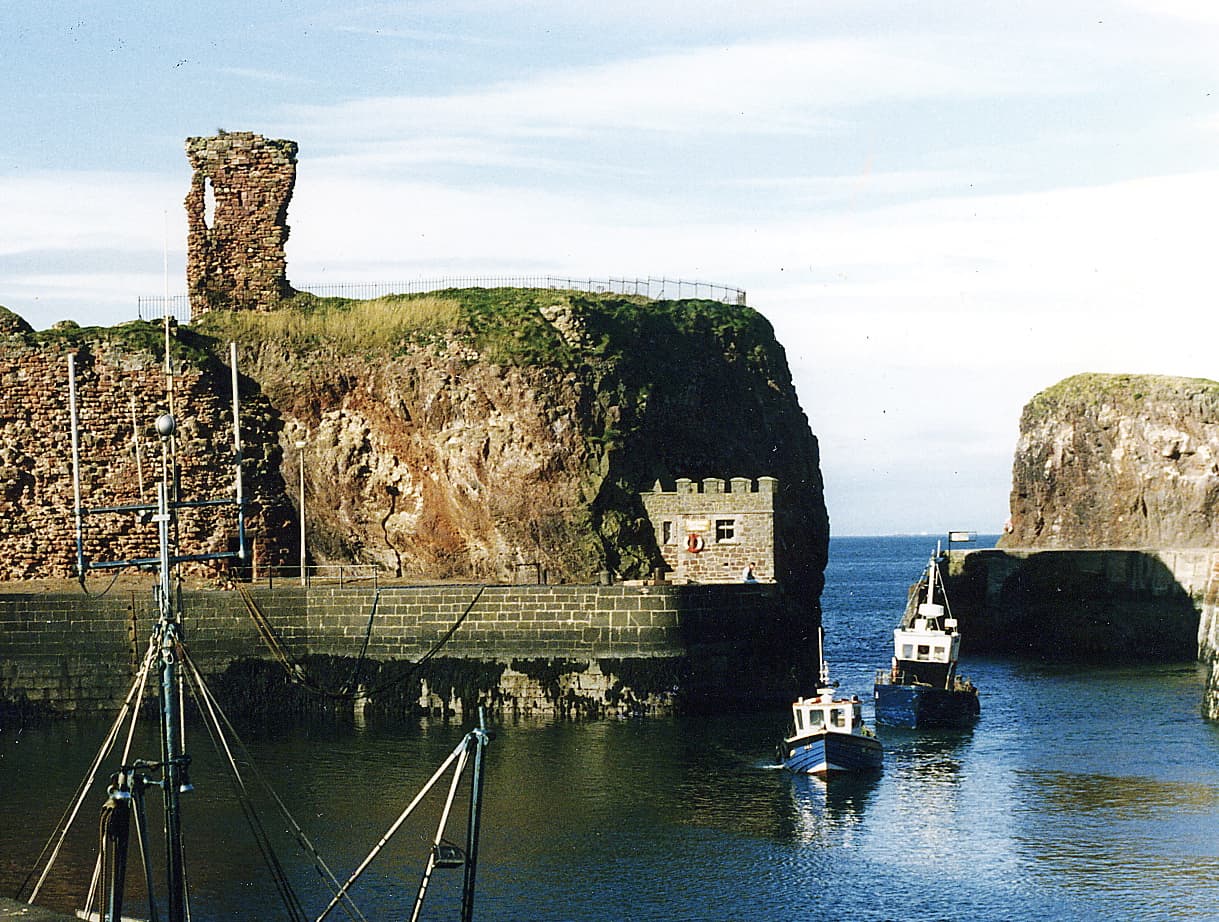
A standout feature is the South Battery, serving as the castle's citadel or keep. This octagonal stronghold sits atop a detached vertical rock approximately 72 feet high, accessible only via a masonry passage about 69 feet long connecting it to the main castle. The interior measures roughly 54 by 60 feet and includes five surviving gun-ports designed to accommodate artillery fire while providing defensive protection.
The main castle buildings were arranged around an open courtyard, illuminated by natural light. Architecturally notable are the arches extending about eight feet from the outer walls, supporting various structures. A mid-fortress wall features a gateway adorned with armorial bearings, including the shield of George, 10th Earl of Dunbar, displaying a lion rampant within a border decorated with eight roses, flanked by the arms of the Bruces and the Isle of Man, and topped with a helmet bearing a horse's head crest.
The castle's towers rise steeply towards the sea, with some sections descending directly to the water. Northeast lies a large natural cavern of black stone, traditionally believed to have served as a dungeon, where prisoners like Bishop Gavin Douglas were confined. A secret postern gate opened onto a rocky inlet, enabling covert resupply during sieges, a feature instrumental during the 1338 siege relief by Sir Alexander Ramsay.
Later additions include the western artillery bulwark from the early 16th century, timber structures for the Hannis tower, a gatehouse with wooden portcullises and metal grilles known as "yetts," new wells, and iron window grills. The mid-16th century fortifications expanded to accommodate up to 500 additional soldiers, reflecting the castle's continued military significance.
Among the more secluded ruins in the northwest stands a nearly inaccessible chamber approximately 12 feet square, traditionally identified as the room of Mary, Queen of Scots. The 1567 demolition order aimed to destroy the castle entirely, but only partial dismantling was achieved. Stones salvaged from the castle were used in quay construction at Leith, marking the physical decline of this once formidable fortress.
Cultural heritage and visitor experience
Today, Dunbar Castle remains a site of great historical and cultural importance. Its ruins offer insight into medieval military architecture, the evolution of artillery fortifications, and Scotland's complex history of conflict and monarchy. Visitors can explore the extensive remains, including the South Battery and the medieval courtyard, while appreciating the castle's dramatic setting overlooking the sea.
The castle's layered history, from its origins with the Votadini tribe through its involvement in the Wars of Scottish Independence and the Reformation, makes it a compelling destination for those interested in Scottish heritage and medieval fortifications. Interpretive signage and guided tours help illuminate the castle's past, enriching the visitor experience.
Frequently asked questions (FAQ)
- How do I get to Dunbar Castle?
- Dunbar Castle is located in the town of Dunbar in East Lothian, Scotland. It is accessible by car and public transport, with the town served by train and bus links from Edinburgh and other nearby cities.
- What is the best time to visit Dunbar Castle?
- The best time to visit Dunbar Castle is during the spring and summer months when the weather is milder and the surrounding landscape is at its most vibrant. These seasons also offer longer daylight hours for exploring the ruins.
- Is Dunbar Castle suitable for families?
- Yes, Dunbar Castle is suitable for families. The castle ruins provide an engaging historical experience for children and adults alike. However, visitors should be cautious as some areas are uneven or steep, so appropriate footwear is recommended.
- Are there guided tours available at Dunbar Castle?
- Guided tours are occasionally available, often organized by local heritage groups or during special events. Visitors should check with the local tourist information center in Dunbar for current tour schedules and availability.
- Can I explore the entire castle ruins?
- While much of Dunbar Castle's ruins are accessible to visitors, some areas are restricted for safety reasons. Visitors can explore the main courtyard, South Battery, and other significant features but should follow posted signs and guidelines.
Photo gallery

Information
Loading map...
Visitor reviews
No reviews yet. Been here? Write the first review and help other travelers!
Write the first reviewVisited this castle? Share your experience
Your review helps other travelers and adds first-hand knowledge to our encyclopedia.