Sztum
Sztum Castle stands as a significant example of late medieval Gothic military architecture in northern Poland. Constructed primarily by the Teutonic Order between the late 14th and early 15th centuries, the castle occupies a strategic position on what was originally a group of three islands in the area of Lake Sztumskie. Over centuries, the site evolved from a simple wooden stronghold into a complex stone fortress that played a crucial role in the political and military history of the region.
The castle's origins trace back to 1236 when the Teutonic Knights seized the Prussian stronghold known as "Stumo," located on an island in what was then Lake Białe. This early fortress likely utilized the natural defensive advantages of the island setting. After 1377, the wooden fortifications were replaced with a substantial brick and stone castle, designed to serve as the seat of the local vogt (administrator) directly subordinate to the Grand Master at Malbork Castle.
Architectural layout and features
Sztum Castle is distinctive for its irregular pentagonal plan, a rarity among Teutonic fortresses, which typically favored more regular shapes. The castle was built on the central island, with two additional fortified baileys on the adjacent islands, later transformed into peninsulas due to water level changes. Each section was surrounded by moats and defensive walls, with the western bailey developing into a settlement enclosed by walls on three sides.
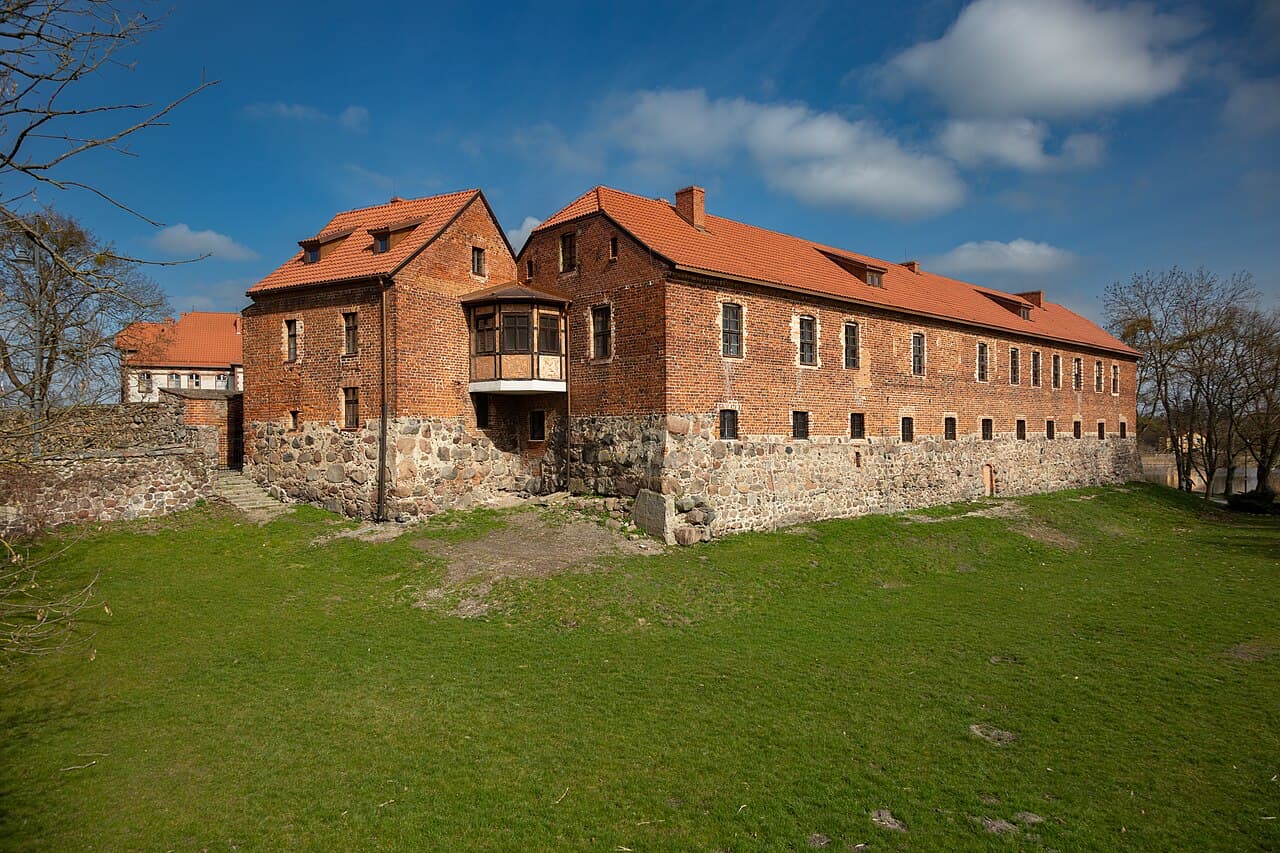
The main castle is constructed of brick on a stone foundation, typical of the Teutonic Order's brick Gothic style. The perimeter wall featured a guard walkway and incorporated about ten towers, mostly open bastions projecting outward to provide defensive coverage. The north-east tower, built on a quadrilateral plan, guarded the eastern gate leading to the eastern bailey. The north-west tower, hexagonal in shape, contained a dungeon on its lowest level.
The southern gatehouse was protected by a drawbridge and was slightly protruded from the curtain wall. Adjacent to this gate stood an imposing eight-story tower, approximately 30 meters tall, with a square base measuring 9 meters on each side. This tower served as a key defensive and symbolic element of the fortress.
Along the southern curtain wall, a large residential wing measuring 52 by 11 meters was constructed. This building was vaulted in the basement, which served economic functions, while the upper floors housed the vogt's apartments, a refectory, and guest chambers. The attic was used for storage and defense, featuring a continuous defensive gallery. The eastern wall included a castle chapel and a granary, while the northern courtyard was occupied by various service buildings.
The castle was surrounded by a moat approximately 3 meters deep and 10 to 15 meters wide, lined with stone on both sides, enhancing its defensive capabilities.
Historical significance and events
Sztum Castle played a pivotal role in the regional conflicts of the Baltic area. In 1410, it was captured by Polish forces under King Władysław Jagiełło during the Polish-Teutonic Wars, shortly after the Battle of Grunwald. However, the Teutonic Knights, led by Heinrich von Plauen, recaptured it after a six-week siege. The castle's strategic importance continued through the Thirteen Years' War (1454–1466), when it briefly came under the control of the Prussian Confederation and Polish forces before reverting to the Order. Following the Second Peace of Toruń in 1466, the castle became part of Royal Prussia under Polish sovereignty and served as the residence of Polish starosts.
In the 15th century, the castle was expanded to include a summer residence for the Grand Masters of the Teutonic Order, reflecting its elevated status. The eastern bailey featured a menagerie with exotic animals gifted by the Grand Duke of Lithuania, Vytautas, including a lion and an aurochs.
During the 17th century, the castle suffered damage during the Swedish invasions, known as the Deluge, and was occupied by Swedish forces in 1626. It was partially rebuilt between 1660 and 1664 but sustained further damage during subsequent conflicts and fires.
After the First Partition of Poland in 1772, Sztum Castle came under Prussian control. The castle was repurposed as an administrative center, housing the Prussian Treasury Management and later the District Court and prison. Extensive structural modifications occurred in the 19th century, including demolitions of medieval wings and towers, lowering of the gate tower, and the addition of neogothic elements to the eastern wing.
Modern preservation and cultural role
Today, Sztum Castle is recognized as a well-preserved example of Teutonic military architecture, although much of the original medieval fabric has been altered or lost due to centuries of warfare, administrative changes, and renovations. The southern wing remains the best-preserved part of the castle and currently houses a museum dedicated to the region's history and cultural heritage.
The castle grounds are used for various cultural events, including medieval reenactments, knightly tournaments, and historical festivals that celebrate the rich heritage of the area. These activities attract tourists and locals alike, offering a vivid connection to the castle's storied past.
Archaeological and architectural research conducted since the 19th century has helped to document and preserve the castle's features, informing restoration efforts and enhancing public understanding of its historical significance.
Location and accessibility
Sztum Castle is situated in the town of Sztum, in the Pomeranian Voivodeship of northern Poland. It lies near Lake Sztumskie, on Galla Anonima street, making it accessible for visitors interested in exploring the Teutonic heritage of the region.
Architectural style and classification
The castle is classified as a hill castle due to its elevated position on the former island site. Its architectural style is predominantly Gothic, characterized by brick construction, pointed arches, and defensive features typical of the Teutonic Order's fortresses.
Frequently asked questions (FAQ)
- When was Sztum Castle originally built?
- Sztum Castle was constructed primarily in the late 14th and early 15th centuries, with initial fortifications dating back to shortly after 1377.
- What architectural style characterizes Sztum Castle?
- The castle is predominantly Gothic, featuring brick construction, pointed arches, and defensive towers typical of Teutonic Order fortresses.
- Is Sztum Castle open to visitors?
- Yes, the castle houses a museum in its southern wing and hosts cultural events, making it accessible to tourists and history enthusiasts.
- What historical events is Sztum Castle known for?
- It played a key role in the Polish-Teutonic Wars, including the Battle of Grunwald in 1410 and the Thirteen Years' War, changing hands between Polish and Teutonic forces.
- How has the castle changed over time?
- The castle underwent expansions in the 15th century, damage during Swedish invasions in the 17th century, and significant 19th-century modifications for administrative use.

Information
Sources & official resources
Verify the information above using these authoritative references.
Loading map...
Visitor reviews
No reviews yet. Been here? Write the first review and help other travelers!
Write the first reviewVisited this castle? Share your experience
Your review helps other travelers and adds first-hand knowledge to our encyclopedia.