Szczytno Castle Ruins
Szczytno Castle Ruins stand as a testament to the turbulent history and architectural evolution of a late medieval Teutonic fortress in the heart of Poland. Founded between 1350 and 1360 by Ortolf von Trier, a knight of the Teutonic Order and Komtur of Elbląg, the castle was initially established as a wooden fortification near an Old Prussian settlement in the region historically known as Galindia. The earliest document mentioning the fort dates to 24 September 1360, when Ortolf invited Masovian colonists to settle, marking the beginning of the town of Szczytno.
The castle's strategic location along the trade route connecting Warsaw to Königsberg (modern-day Kaliningrad) contributed to its growth and importance. Originally constructed as a wooden fort, it was destroyed in 1370 by Lithuanian forces led by Prince Kęstutis. Soon after, the castle was rebuilt in stone, transitioning from a timber stronghold to a more durable brick and fieldstone fortress. This reconstruction marked the beginning of the castle's most significant phase as a military and administrative center of the Teutonic Order.
Architectural design and fortifications
The castle was designed on a nearly square layout measuring approximately 39 by 39 meters, with four wings each about 11 meters wide and rising to three stories. These wings enclosed a central courtyard, a common feature in medieval castles that facilitated defense and internal communication. The entire complex was surrounded by defensive outer walls and a water-filled moat, enhancing its protection against invaders.
The walls were constructed primarily from a combination of brick and fieldstone, materials chosen for their strength and resilience. The stonework typically extended up to the main floor level, providing a solid base for the upper brick structures. A smaller tower measuring roughly 9 by 9 meters was situated at the southwestern corner, serving as a key element in the castle's defensive system.
In the late 16th century, under the direction of Margrave Georg Friedrich of Brandenburg-Ansbach (1577–1603), the castle underwent significant renovations. Four round towers were added at the corners, enhancing the castle's defensive capabilities by allowing defenders to cover multiple angles and better withstand artillery advances. These towers stood as prominent features until their dismantling in the late 18th century.
Internal layout and facilities
The castle's interior was well-equipped to support both military and administrative functions. Historical inventories from before the Thirteen Years' War (1454–1466) describe a complex that included storage rooms for grain, a malt house for brewing, various cellars, a kitchen, a chapel, and facilities for livestock and farming. This array of amenities reflects the castle's role as a self-sustaining fortress capable of withstanding sieges.
A significant arsenal was maintained within the castle, housing hundreds of crossbows, bolts, and hand cannons, underscoring its strategic importance in the region. A well located in the central courtyard ensured a reliable water supply during prolonged conflicts or isolation.
Historical significance and transformations
The castle played a pivotal role during the Thirteen Years' War, when it was occupied by Polish troops, highlighting its contested status between the Teutonic Order and the Kingdom of Poland. After the secularization of the Teutonic Order in 1525, the castle's military importance declined. It became the residence of the ducal starost, an official managing the area for the Duchy of Prussia, and was used as a hunting lodge by Duke Albert and his successors.
Despite its reduced military role, the castle saw notable redevelopment under Margrave Georg Friedrich, who appreciated the surrounding forests for hunting. His renovations between 1579 and 1581 modernized the fortress and adapted it for leisure purposes, blending defensive architecture with residential comfort.
Over the centuries, the castle's condition deteriorated. From 1766 to 1792, significant parts, including the northeast wing and upper floors, were dismantled. The southern moat was filled in, and by the 19th century, further demolition removed remaining towers and sections of the defensive walls. The site gradually lost its prominence as a military and administrative center.
Impact of wars and modern changes
The castle and the town of Szczytno suffered severe damage during World War I. On 30 August 1914, Russian troops set fire to the area, destroying 160 houses and 321 commercial buildings, including parts of the castle ruins. This devastation marked a dramatic turning point in the site's history.
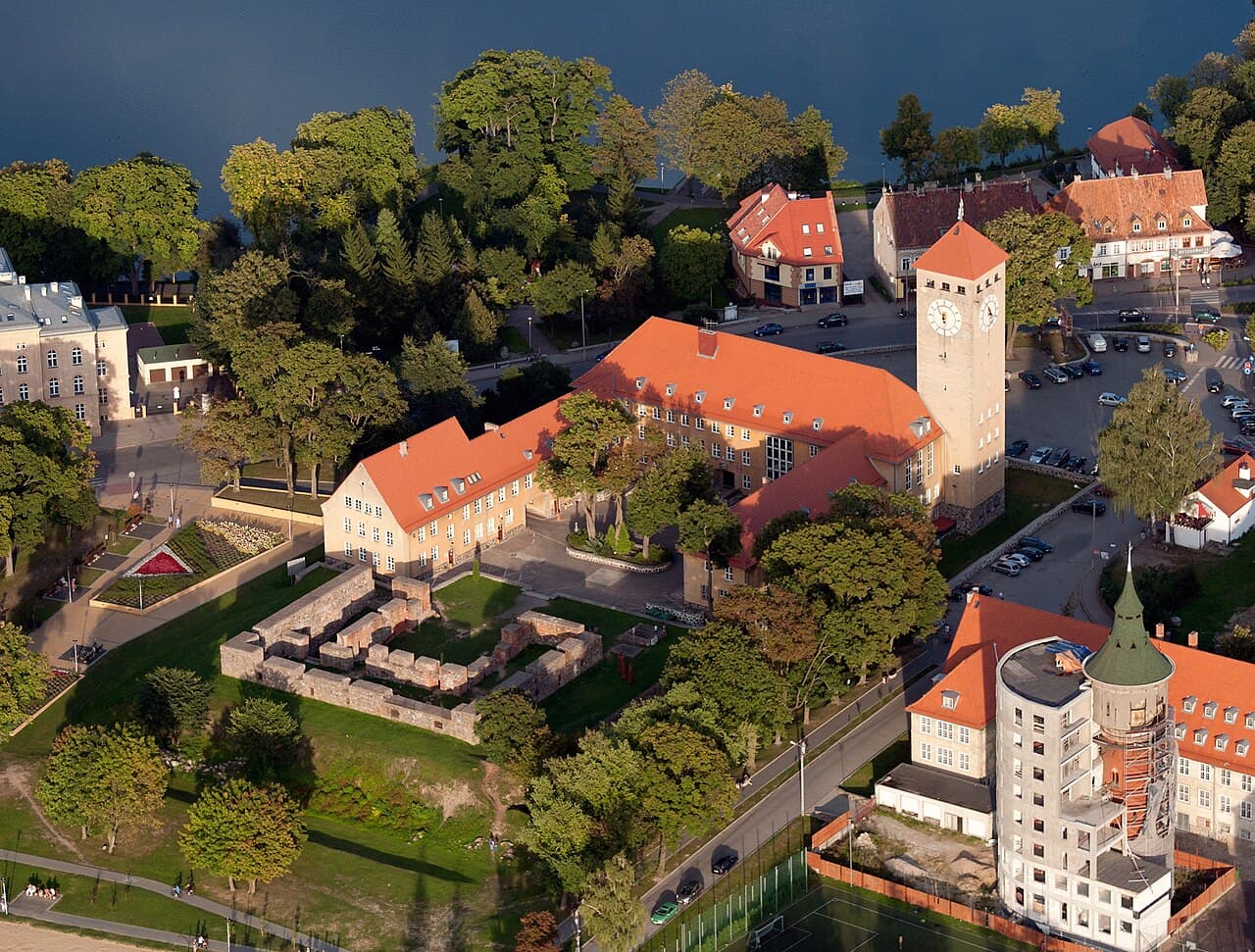
In the 20th century, the castle grounds underwent further transformation. Between 1936 and 1937, a town hall was constructed on the former castle foundations, altering the original medieval footprint. Despite these changes, remnants of the castle continue to evoke its historical legacy.
Remaining structures and cultural heritage
Today, only fragments of the original Szczytno Castle remain. The most notable surviving feature is the "Jurand's Tower", a 46-meter-high section of the original gatehouse named after a character in Henryk Sienkiewicz's novel "The Teutonic Knights." This tower stands as a prominent symbol of the castle's medieval past and literary significance.
Other remnants include parts of the defensive walls and foundations of the castle wings, which outline the former layout. Sections of the moat still exist, providing a glimpse into the castle's defensive design. Archaeological studies and historical records have helped reconstruct the castle's architectural and functional evolution over its centuries of use.
The castle's story intertwines with the broader history of the region, reflecting the shifting political, military, and cultural landscapes of East Prussia and Poland. Its preservation as a ruin offers valuable insight into medieval fortification techniques and the legacy of the Teutonic Order in Central Europe.
Visiting szczytno castle ruins today
Visitors to the Szczytno Castle Ruins can explore the surviving structures and learn about the castle's rich history through interpretive displays and local museums. The site is accessible within the town of Szczytno, making it a convenient destination for those interested in medieval architecture, military history, and Polish heritage.
The ruins provide a tangible connection to the past, allowing visitors to imagine the castle's former grandeur and strategic importance. The surrounding town offers additional cultural attractions, enhancing the experience of exploring this historic site.
Frequently asked questions (FAQ)
- How do I get to Szczytno Castle Ruins?
- Szczytno Castle Ruins are located in Szczytno, Poland, easily accessible by car or public transport. The nearest train station is in Szczytno, from where you can take a short taxi ride to the castle site.
- What is the historical significance of Szczytno Castle Ruins?
- Szczytno Castle, built in the 14th century, served as a stronghold for the Teutonic Knights. It played a crucial role in the region's medieval history, reflecting the architectural style and military strategies of its time.
- When was Szczytno Castle constructed?
- Szczytno Castle was constructed in the early 14th century, specifically around 1345. It was part of the defensive network established by the Teutonic Knights during their expansion in the region.
- Can I visit Szczytno Castle Ruins?
- Yes, visitors are welcome to explore the Szczytno Castle Ruins. While the site is primarily in ruins, it offers a fascinating glimpse into medieval architecture and history.
- Why is Szczytno Castle Ruins a popular tourist attraction?
- Szczytno Castle Ruins attract visitors due to their historical significance and picturesque setting. The ruins provide a unique opportunity to appreciate medieval architecture while enjoying the surrounding natural beauty.
- Is it possible to take guided tours of the castle ruins?
- Currently, guided tours are not regularly offered at Szczytno Castle Ruins. However, informational panels are available on-site, providing insights into the castle's history and architecture for self-guided exploration.
- What are the opening hours for Szczytno Castle Ruins?
- Szczytno Castle Ruins are typically open year-round, with access usually available during daylight hours. It’s recommended to check local resources or tourism websites for any seasonal changes in operating hours.
- What is the best time to visit Szczytno Castle Ruins?
- The best time to visit Szczytno Castle Ruins is during the late spring and early autumn months when the weather is mild and the surrounding landscape is lush. These seasons also tend to be less crowded compared to summer.
- Are there any nearby attractions to Szczytno Castle Ruins?
- Yes, nearby attractions include the beautiful lakes of the Masurian region and several charming towns such as Mrągowo and Giżycko. These locations offer various recreational activities, making for a great day trip after visiting the ruins.
- What are the ticket prices for visiting Szczytno Castle Ruins?
- Entry to Szczytno Castle Ruins is typically free, allowing visitors to explore the site without any cost. However, donations are often appreciated to help with the preservation of the ruins and surrounding area.
Photo gallery

Information
Website
Visit websiteSources & official resources
Verify the information above using these authoritative references.
Loading map...
Visitor reviews
No reviews yet. Been here? Write the first review and help other travelers!
Write the first reviewVisited this castle? Share your experience
Your review helps other travelers and adds first-hand knowledge to our encyclopedia.