Nidzica
Nidzica Castle stands as a significant example of a late-medieval Gothic bastioned fortress in the town of Nidzica, Poland. Its origins trace back to the second half of the 13th century when the Teutonic Knights likely established a wooden-earth watchtower on a strategic hill overlooking the marshy valley of the Nida River. This early fortification served as a local administrative center subordinate to the Dzierzgoń commandery and was the residence of an official known as a komornik.
By the 14th century, the Teutonic Order intensified settlement efforts in the depopulated Prussian lands. At the foot of the hill, a settlement developed which received town rights in 1381 from the Grand Master Winrich von Kniprode. The first documented mention of a castle dates to 1359, suggesting initial plans for a modest fortification at the site. However, a decision was later made to construct a larger stone castle to strengthen the border with Mazovia. The surviving Gothic castle's construction began around 1370 and continued until 1407.
Architectural design and layout
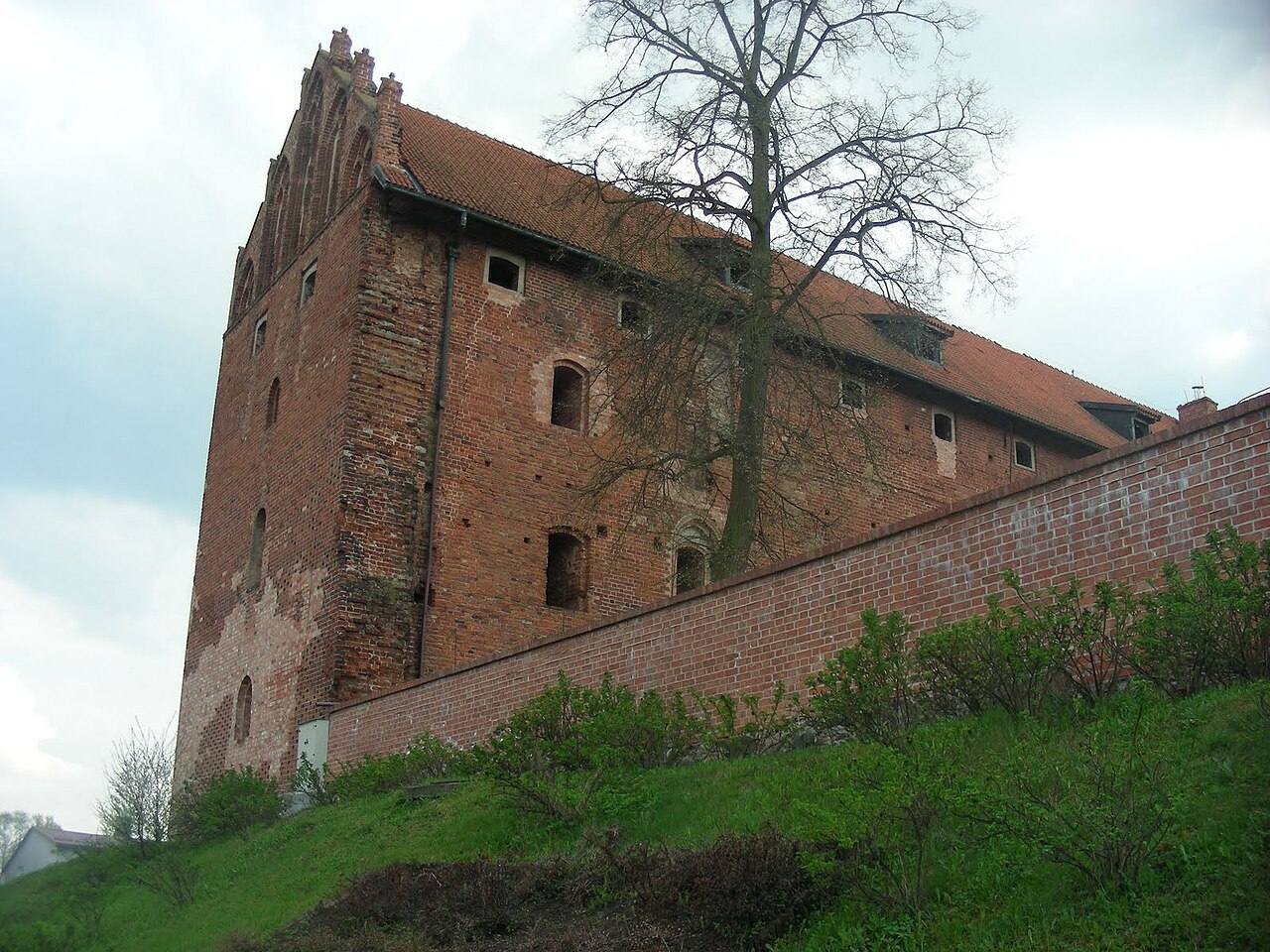
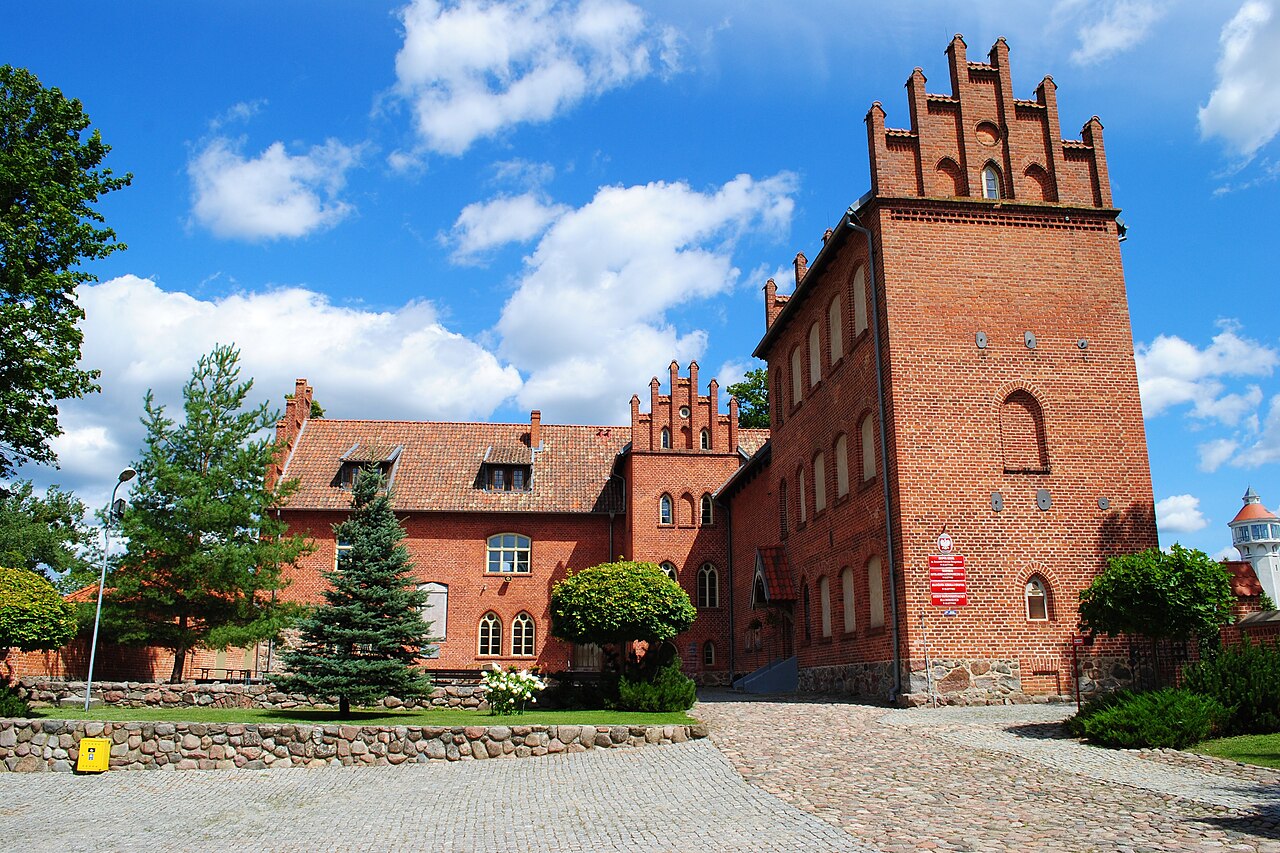
The castle is built on a rectangular plan measuring approximately 62 by 44 meters, primarily from red brick with fieldstone used in the lower sections. It features four wings enclosing an inner courtyard. The western wing is the most imposing, rising four stories with decorative gables. This wing housed the chapel on the first floor, notable for its two-bay star-vaulted ceiling and an apsidal bay window in the form of an oriel. Adjacent to the chapel were the refectory and chancery. The ground floor and basement contained utility rooms such as the kitchen, pantry, and brewery, while the top floor served as a granary.
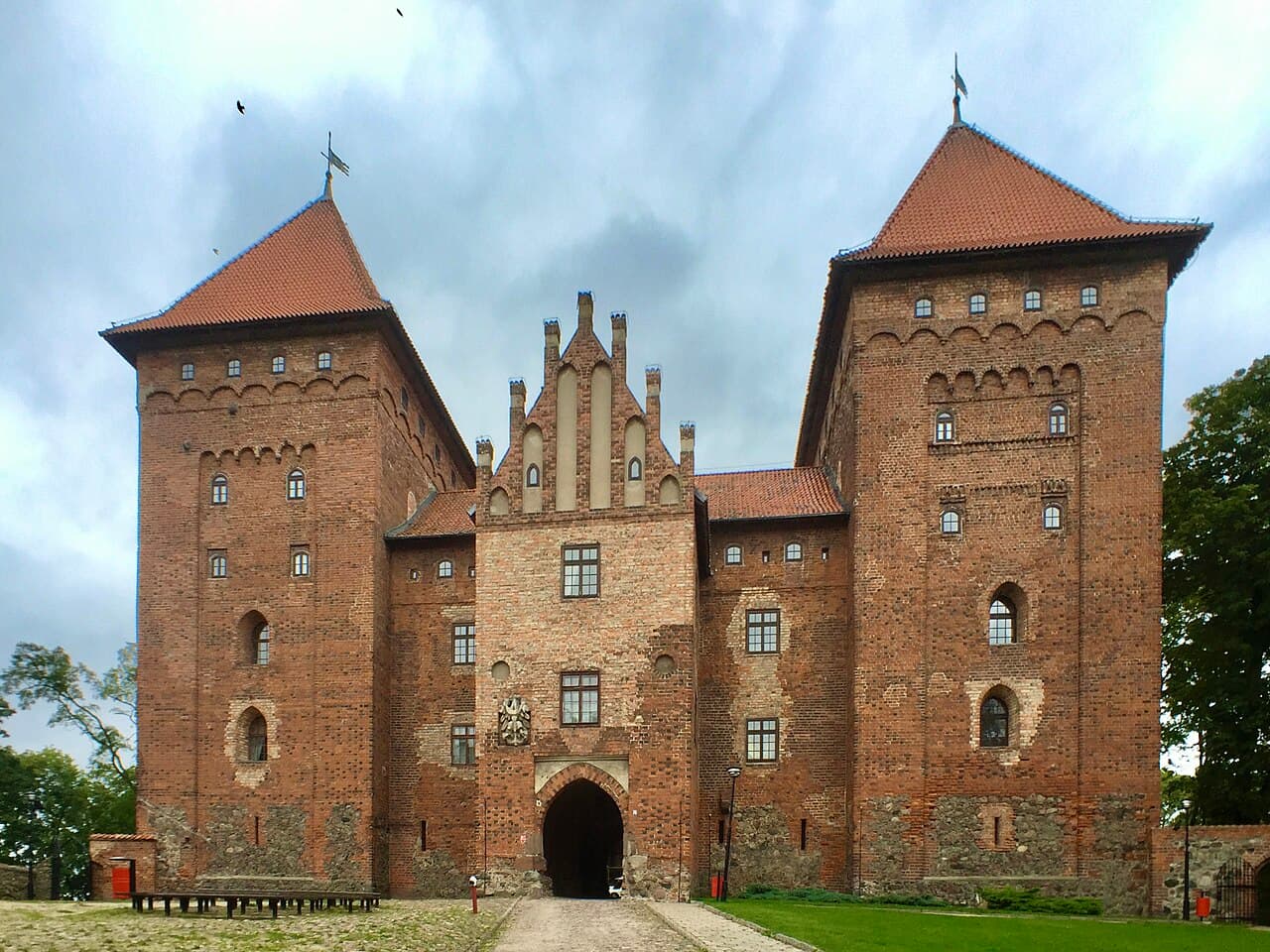
Along the exterior walls runs a defensive gallery with arrow slits, allowing defenders to patrol and protect the fortress. The northern and southern wings are two stories high with utilitarian functions, covered by shed roofs and featuring wall walkways within the thickness of the walls. The eastern wing, four stories tall, forms the gatehouse and is preceded by a moat and a drawbridge. It includes a projecting gate passage with an ornamental gable, extending the entrance in the style of a gate neck.
Flanking the eastern wing are two square, five-story residential towers that project prominently beyond the curtain wall, providing flanking fire and living quarters. The castle's eastern side adjoins a fortified outer bailey, which was later enclosed by defensive walls and bastions adapted for artillery.
Fortifications and town defenses
Alongside the castle's construction, the adjacent town was fortified with walls strengthened by towers, two main gates, and a postern gate facing the castle. The town defenses included a moat fed by a mill pond, enhancing the overall security of the complex. After completion in 1409, the castle became the seat of the Teutonic procurator responsible for administration and defense.
Historical conflicts and military significance
Nidzica Castle played a prominent role in the turbulent military history of the region. In the Battle of Grunwald (1410) campaign during the Polish-Teutonic War, Polish-Lithuanian forces occupied the lightly defended castle without resistance. The castle was briefly given to the Mazovian duke Janusz but was soon reclaimed by the Teutonic Order.
During the Hunger War of 1414, Polish forces besieged the castle for several days, with King Władysław Jagiełło personally directing the bombardment. The fortress capitulated on August 6 but was retaken by the Teutonic Knights in September after a surprise counterattack.
In the Thirteen Years' War (1454-1466), the castle was seized by supporters of the Prussian Confederation and held by mercenary forces loyal to the Polish crown. It withstood a Teutonic siege in 1455 led by the Order's commanders. The war ended with the Second Peace of Toruń, returning the castle to the Order, who undertook further fortifications.
In the early 16th century, the castle's outer bailey was reinforced with circular bastions designed to accommodate firearms. The fortress also saw action during the Polish-Teutonic War of 1519-1520, successfully resisting Polish-Masovian attempts to capture it.
Later history and restoration
After the secularization of the Teutonic Order in 1525, Nidzica became part of Ducal Prussia and served as the seat of a ducal starost. In the late 16th century, two bastions were added to the outer walls, and a second outer bailey was constructed. The castle suffered occupation and damage during the Swedish Deluge in the mid-17th century and was besieged by Tatar forces allied with the Polish king Jan Kazimierz in 1656.
The castle gradually lost its military importance in the 18th century. A devastating fire in 1784 destroyed the second outer bailey, and the castle was further damaged by French troops in 1812 during the Napoleonic Wars. By the early 19th century, the castle was in decline and partially in ruins.
Between 1828 and 1830, the castle was rescued from ruin by Tymoteusz Gregorovius, a local court counselor, who undertook restoration and adapted the interiors for use as a court, prison, and private residences. The castle suffered heavy damage again in 1945 during Soviet bombardments in World War II.
Post-war restoration began in 1949, with major conservation efforts carried out between 1961 and 1965. Today, the castle is partially open to visitors and hosts cultural institutions and a hotel, preserving its rich historical and architectural legacy.
Architectural features and interior highlights
The castle's Gothic architecture is evident in its pointed arches, ribbed vaults, and decorative brickwork. The western wing's chapel contains rare surviving frescoes, including a partially preserved mural of Saint Veronica surrounded by angels, located in the refectory. The castle's towers feature distinctive tent-shaped roofs adorned with ornamental niches and flat decorative elements.
The basement prison cells reflect the castle's later use as a detention facility. The inner courtyard includes a well that historically provided fresh water to the inhabitants. Defensive galleries and wall walks enabled effective surveillance and protection against attackers.
The surrounding 19th-century park enhances the castle's setting, offering a verdant contrast to the medieval masonry. The castle's spatial layout has remained largely unchanged over the centuries, maintaining its original form and defensive character.
Visiting and cultural significance
Today, Nidzica Castle is recognized as one of the strongest military fortifications built by the Teutonic Order, notable for diverging from the typical conventual castle design. Its well-preserved structure, layered history, and architectural details make it a valuable cultural heritage site in Poland.
The castle is partially accessible to visitors, who can explore the interior courtyards, some restored chambers, and the surrounding park. It serves as a venue for cultural events and houses a hotel, allowing guests to experience the historical atmosphere firsthand.
For enthusiasts of medieval architecture and history, Nidzica Castle offers a fascinating glimpse into the military, administrative, and residential functions of a Teutonic fortress through centuries of conflict and change.
Frequently asked questions (FAQ)
- What is the historical significance of Nidzica Castle?
- Nidzica Castle, dating back to the 14th century, was originally built as a defensive fortress by the Teutonic Knights. Its strategic location allowed it to play a crucial role in the region's military history and trade routes. Today, the castle stands as a testament to medieval architecture and the historical narrative of Poland.
- When was Nidzica Castle built?
- Nidzica Castle was constructed between 1350 and 1400, serving as a stronghold for the Teutonic Knights. Over the centuries, it has been renovated and restored, reflecting various architectural styles while preserving its original charm.
- Can I visit Nidzica Castle?
- Yes, Nidzica Castle is open to visitors year-round. You can explore its fascinating history through guided tours, which provide insights into its architecture and the events that shaped the region.
- What are the opening hours for Nidzica Castle?
- Nidzica Castle is typically open from 10 AM to 6 PM during the summer months and has reduced hours in the winter. It's advisable to check the official website or contact the castle administration for the most current visiting hours before planning your trip.
- Is it possible to access Nidzica Castle with a disability?
- Nidzica Castle offers limited accessibility for visitors with disabilities. While some areas are easier to navigate, certain sections, particularly those involving stairs, may pose challenges. It's recommended to contact the castle in advance to inquire about specific accommodations.
- What are the ticket prices for Nidzica Castle?
- Ticket prices for visiting Nidzica Castle are quite affordable, with discounts available for students and seniors. Children under a certain age may enter for free, making it a great spot for family outings.
- When is the best time to visit Nidzica Castle?
- The best time to visit Nidzica Castle is during the spring and summer months when the weather is pleasant, and the surrounding gardens are in full bloom. Additionally, special events and reenactments often take place during this period, enriching the visitor experience.
- Are there any nearby attractions to Nidzica Castle?
- Yes, there are several attractions near Nidzica Castle, including the picturesque town of Nidzica itself, with its charming streets and local shops. Additionally, visitors can explore the scenic landscapes and hiking trails in the surrounding area, making for a perfect day trip.
Photo gallery

Information
Website
Visit websiteSources & official resources
Verify the information above using these authoritative references.
Loading map...
Visitor reviews
No reviews yet. Been here? Write the first review and help other travelers!
Write the first reviewVisited this castle? Share your experience
Your review helps other travelers and adds first-hand knowledge to our encyclopedia.