Svojkov Castle
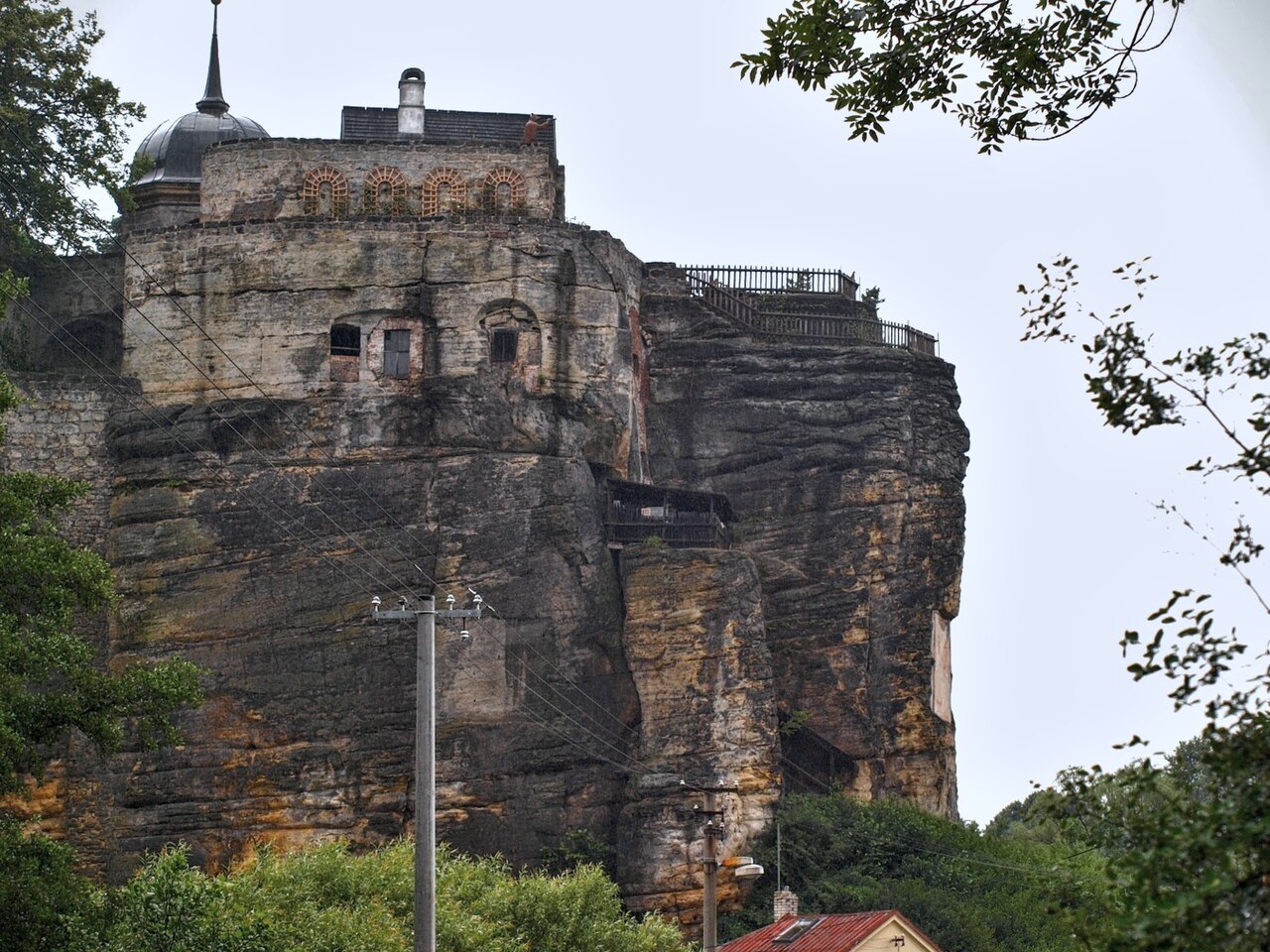
Svojkov Castle stands as a remarkable example of medieval fortress architecture uniquely integrated with its natural sandstone environment in the Czech Republic. Nestled in the municipality of Svojkov, this hill castle was constructed during the High Medieval period and first documented in 1355. Its strategic location atop a wooded hill and carved directly into a towering sandstone pillar demonstrates the ingenuity of medieval builders in adapting natural geological features for defensive purposes.
Historical background and ownership lineage
The castle's earliest known owner, recorded by 1370, was Ješek, likely affiliated with the influential Berk family from Dubá. This association places Svojkov within the network of noble estates prominent in the Bohemian lands during the Middle Ages. In the early 15th century, ownership passed to Jan of Chlum, a notable figure historically recognized for escorting the religious reformer Jan Hus to the Council of Constance, a pivotal event in Bohemian and European history.
By around 1437, the castle was acquired by Ctibor of Kačice, whose family subsequently adopted the surname "of Svojkov," reflecting their deep connection to the fortress. This transition illustrates the castle's role not only as a military stronghold but also as a symbol of noble identity and territorial control.
The mid-15th century brought turbulent times when Mikeš Pancíř of Smojno, a knight infamous for his robber activities, seized the castle between 1444 and 1445. His occupation provoked a military retaliation from the neighboring Lusatian towns, whose forces captured and set fire to Svojkov Castle. This assault also extended to the nearby Sloup Castle, underscoring the violent regional conflicts and power struggles of the era.
Following its destruction, the castle was abandoned around 1530, left to deteriorate into ruins. The site remained neglected until the late 18th century when Count Josef Jan Maxmilián Kinský purchased the surrounding lands. In 1780, efforts were made to restore parts of the ruins in the romantic style popular at the time, including the construction of a wooden staircase and a summer pavilion, though the pavilion no longer survives.
Architectural features and adaptation to natural terrain
Svojkov Castle is distinguished by its exceptional integration with the natural sandstone rock pillar, which rises approximately 13 meters above the surrounding terrain on a wooded hill about 20 meters high. The castle's fortifications were carved into the sandstone in three distinct levels, demonstrating advanced medieval rock-cut architectural techniques.
At the summit of the rock formation stood a palace consisting of two masonry wings. Although now in ruins, remnants of the palace walls remain, providing valuable insights into the castle’s original layout and residential functions. The sandstone pillar itself housed numerous rooms and connecting passageways hewn directly from the rock, along with staircases carved into the rock faces to facilitate movement between levels.
Originally, wooden galleries linked different parts of the structure, enhancing accessibility and living space, but these wooden elements have not survived. The castle's design also included storage areas carved into the rock, intended for weapons, clothing, and food supplies, reflecting its preparedness for sieges and prolonged defense.
Defensive and residential elements
The combination of natural rock formations and constructed masonry made Svojkov Castle a formidable defensive position. The castle’s elevated position provided extensive views of the surrounding landscape, crucial for early warning against approaching enemies. The rock-cut chambers and staircases allowed defenders to move efficiently within the fortress while maintaining protection from external attacks.
The palace wings atop the rock pillar likely contained living quarters and administrative spaces, serving the noble family that controlled the castle. The integration of carved rock rooms with built structures is a distinctive feature, illustrating a harmonious blend of natural and human-made fortifications.
Cultural significance and preservation efforts
Today, the ruins of Svojkov Castle are protected as a cultural monument, recognized for their historical and architectural value. The site offers a unique glimpse into medieval castle-building techniques that adapted to and utilized challenging natural landscapes. Preservation efforts have focused on maintaining the remaining rock-cut chambers, palace walls, and staircases to ensure their survival for future generations.
The castle ruins attract visitors interested in medieval history, architecture, and natural heritage. Interpretive signage and guided tours help contextualize the site’s significance within the broader history of the Bohemian region and its turbulent medieval past.
Romantic restoration and legacy
The late 18th-century restoration under Count Kinský reflected the era’s romantic fascination with medieval ruins. The addition of a wooden staircase and a summer pavilion aimed to make the site more accessible and picturesque, although only the staircase remains today. This restoration phase contributed to the castle’s enduring legacy as a symbol of regional history and cultural identity.
Visiting information and accessibility
Visitors to Svojkov Castle can explore the atmospheric ruins set against the backdrop of the sandstone pillar and surrounding forested hill. While the site is primarily an archaeological ruin, pathways and staircases allow access to key features such as the rock-cut chambers and palace wall remnants.
The castle’s location on a hill requires a moderate hike through natural terrain, making it suitable for visitors with reasonable mobility. There are no extensive visitor facilities on-site, so preparation with appropriate footwear and weather considerations is recommended.
As a protected cultural monument, the castle is accessible year-round, though visitor numbers may be higher during warmer months. The site offers an evocative experience of medieval fortification architecture intertwined with natural rock formations, appealing to history enthusiasts and nature lovers alike.
Frequently asked questions (FAQ)
- When was Svojkov Castle first mentioned in historical records?
- Svojkov Castle was first mentioned in written records in 1355, marking its presence in medieval Bohemian history.
- What is unique about the architecture of Svojkov Castle?
- The castle is uniquely carved into a sandstone pillar with three levels hewn directly from the rock, combining natural formations with masonry structures.
- Can visitors access the rock-cut chambers and palace ruins at Svojkov Castle?
- Yes, visitors can explore the surviving rock-cut chambers, palace wall remnants, and staircases, though the site is primarily archaeological ruins.
- Why was Svojkov Castle burned down in the 15th century?
- It was burned down by Lusatian towns' forces in retaliation against Mikeš Pancíř of Smojno, who used the castle as a base for robber activities.
- Is Svojkov Castle suitable for visitors with limited mobility?
- The castle is located on a hill requiring a moderate hike through natural terrain, so it may be challenging for visitors with limited mobility.
Information
Loading map...
Visitor reviews
No reviews yet. Been here? Write the first review and help other travelers!
Write the first reviewVisited this castle? Share your experience
Your review helps other travelers and adds first-hand knowledge to our encyclopedia.