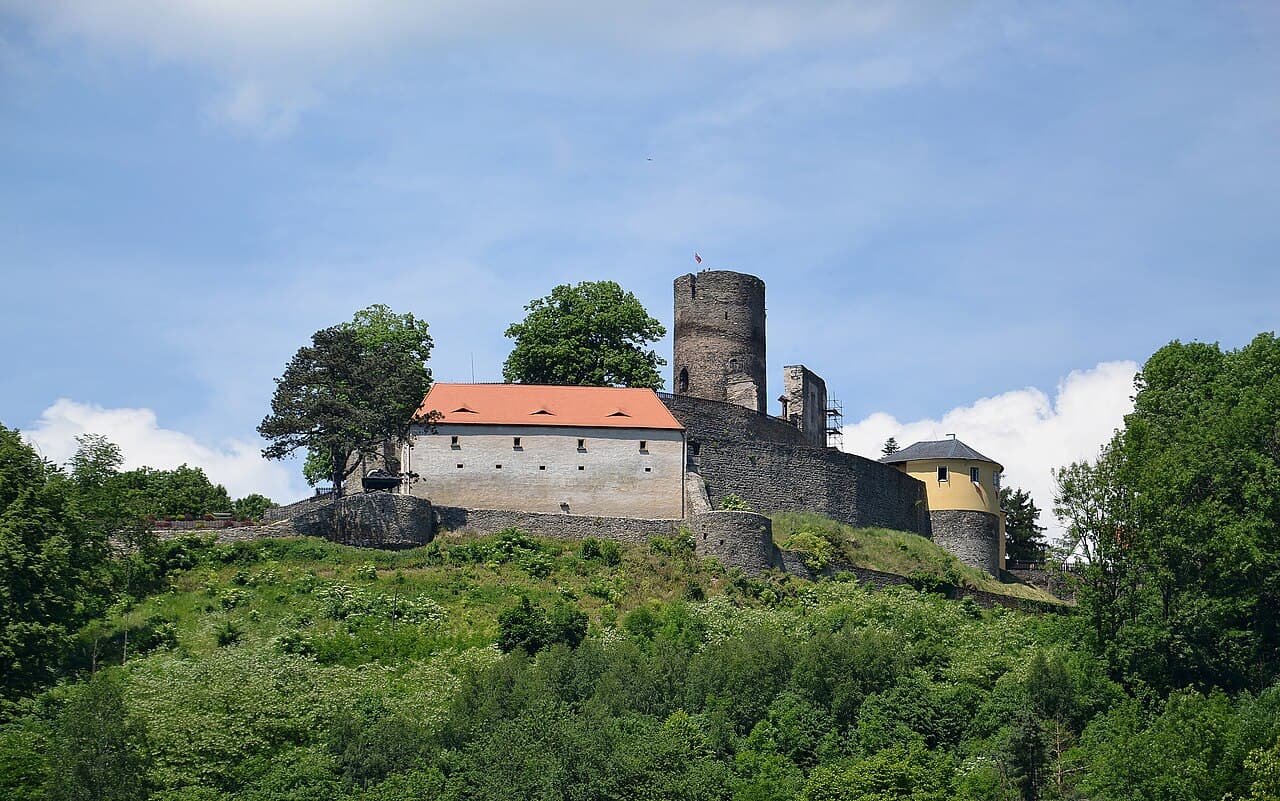
Svojanov Castle
Svojanov Castle stands as a remarkable example of a high medieval hill castle in the heart of the Czech Republic. Constructed originally in 1224, it was strategically positioned to oversee and protect a vital trade route connecting Bohemia and Moravia. This location on a rocky promontory overlooking the Křetínka River provided natural defensive advantages that were enhanced through successive architectural developments over centuries.
The castle’s origins are closely tied to the reign of King Přemysl Otakar II, who established the fortress as a royal stronghold in the mid-13th century. The first documented mention of the castle dates to 1287, when it was under the ownership of Záviš of Falkenstein. Záviš expanded the original fortress into a significant Gothic castle, reflecting the architectural styles and military needs of the period. Ownership of the castle fluctuated between noble families and the Bohemian crown, with notable possession by the Lords of Boskovice during the Hussite Wars in the early 15th century.
Medieval origins and strategic importance
The establishment of Svojanov Castle was primarily motivated by its role in securing the important trade route that linked the regions of Bohemia and Moravia. This route was crucial for commerce and military movements, making the castle a focal point in regional power struggles. The castle’s location on a hill allowed defenders to monitor the surrounding landscape and control access along the trade path.
Throughout the 13th and 14th centuries, Svojanov Castle served as a royal fortress and administrative center. Its early construction featured a robust curtain wall and a bergfrit—a tall cylindrical tower typical of medieval fortifications designed as a last refuge during sieges. The bergfrit at Svojanov is particularly notable for its two separate entrances on the first and second floors, with the ground floor accessible only via a hatch from above, enhancing its defensibility.
Castle architecture and defensive features
The castle complex is enclosed by a thick curtain wall, varying in thickness from about three meters in the oldest sections to five meters in later late Gothic modifications. This wall was supplemented by an outer line of fortifications including four semi-circular bastions arranged to provide flanking fire along the walls, a round tower, and a triangular bastion with rounded corners. These features reflect adaptations to evolving military technology and siege tactics over the centuries.
The bergfrit’s interior includes a vaulted stone dome on the ground floor and timber floors above, connected by ladder-like stairs. Its base measures approximately 1.9 meters in diameter, and the interior floor rests directly on the natural rock, with a small niche whose original purpose remains uncertain. This tower remains accessible today, offering visitors panoramic views of the surrounding landscape.
The castle’s palace, originally a three-room structure on the ground floor with potential upper chambers, retains much of its medieval core, especially in the cellar and western ground floor. Renaissance and Empire style renovations extended the palace eastward, reflecting changing tastes and residential needs. Access to the palace is through a steep stairway from the courtyard, passing two portals, with evidence of a blocked corridor that may have led to latrines.
Historical events and ownership changes
Svojanov Castle’s history is marked by significant events and changes in ownership. After Záviš of Falkenstein’s imprisonment in 1289, the castle reverted to royal hands and remained so until 1419. During the Hussite Wars, the castle was pledged to the Lords of Boskovice, who were influential nobles in the region. In the early 1500s, it was sold to the Trčka of Lípa family, who undertook Renaissance-style renovations.
The castle endured a siege by the famed Hussite commander Jan Žižka in 1421. Later, during the Thirty Years’ War (1618–1648), it suffered damage from fire and occupation by Swedish troops between 1642 and 1645. The decline of the castle’s military importance coincided with the rise of new transportation methods, such as railways, in the 19th century.
In the 19th century, the castle grounds were repurposed for industrial use, housing a graphite processing factory until a fire in 1842 caused significant damage. Subsequent reconstruction incorporated Empire style architectural elements, blending historical preservation with contemporary tastes of the period. Ownership transferred to the town of Polička in 1910, and the site was affected by events during World War II. Restoration efforts resumed after 1992 to preserve the castle's historical and cultural legacy.
Architectural evolution and restoration
Svojanov Castle’s architecture reflects a layered history of medieval fortification, Renaissance remodeling, and 19th-century stylistic updates. The original high medieval construction prioritized defense, evident in the thick walls, bergfrit tower, and strategic hilltop location. The later Gothic additions enhanced fortifications with bastions and improved curtain walls to adapt to advances in siege warfare.
The Renaissance period brought residential and aesthetic improvements, including expansions to the palace and the introduction of decorative elements. The 19th-century Empire style renovations added further refinements, particularly in interior spaces, blending functionality with elegance.
Since the mid-20th century, Svojanov Castle has been legally protected as a cultural monument, ensuring its preservation. Archaeological excavations, such as the 2011 discovery of a previously covered well in the courtyard, have provided valuable insights into the castle’s infrastructure and daily life.
Current condition and visitor experience
Today, Svojanov Castle is well preserved and open to the public. Visitors can explore the castle’s extensive grounds, including the bergfrit tower, palace, curtain walls, bastions, and remains of a chapel and gardens. The castle hosts cultural events and exhibitions showcasing life in the 19th century, enriching the visitor experience with historical context.
The castle’s elevated position offers panoramic views of the surrounding landscape, making it a popular destination for history enthusiasts and tourists. Its combination of medieval military architecture and later stylistic layers provides a tangible connection to the region’s complex past.
Visitor information and accessibility
Svojanov Castle is accessible year-round, with guided tours available to provide in-depth historical and architectural insights. The site’s facilities support cultural events, educational programs, and seasonal activities. Visitors are encouraged to explore the castle’s courtyards, towers, and exhibitions to fully appreciate its historical significance.
Frequently asked questions (FAQ)
- What is the historical significance of Svojanov Castle?
- Svojanov Castle dates back to the 13th century and is one of the oldest stone castles in Czechia. It played a crucial role in the defense of the region and has witnessed numerous historical events, making it an essential part of Czech heritage.
- When was Svojanov Castle built?
- The construction of Svojanov Castle began in the mid-13th century, around 1250. It was built as a royal fortress and has undergone various renovations throughout the centuries, reflecting different architectural styles.
- Can I visit Svojanov Castle, and what are the opening hours?
- Yes, Svojanov Castle is open to visitors, typically from April to October. The castle's opening hours may vary, so it's recommended to check their official website for the most current information before your visit.
- How do I get to Svojanov Castle?
- Svojanov Castle is located in the small town of Svojanov, accessible by car or public transportation. The nearest major city is Pardubice, from where you can take a regional bus or drive to the castle.
- What are the ticket prices for Svojanov Castle?
- Ticket prices for Svojanov Castle are generally affordable, with discounts available for children, students, and seniors. It’s advisable to check the castle's official website for the latest pricing and any special offers.
- Is it possible to take guided tours at Svojanov Castle?
- Yes, guided tours are available at Svojanov Castle, providing visitors with in-depth knowledge about its history and architecture. These tours typically run during the castle's opening hours and can enhance your experience significantly.
- What is the best time to visit Svojanov Castle?
- The best time to visit Svojanov Castle is during the spring and summer months when the weather is pleasant, and the grounds are in full bloom. Additionally, special events and activities often take place during these seasons, making your visit even more enjoyable.
- Are there any nearby attractions to visit while at Svojanov Castle?
- Yes, there are several nearby attractions, including the charming town of Polička and the scenic countryside of the Bohemian-Moravian Highlands. Exploring these areas can provide you with a richer experience of the region's history and natural beauty.
- Is Svojanov Castle accessible for visitors with disabilities?
- Svojanov Castle strives to accommodate all visitors, including those with disabilities. However, due to its historic architecture, some areas may have limited accessibility, so it's best to contact the castle in advance for specific inquiries regarding mobility options.
Photo gallery

Information
Website
Visit websiteSources & official resources
Verify the information above using these authoritative references.
Loading map...
Visitor reviews
No reviews yet. Been here? Write the first review and help other travelers!
Write the first reviewVisited this castle? Share your experience
Your review helps other travelers and adds first-hand knowledge to our encyclopedia.


