Dalečín Castle
Dalečín Castle stands as a significant example of a mid-14th century Gothic hill castle in the Czech Republic, embodying the medieval Bohemian noble tradition. Constructed by the Tasov family shortly after 1349, the castle's strategic location on a rocky promontory surrounded by the Svratka River offered natural defense, augmented by man-made fortifications such as a wide ditch and rampart. This site reflects the architectural and historical evolution typical of Luxembourg Gothic castles in the region.
Historical background and noble connections
The origins of Dalečín Castle are closely tied to Vznata of Tasov, who initiated its construction during the mid-14th century. Through marital ties to the powerful Pernštejn family, the castle came under their ownership by 1358, as documented in early records. Although the Pernštejns were a prominent noble house in Moravia and Bohemia, Dalečín Castle was not their primary residence, and detailed accounts of its role during their tenure remain limited.
Following the Hussite Wars in the 15th century, the castle's fortunes declined. It reportedly became a refuge for bandits, reflecting the turbulent regional conditions of the time. In the early 16th century, the castle suffered destruction, traditionally attributed to forces under Archleb Vranovský of Boskovice in 1519, although contemporary evidence for this event is sparse and debated among historians. By 1588, the castle was recorded as abandoned, with ownership transferring to Pavel Katharýn of Kathar, who established a new manor nearby, signaling the end of Dalečín Castle as a noble stronghold.
Architectural features and defensive design
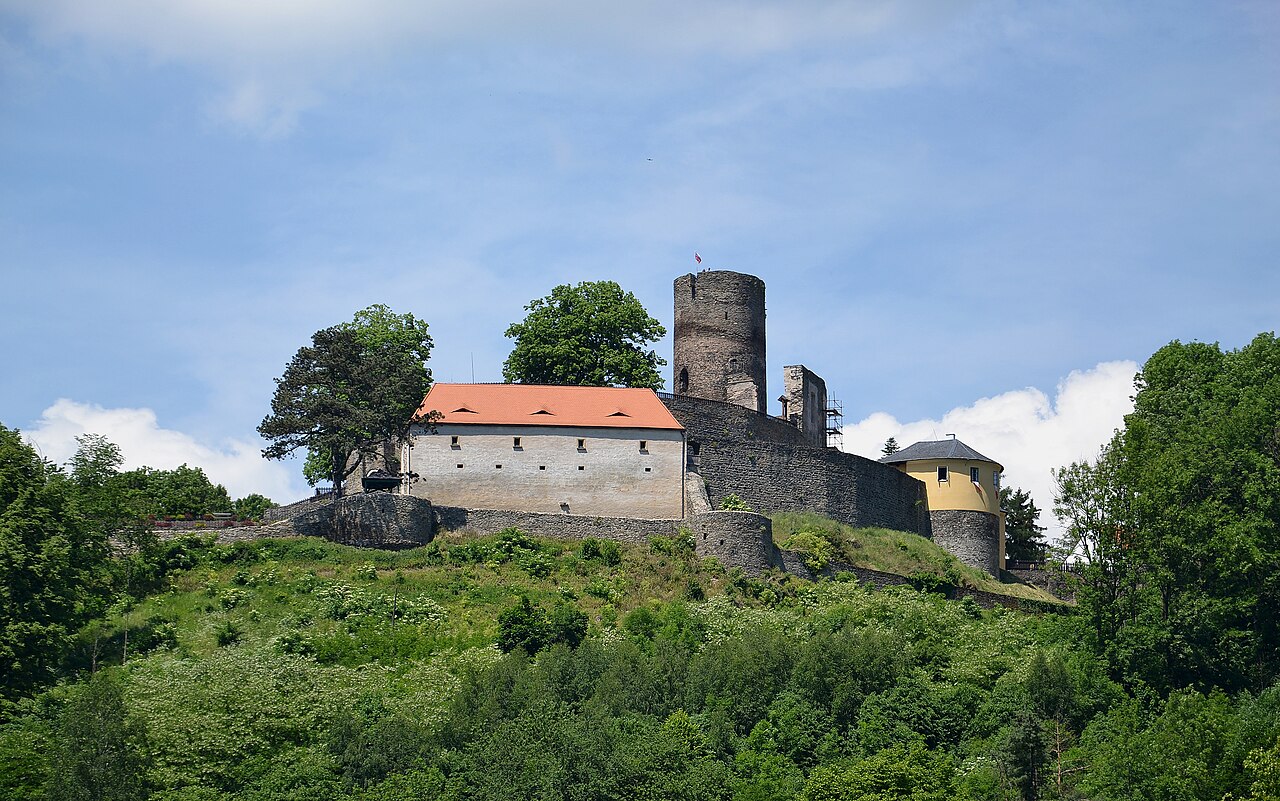
The castle exemplifies the Luxembourg Gothic style characteristic of mid-14th-century fortifications in Bohemia. Its most distinctive feature is the shield wall (plášťová zeď), a massive defensive wall designed to protect the most vulnerable side of the castle. Situated on a rocky outcrop, the castle was naturally defended on three sides by the Svratka River, with additional protection provided by an artificial rampart and a wide ditch measuring 11 to 13 meters across the approach.
The surviving remains include a substantial portion of the outer wall of the palas, a round residential building that housed the noble inhabitants. This wall, built of local stone, preserves evidence of three floors. The ground floor contains three embrasures, narrow vertical openings used for archery defense. The first floor was divided into two rooms with three windows, while the second floor features four windows and traces of either a latrine or a connecting passage to the outer defenses. Above this level, fragments of the battlement remain, indicating where guards would have stood watch.
Inside the palas walls, shallow niches once held built-in seats, providing insight into the living arrangements of the castle's residents. Access to the castle was likely through a parkán, a fortified forecourt with two gates, adding an extra layer of defense before reaching the main gates.
Post-medieval decline and preservation
After its destruction in the early 1500s, Dalečín Castle was never rebuilt. The site fell into ruin and was gradually reclaimed by nature. Today, the ruins are preserved as a protected cultural monument, offering valuable archaeological and architectural insights into medieval castle construction in the Czech lands.
The castle ruins have been stabilized and arranged within a park setting that allows visitors to view the masonry and architectural details clearly. The preservation of the shield wall, palas remains, and defensive earthworks provides a tangible connection to the region's medieval past and the noble families who once inhabited the site.
Cultural significance and visitor experience
Dalečín Castle is an important heritage site that illustrates the military and residential architecture of the Luxembourg Gothic period in Bohemia. Its strategic location and defensive features exemplify the adaptation of medieval castles to natural landscapes and evolving warfare techniques.
Visitors to the site can explore the ruins within a scenic park environment, appreciating the castle's historical context and architectural ingenuity. Interpretive signage and archaeological remains enhance understanding of the castle's original layout and function.
Frequently asked questions (FAQ)
- How do I get to Dalečín Castle?
- Dalečín Castle is located near the village of Dalečín in the Vysočina Region of Czechia. It can be reached by car or local public transport, with walking paths leading to the ruins from the village center.
- What is the historical significance of Dalečín Castle?
- Dalečín Castle is a notable example of a 14th-century Gothic hill castle that reflects the medieval noble culture of Bohemia and Moravia. It played a role in regional conflicts and noble ownership, illustrating architectural and defensive trends of its era.
- Can I visit the ruins of Dalečín Castle?
- Yes, the ruins of Dalečín Castle are accessible to the public. The site is preserved within a park setting, allowing visitors to explore the remains safely while enjoying the surrounding natural landscape.
- When was Dalečín Castle built?
- Dalečín Castle was constructed in the mid-14th century, shortly after 1349, by the Tasov family during the Luxembourg Gothic period.
- What architectural features are visible at Dalečín Castle?
- Visitors can see the remains of the shield wall, the round palas with three floors including embrasures and battlements, and the defensive ditch and rampart that protected the castle.
Information
Current owner
State cultural heritage authority
Loading map...
Visitor reviews
No reviews yet. Been here? Write the first review and help other travelers!
Write the first reviewVisited this castle? Share your experience
Your review helps other travelers and adds first-hand knowledge to our encyclopedia.