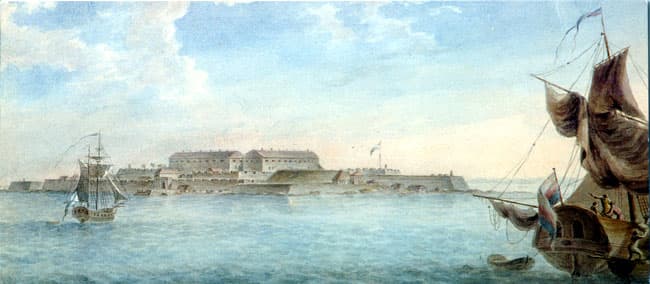
Svartholma Fortress
Svartholma fortress is a prominent 18th-century bastion sea fortress located on a small island near Loviisa, Finland. Built by Sweden between 1748 and 1770, it was strategically designed to protect the eastern border of Sweden-Finland and secure vital maritime routes against Russian advances. The fortress exemplifies post-Renaissance military architecture with its well-planned bastion system, integrating four main bastions and an outer fortification to create overlapping fields of fire, a hallmark of the era's defensive design.
The strategic importance of svartholma fortress
Following the Treaty of Åbo in 1743, which shifted Sweden's eastern border closer to the Kymi River, the need for robust coastal defenses became paramount. Svartholma was constructed as a maritime stronghold to protect the critical road from Turku to Viborg and to serve as a naval base alongside the nearby Loviisa land fortress. Its location on a narrow island allowed control over sea access routes and provided a key logistical hub for the Swedish fleet.
During the Russo-Swedish War of 1788–1790, although Svartholma did not endure direct combat, it functioned as a vital naval stronghold and supply base. The fortress supported the Swedish fleet during the Battle of Ruotsinsalmi, a significant naval victory against Russian forces. However, its military role diminished during the Finnish War (1808-1809), when Russian forces besieged the fortress. Despite sporadic artillery fire causing minimal damage, the garrison surrendered due to poor morale and supply shortages under the command of Carl Magnus Gripenberg.
Architectural design and construction details
Bastion system and fortifications
Svartholma fortress is a classic example of an 18th-century bastion fort, featuring four primary bastions named von Röök, von Schantz, Qveckfeldt, and Nordenskiöld. These bastions were arranged to provide comprehensive defensive coverage through overlapping artillery fire. The fortress walls, constructed predominantly from locally quarried granite, stand between seven and nine meters high, forming a formidable barrier against attackers.
The design included brick-vaulted casemates—bombproof chambers used for housing artillery and supplies—with nineteen such casemates integrated into the fortress walls, along with twenty-two sections of granite masonry. The walls were originally topped with open firing platforms, which were later replaced with attic floors and waterproof roofs to improve durability and living conditions.
Internal structures and facilities
Within the fortress, several key buildings served military and logistical purposes. The barracks contained five rooms with bombproof vaulted ceilings, providing protection for soldiers. Storage needs were met by six dedicated rooms, while food preparation facilities included three baking chambers, five kitchens, and eight halls. The presence of two chapels indicates the importance of spiritual care for the garrison. Additionally, two powder magazines were constructed with safety features such as fire ladders and storage attics to minimize explosion risks.
Maritime access was facilitated by two piers: a loading pier approximately 42 meters long and a ship pier about 47 meters long, both around six meters wide. These allowed efficient transfer of troops, artillery, and supplies between sea vessels and the fortress.
Historical phases and military engagements
Construction of Svartholma began under the supervision of Colonel Augustin Ehrensvärd, a renowned military engineer who also designed the famous Suomenlinna fortress. Work was interrupted by European conflicts such as the Pomeranian War and the Seven Years’ War, delaying completion until the 1760s. Some planned defensive elements, including ravellins intended to protect the eastern and western gates, were never finished, slightly weakening the fortress's overall defense.
During the Finnish War, the fortress was besieged by Russian forces in 1808 but surrendered without significant damage due to low morale and supply shortages. After Finland became part of the Russian Empire in 1809, Svartholma lost its frontline military significance and was repurposed as a prison facility, housing Finnish and Russian detainees until the early 1850s.
The fortress suffered substantial damage during the Crimean War in 1855 when British naval forces deliberately destroyed parts of it to prevent Russian use. Following this, the fortress fell into disrepair, with walls collapsing and structures overgrown by vegetation.
Restoration and current status
Restoration efforts began in the early 20th century and intensified in the 1960s under the guidance of Finland’s National Board of Antiquities. Archaeological excavations and structural repairs uncovered the inner courtyard, barracks ruins, and cobblestone paths linking the main gate to the shore. Some bastion walls were reinforced and partially rebuilt, and protective coverings were installed over vulnerable ruins.
A historically informed wooden pier was reconstructed to replicate the fortress's original maritime access. Today, Svartholma fortress stands as a well-preserved cultural heritage site and popular tourist attraction. Visitors can explore the fortress through guided walking tours and visit the onsite museum. Seasonal ferry services from Loviisa provide convenient access during the summer months.
Architectural significance and cultural heritage
Svartholma fortress is a significant example of post-Renaissance bastion fortifications in the Baltic region, illustrating the military architectural advancements of the 18th century. Its design reflects the strategic military thinking of the era, emphasizing strong coastal defense and naval support. The fortress's layered history—from Swedish military bastion to Russian prison, and finally to a restored heritage site—offers valuable insights into the geopolitical shifts in Northern Europe over several centuries.
Its preservation allows visitors to appreciate the complexity of bastion fort design, including the integration of living quarters, storage, and defensive structures within a compact island setting. The site serves not only as a monument to military history but also as a cultural symbol of Finland's layered past and resilience.
Frequently asked questions (FAQ)
- How do I get to Svartholma fortress?
- Svartholma fortress is accessible by ferry from Loviisa during the summer months. The ferry provides a scenic and convenient route to the island where the fortress is located.
- What is the best time to visit Svartholma?
- The best time to visit Svartholma fortress is during the summer when the ferry service operates, and guided tours are available. The weather is pleasant for exploring the outdoor areas of the fortress.
- Can I take guided tours at Svartholma fortress?
- Yes, guided walking tours are offered at Svartholma fortress, providing detailed historical and architectural insights about the site.
- Is Svartholma fortress wheelchair accessible?
- Due to the historic nature and terrain of the fortress island, wheelchair accessibility is limited. Visitors with mobility concerns should inquire in advance about available accommodations.
- What are the opening hours of Svartholma fortress?
- Svartholma fortress is generally open during the summer months when the ferry operates, typically from late May to early September. Specific hours may vary, so checking local schedules before visiting is recommended.
Photo gallery

Photo by Гавриил Сергеевич Сергеев (1765—1816)•Public domain
Information
Sources & official resources
Verify the information above using these authoritative references.
Loading map...
Visitor reviews
No reviews yet. Been here? Write the first review and help other travelers!
Write the first reviewVisited this castle? Share your experience
Your review helps other travelers and adds first-hand knowledge to our encyclopedia.



