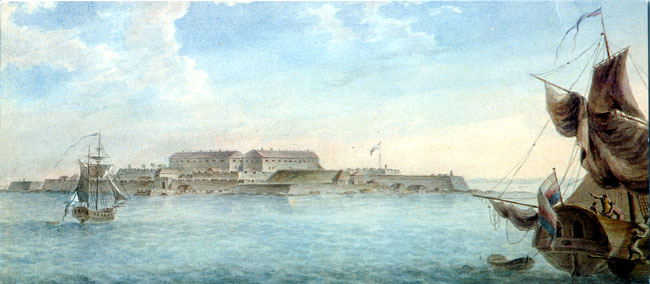
Loviisa Fortress
Loviisa fortress is a notable example of 18th-century military architecture in Finland, reflecting the strategic importance of the region during the post-Renaissance period. Constructed between 1748 and 1757, the fortress was part of a broader defensive system initiated after Sweden's defeat in the Russo-Swedish War of 1741-1743, also known as the Hats' Russian War. This conflict resulted in the shifting of Finland's eastern border westward, leaving several key fortresses such as Hamina, Lappeenranta, and Savonlinna on the Russian side. As a consequence, the establishment of new fortifications became essential for Sweden to secure its remaining territories.
The city of Loviisa was founded in 1745 to serve as a hub for international commerce within Finland. Its location along the strategic road connecting Vyborg to Turku made it a critical point for defense and trade. In 1747, the Swedish parliament approved a plan to build twin fortresses: one within Loviisa to protect the land route, and another on the nearby Svartholma island to defend the city from sea attacks. These fortifications were designed to work in tandem to safeguard the region from potential Russian incursions.
Construction challenges and incomplete plans
The construction of the Loviisa fortress began promptly in 1748, but progress was hampered by several significant issues. The site chosen for the fortress was characterized by muddy ground conditions, which proved unsuitable for the heavy stone walls originally planned. This geological challenge complicated the building process and necessitated adjustments to the construction methods and materials.
Additionally, the Swedish Crown faced a persistent shortage of funds throughout the project, which further slowed the work. Despite ongoing efforts, the fortress was never completed as initially envisioned. Construction was halted in 1757, and although some work continued intermittently, King Gustav III ultimately ordered the permanent cessation of building activities in 1775.
Architectural features and surviving structures
Today, the most visible remnants of the Loviisa fortress are the two bastions named Rosen and Ungern. These bastions represent the core defensive elements of the fortress and illustrate the military architectural style of the period. The Ungern bastion has undergone significant renovation since the 1960s and is largely restored, offering visitors a glimpse into the fortress's original defensive capabilities.
In contrast, the Rosen bastion remains mostly incomplete and in a ruined state. Its condition reflects the halted construction and the challenges faced during the fortress's development. These bastions were designed to provide overlapping fields of fire and strong defensive positions typical of post-Renaissance bastioned fortifications, which emphasized angled walls and artillery placements to resist siege warfare.
Role in regional conflicts and historical significance
Despite its strategic importance, the Loviisa fortress never saw battle. During the Finnish War of 1808-1809, the fortress surrendered to Russian forces without resistance. This decision was driven by the local population's desire to avoid the destruction of the city, reflecting the complex interplay between military strategy and civilian considerations during wartime.
The fortress's history is closely linked to the broader geopolitical shifts in Northern Europe during the 18th century, especially the rivalry between Sweden and Russia for control over Finland. The fortifications at Loviisa and Svartholma were part of Sweden's effort to fortify its new western border and maintain its influence in the region.
Modern preservation and visitor experience
Since the 1960s, efforts to preserve and restore parts of the Loviisa fortress have been underway, with particular focus on the Ungern bastion. These renovations have aimed to stabilize the structures and make them accessible for educational and cultural purposes. The fortress today stands as a historical site that offers insight into 18th-century military engineering and the turbulent history of Finland's borderlands.
Visitors to Loviisa can explore the restored bastion and the surrounding areas, which provide a tangible connection to the military and political history of the region. The site is an important cultural landmark that illustrates the challenges of fortress construction in difficult terrain and the shifting tides of European power struggles in the early modern era.
Frequently asked questions (FAQ)
- When was Loviisa fortress built?
- Loviisa fortress was constructed between 1748 and 1757 following the Russo-Swedish War to secure Finland's new western border.
- Why was the construction of Loviisa fortress never completed?
- The construction was halted due to unsuitable muddy ground conditions and a persistent lack of funds, with work stopping permanently in 1775 by order of King Gustav III.
- What remains of Loviisa fortress today?
- Two bastions, Rosen and Ungern, survive today. Ungern has been mostly renovated since the 1960s, while Rosen remains largely in ruins.
- Did Loviisa fortress ever see battle?
- No, the fortress never saw battle and surrendered to Russian forces without fighting during the Finnish War of 1808-1809 to avoid city destruction.
- Where is Loviisa fortress located?
- Loviisa fortress is located in the city of Loviisa, in the Uusimaa region of Finland, along a strategic road from Vyborg to Turku.
Information
Loading map...
Visitor reviews
No reviews yet. Been here? Write the first review and help other travelers!
Write the first reviewVisited this castle? Share your experience
Your review helps other travelers and adds first-hand knowledge to our encyclopedia.