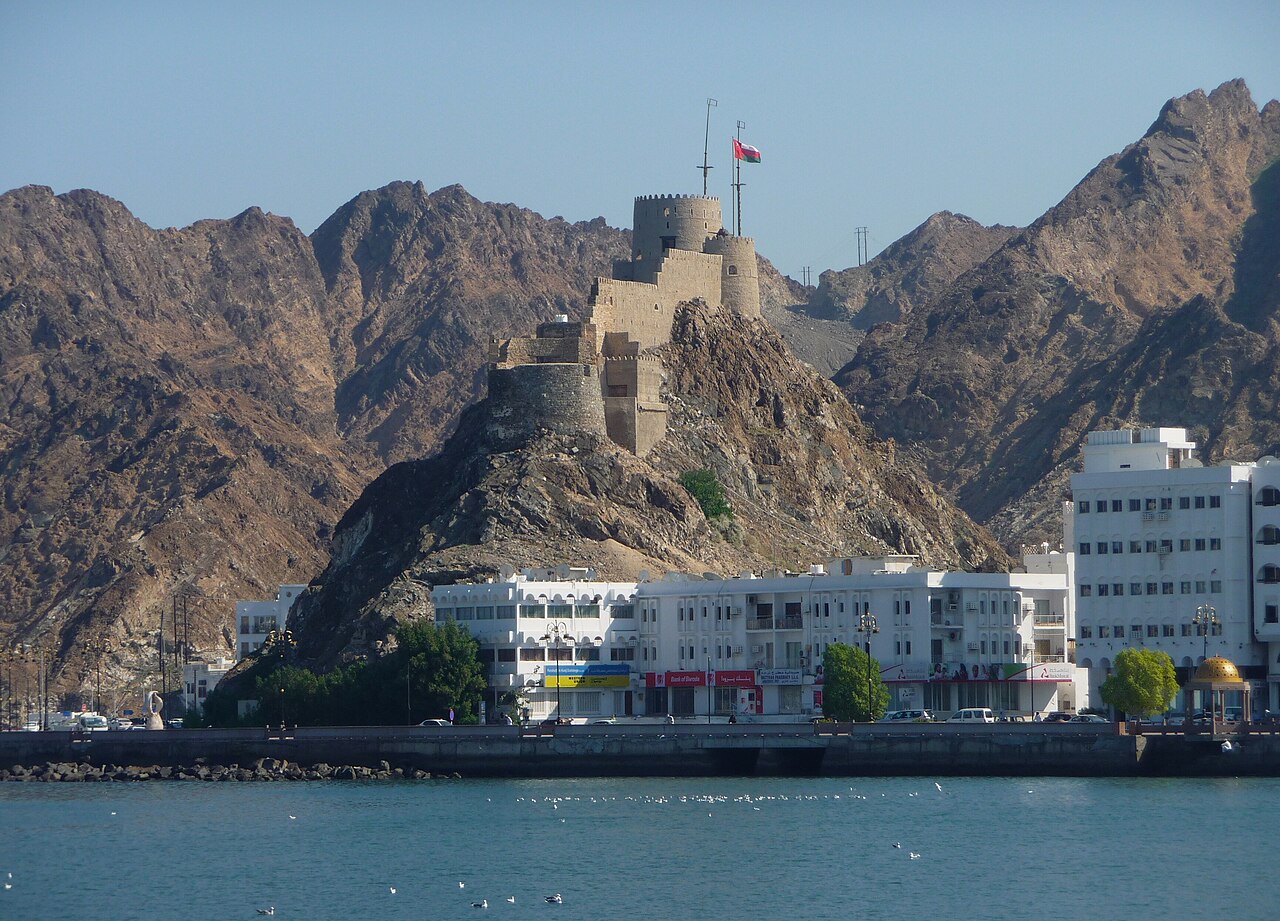
Sur Al Lawatia Tower
The Sur Al Lawatia Tower is a notable historical structure located in the town of Mutrah within the Muscat Governorate of Oman. It is part of the Sur Al Lawatia district, a distinctive walled-off area adjacent to the bustling Mutrah Souq. This district is characterized by its rectangular shape and fortified walls, which enclose a private residential area traditionally inhabited by families of the Al Lawati tribe, a prominent merchant community in the region.
The Al Lawati tribe has played a significant role in the commercial history of Mutrah, and their settlement within this fortified district reflects their social status and the need for security in earlier centuries. The district is notably secluded, with only two gates providing access, emphasizing its function as a private housing complex rather than a public space. Consequently, visitors are not permitted to enter the district, and the tower itself can only be appreciated from the outside.
The historical context of Sur Al Lawatia Tower
The precise date of construction for the Sur Al Lawatia Tower and the surrounding walled district remains uncertain. However, historical suggestions link the origins of the settlement of Mutrah to the Portuguese presence in the region during the 17th century. It is believed that the walled district may have originally served as a garrison for the Portuguese forces who controlled parts of the Omani coast during this period.
Following the expulsion of the Portuguese from Oman, the Sultan is said to have granted the district to the Al Lawati tribe, thereby transforming the area from a military installation into a residential and commercial enclave for this influential merchant group. This transition highlights the shifting power dynamics and cultural influences in Oman during the Renaissance period.
Architectural features and layout
The Sur Al Lawatia Tower itself is a simple, rectangular corner tower that forms part of the district's defensive walls. While modest in design compared to larger forts and castles, its strategic position as a corner tower would have been important for surveillance and defense of the enclosed area.
The tower's architecture reflects practical considerations typical of the period and region, focusing on functionality rather than elaborate ornamentation. The surrounding walls create a secure perimeter around the residential district, which was essential for protecting the inhabitants and their valuable commercial assets.
Relation to nearby historic sites
The tower is located near other significant historical landmarks in Mutrah, including the Mutrah Fort, which is a larger and more fortified structure. The proximity of Sur Al Lawatia Tower to Mutrah Fort suggests a coordinated defensive network protecting the harbor and town.
Visitors to the area often explore the atmospheric Mutrah Souq and can view the tower externally as part of the rich historical fabric of Mutrah's old town. Although entry into the Sur Al Lawatia district is restricted, the tower remains an important visual reminder of the area's layered history.
Preservation and current status
Today, the Sur Al Lawatia Tower is preserved as part of the private residential district of the Al Lawati tribe. Its condition is maintained as a well-preserved historical structure, although it is not open to public access. The tower's external appearance offers insight into the defensive architecture of the period and the social organization of Mutrah's merchant communities.
The tower and district continue to serve as a cultural heritage site, illustrating the blend of military, commercial, and residential functions in Omani coastal towns during the 17th century. Its presence enriches the historical landscape of Mutrah and provides context for understanding the region's maritime and trading history.
Frequently asked questions (FAQ)
- What is the historical significance of Sur Al Lawatia Tower?
- Sur Al Lawatia Tower is historically significant as part of a walled district inhabited by the Al Lawati merchant tribe, possibly built on a former Portuguese garrison site from the 17th century.
- Can visitors enter the Sur Al Lawatia district?
- No, the Sur Al Lawatia district is a private residential area with restricted access, so visitors can only view the tower from the outside.
- Where is Sur Al Lawatia Tower located in relation to other historic sites?
- The tower is near Mutrah Souq and close to Mutrah Fort, forming part of the historical defensive and commercial area of Mutrah in Muscat.
- What architectural features characterize Sur Al Lawatia Tower?
- The tower is a simple rectangular corner tower forming part of the district's defensive walls, designed primarily for surveillance and protection.
- When was Sur Al Lawatia Tower built?
- The tower dates back to the 17th century, during the Renaissance period, linked to the Portuguese presence in Oman.
Information
Loading map...
Visitor reviews
No reviews yet. Been here? Write the first review and help other travelers!
Write the first reviewVisited this castle? Share your experience
Your review helps other travelers and adds first-hand knowledge to our encyclopedia.