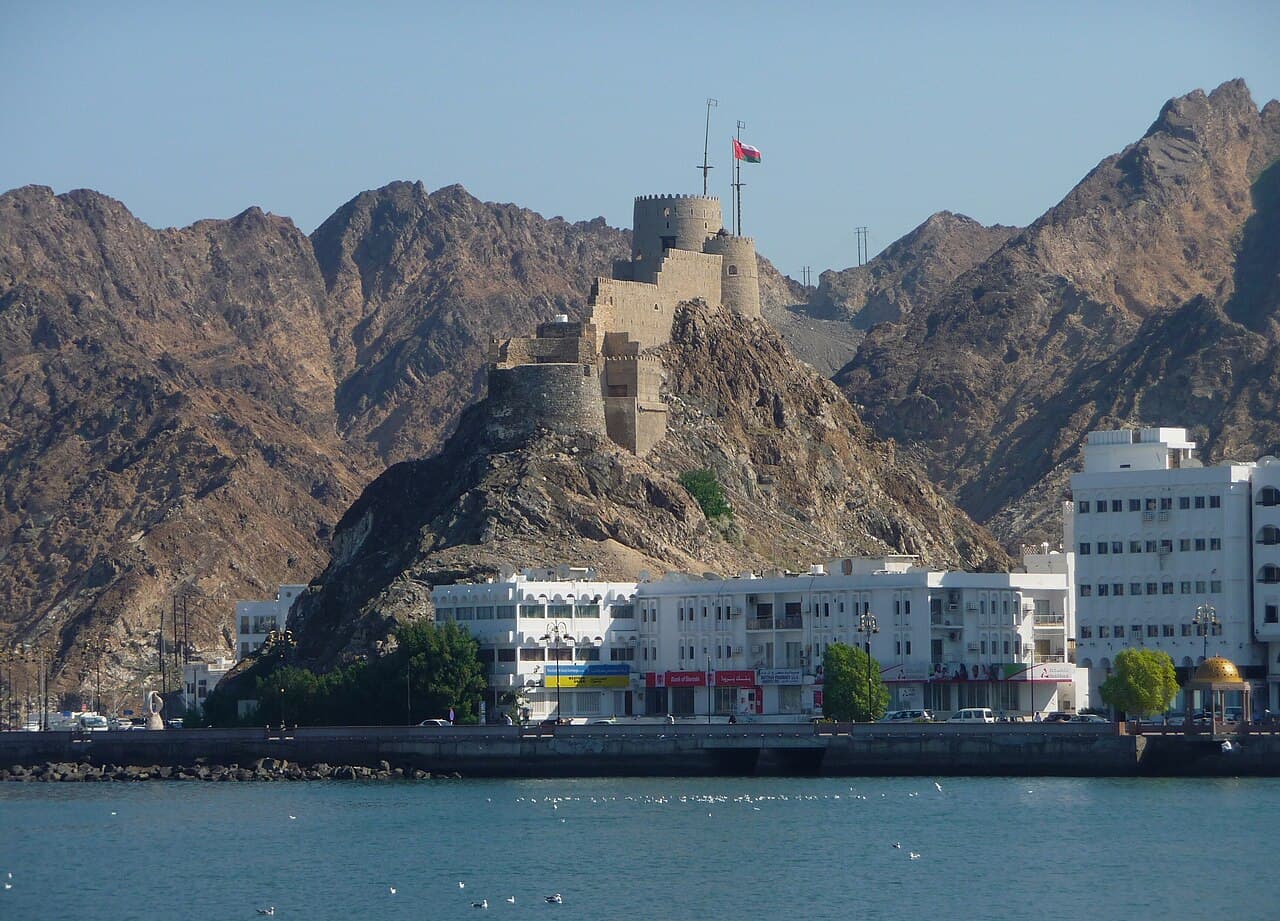
Mutrah Fort, located in the coastal town of Mutrah within the Muscat Governorate of Oman, is a significant historical bastioned fortress that played a pivotal role in the defense of the important Mutrah harbor. The fort's origins trace back to the early 16th century, with construction phases attributed to both the Omanis and the Portuguese, reflecting the complex colonial and regional conflicts of the 16th century.
Historical background and strategic importance
The initial fortification at Mutrah Fort likely began around 1507 when the Omanis are believed to have constructed two defensive towers on a prominent rocky outcrop overlooking the harbor. These towers were part of early efforts to secure the coastline against foreign incursions. Shortly after, around 1575, the Portuguese either built or significantly enhanced these towers as part of their broader strategy to control the maritime trade routes in the Arabian Peninsula and protect their interests in the region.
The Portuguese expanded the fortifications by connecting the two towers with curtain walls, effectively transforming the structure into a more formidable bastioned fortress. This design allowed for better defense and control over the harbor approaches, a critical factor given Mutrah's role as a key port in Oman.
Mutrah Fort was further supported by a network of eight watchtowers strategically positioned on surrounding rocky outcrops. These towers were arranged so that the fort's artillery could target and destroy any watchtower that might fall to enemy forces, creating a layered defense system to protect the harbor and town.
Architectural features and layout
The fort has an elongated shape that follows the natural contours of the rocky promontory on which it stands. This adaptation to the terrain maximized its defensive capabilities, allowing for extensive views over the harbor and surrounding sea approaches. The fort's walls and bastions are constructed from local stone, providing robust protection against artillery and siege tactics of the period.
Key architectural elements include the two original towers, thick curtain walls, bastions equipped with cannon placements, and internal courtyards. The design reflects the bastioned fortress style common in the late medieval and early modern periods, emphasizing angled walls and bastions to deflect cannon fire and provide overlapping fields of fire.
Military history and sieges
Mutrah Fort was a focal point during the turbulent conflicts between the Portuguese, Ottoman Empire, and the Omanis in the late 16th and early 17th centuries. It fell twice to Ottoman admirals Piri Reis and Ali Beg during their campaigns in the region in the late 1500s. These captures underscored the fort's strategic value in controlling access to the Arabian Gulf and the Indian Ocean trade routes.
In the 1640s, the fort was reclaimed by the Omanis, marking a turning point in their efforts to expel the Portuguese from the region. The successful recapture of Mutrah Fort was instrumental in the eventual Portuguese withdrawal from Oman in 1650, ending decades of colonial dominance.
Restoration and current status
After centuries of military use and periods of neglect, Mutrah Fort underwent significant restoration in the 1980s. These efforts aimed to preserve the fort as a cultural and historical monument, maintaining its structural integrity and making it accessible to visitors.
Today, the fort is well-preserved and open to the public for a small entrance fee. Visitors can explore the fort's walls, towers, and courtyards, gaining insight into its defensive architecture and historical significance. Within the fort, there is a small café, although it may not always be operational.
The fort's location near the Sur Al Lawatia Tower and the vibrant Mutrah Souq adds to its appeal, offering visitors a rich cultural experience combining history, architecture, and local commerce.
Visiting information and tips
Mutrah Fort is accessible to visitors interested in Oman’s maritime and military history. The site provides panoramic views of the harbor and the city of Mutrah, making it a favored spot for photography and historical tours. The fort's elevated position also offers a unique perspective on the relationship between the natural landscape and defensive architecture.
Visitors should check opening hours and ticket prices in advance, as these can vary seasonally. The nearby Mutrah Souq is an excellent place to explore after visiting the fort, offering traditional crafts, spices, and local goods.
Frequently asked questions (FAQ)
- When was Mutrah Fort originally built and by whom?
- Mutrah Fort's initial construction likely began around 1507 by the Omanis, with significant enhancements by the Portuguese around 1575.
- What architectural style characterizes Mutrah Fort?
- Mutrah Fort features bastioned fortress architecture typical of the late medieval to early modern period, emphasizing angled walls and bastions for artillery defense.
- Can visitors access Mutrah Fort today?
- Yes, Mutrah Fort is open to the public for a small fee and offers panoramic views of the harbor and city of Mutrah.
- What role did Mutrah Fort play in regional conflicts?
- The fort was central in conflicts between the Portuguese, Ottomans, and Omanis in the 16th and 17th centuries, including Ottoman captures and the Omani recapture that led to Portuguese expulsion.
- Are there other nearby attractions to visit along with Mutrah Fort?
- Yes, visitors often explore the nearby Sur Al Lawatia Tower and the traditional Mutrah Souq, both rich in cultural heritage.
Photo gallery

Information
Loading map...
Visitor reviews
No reviews yet. Been here? Write the first review and help other travelers!
Write the first reviewVisited this castle? Share your experience
Your review helps other travelers and adds first-hand knowledge to our encyclopedia.


