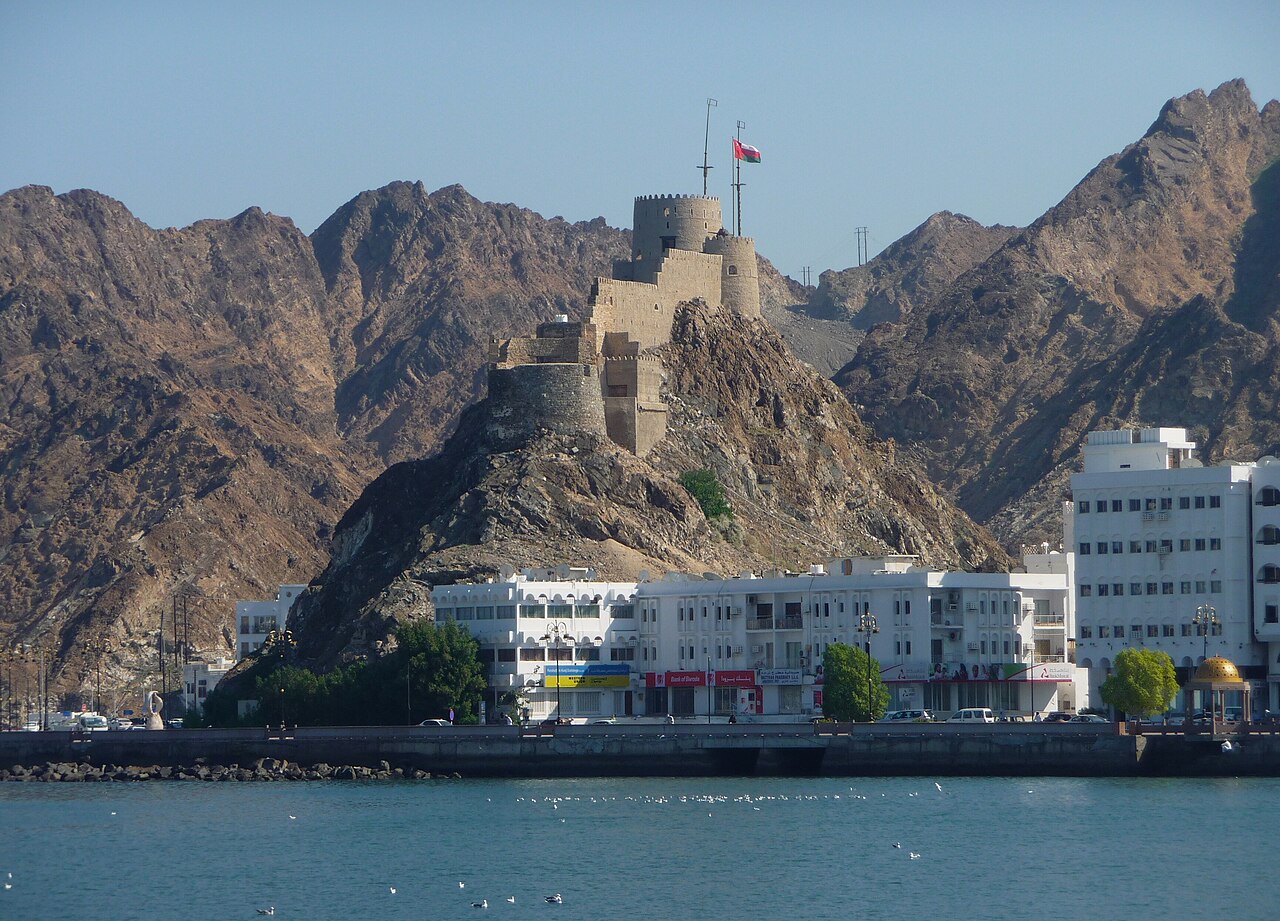
Bait Al Falaj Fort
Bait Al Falaj Fort is a historic military fortress located in the town of Bayt Al Falaj within the Muscat Governorate of Oman. Constructed in 1845 by Sultan Said bin Sultan, the fort originally stood in a strategic position next to the Alkbir Wadi, commanding access to vital mountain passes, including one leading to the important coastal town of Mutrah. At the time of its construction, the fort was surrounded by a wide open valley and rocky mountains that provided natural defense and made the area difficult to traverse.
The initial structure of Bait Al Falaj Fort was a simple square building centered around a courtyard. Over time, the fort was enhanced with the addition of two round towers positioned at opposite corners, which improved its defensive capabilities. These towers were not part of the original design but were added later to strengthen the fortifications.
Military significance and historical events
In 1907, the fort was designated as the Military Headquarters for the Sultan's Armed Forces, underscoring its importance in Oman's defense infrastructure. This role continued for several decades, making it a central point for military operations and administration.
One of the most notable historical events involving Bait Al Falaj Fort occurred in January 1915, following the death of Sultan Faisal bin Turki in 1913. A coalition of tribes opposed his successor, Sultan Taimur bin Faisal, and targeted the fort as a symbol of the ruling authority. The rebels launched a full-scale assault on the fort, resulting in heavy casualties on both sides. Despite the fierce attack, the fort's defenders successfully repelled the rebellion, maintaining control of this strategic stronghold.
Architectural features and layout
The fort's architecture reflects typical military design of the mid-19th century in Oman. The central courtyard served as a multifunctional space for gatherings, drills, and daily activities. The surrounding walls and towers were constructed to withstand attacks and provide vantage points for surveillance and defense. The use of round towers was a tactical choice, as their shape deflected projectiles more effectively than square towers.
Inside the fort, various chambers and halls accommodated military personnel and administrative functions. The robust walls and elevated positions allowed for effective control of the surrounding terrain and protection against invaders.
Transition to museum and current status
After serving as the military headquarters until the 1970s, Bait Al Falaj Fort was repurposed to preserve and showcase Oman's military heritage. In 1988, it was officially opened as the Sultan's Armed Forces Museum. The museum houses a collection of military artifacts, weapons, uniforms, and historical exhibits that illustrate the development of Oman's armed forces and their role in the nation's history.
The museum's open-air exhibition extends to the grounds surrounding the fort, allowing visitors to explore various military equipment and displays in an outdoor setting. This integration of indoor and outdoor exhibits provides a comprehensive experience of Omani military history.
Visiting information and cultural importance
Today, Bait Al Falaj Fort remains a prominent cultural landmark in Muscat. Visitors can tour the museum for a fee and explore the fort's architectural features and historical exhibits. Its location within the town means the fort is now surrounded by modern development, but it retains its historical significance and offers insight into Oman's military past.
The fort and museum attract tourists, historians, and military enthusiasts interested in the region's history. It serves as a reminder of Oman's strategic military importance and the legacy of its rulers who shaped the nation's defense systems.
Frequently asked questions (FAQ)
- What is the historical significance of Bait Al Falaj Fort?
- Bait Al Falaj Fort was built in 1845 by Sultan Said bin Sultan and served as the Military Headquarters for Oman's armed forces from 1907 until the 1970s. It played a key role in defending mountain passes and was the site of a major 1915 siege during a tribal rebellion.
- Can visitors tour Bait Al Falaj Fort today?
- Yes, the fort is now home to the Sultan's Armed Forces Museum and is open to visitors for a fee. The museum features military artifacts and outdoor exhibits on the fort's grounds.
- What architectural features distinguish Bait Al Falaj Fort?
- The fort originally had a square layout around a central courtyard, with two round towers added later at opposite corners. These towers enhanced its defensive capabilities and provided strategic vantage points.
- When was Bait Al Falaj Fort converted into a museum?
- The fort was converted into the Sultan's Armed Forces Museum in 1988, preserving Oman's military heritage and history.
- Where is Bait Al Falaj Fort located?
- Bait Al Falaj Fort is located in the town of Bayt Al Falaj within the Muscat Governorate of Oman, situated near the Alkbir Wadi and commanding access to mountain passes leading to Mutrah.
Information
Current owner
State museum
Address
Al Mujamma St., Oman
Loading map...
Visitor reviews
No reviews yet. Been here? Write the first review and help other travelers!
Write the first reviewVisited this castle? Share your experience
Your review helps other travelers and adds first-hand knowledge to our encyclopedia.