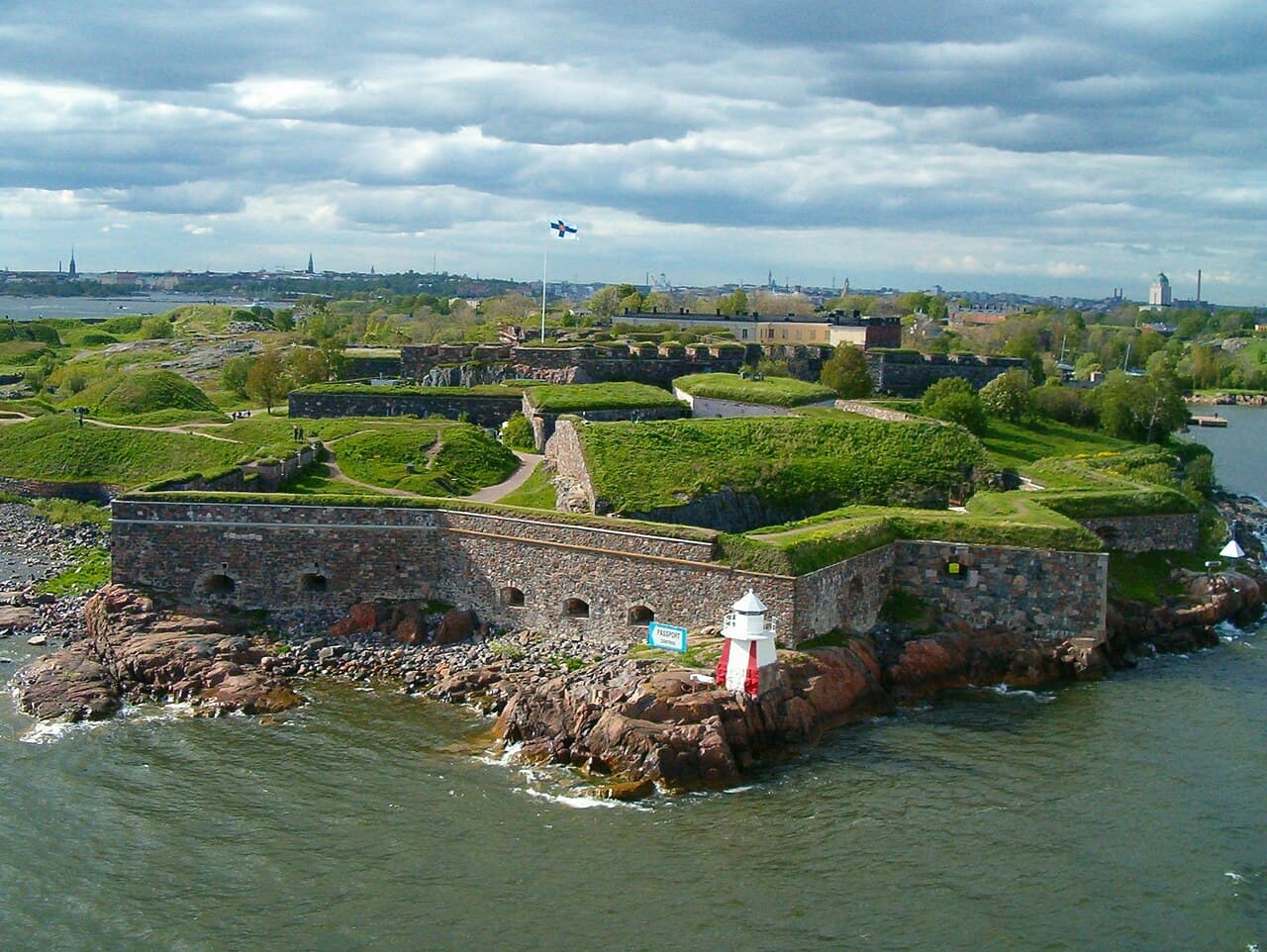
Suomenlinna
Suomenlinna, also known by its Swedish name Sveaborg and formerly as Viapori in Finnish, is a significant bastioned fortress located on a group of eight islands approximately four kilometres southeast of Helsinki, the capital of Finland. This maritime fortress, constructed in the 18th century under the Swedish Crown, was designed to protect the realm from Russian expansion. Its strategic position in the Baltic Sea and its impressive fortifications have made Suomenlinna a key military site and a cultural landmark.
Architectural design and construction
The fortress's construction began in 1748, directed by Admiral Augustin Ehrensvärd, a notable military architect and officer. Ehrensvärd's design was heavily inspired by the principles of the star fort style, a form of bastion fortification popularized by the French military engineer Sébastien Le Prestre de Vauban. This style featured angular bastions projecting outward from the curtain walls to eliminate blind spots and provide overlapping fields of fire, enhancing the fortress's defensive capabilities.
Suomenlinna's design was adapted to the unique topography of the rocky islands, integrating natural features with man-made defenses. The fortress comprises six fortified islands, connected by bridges and causeways, with extensive bastions, ramparts, moats, and sea walls. The layout allowed for a strong defensive perimeter that could withstand naval and land assaults. The use of local granite and other durable materials ensured the fortress's resilience against both military attacks and harsh maritime weather.
Historical significance and military role
Swedish era and the finnish war
During its initial period under Swedish control, Suomenlinna was a critical naval base and defensive stronghold. However, in the Finnish War of 1808-1809, the fortress was besieged by Russian forces. Despite its formidable defenses and reputation as the "Gibraltar of the North", Suomenlinna surrendered after a two-month siege on 3 May 1808. This surrender was pivotal, facilitating Russia's conquest of Finland and the establishment of the Grand Duchy of Finland within the Russian Empire.
Russian rule and modernization
Under Russian administration, the fortress was renamed Sveaborg and served as a major naval base for the Baltic Fleet. The Russians undertook significant modernization efforts, including the construction of the Krepost Sveaborg defense system beginning in 1915 during World War I. These upgrades included reinforced artillery positions and expanded fortifications to adapt to evolving military technologies and threats.
Following Finland's declaration of independence in 1917, the fortress was abandoned by Russian forces. It was renamed Suomenlinna in 1918 to reflect Finnish sovereignty, although its Swedish name Sveaborg remains in use. The fortress also played a role during the Finnish Civil War as the site of a prison camp for captured Red Guard soldiers.
Cultural heritage and current status
After serving as a military installation for over two centuries, Suomenlinna's control was transferred from the Finnish Defense Department to civilian authorities in 1973. Today, it is a popular tourist destination known for its scenic beauty and historical significance. Visitors can explore the extensive network of bastions, tunnels, and historic buildings that illustrate its military past.
Recognized for its outstanding representation of bastion fortifications adapted to a maritime environment, Suomenlinna was designated a UNESCO World Heritage Site in 1991. The fortress is also valued as a cultural venue, hosting museums, galleries, and events that celebrate Finnish history and heritage.
Architectural features and layout
Suomenlinna's design incorporates multiple layers of defense. The bastions are positioned to cover each other with cannon fire, while the curtain walls connect these bastions, forming a continuous defensive perimeter. The fortress includes sea gates allowing controlled access from the water, and dry moats that enhance landward defense.
The fortress's buildings include barracks, magazines, command posts, and chapels, many of which retain their original 18th and 19th-century character. The integration of natural rock formations into the fortifications is a distinctive feature, providing both strength and camouflage.
Visiting information and tourism
Accessible by ferry from Helsinki, Suomenlinna offers visitors a unique opportunity to experience a historic military fortress set in a maritime landscape. The islands feature walking trails, picnic areas, cafes, and museums that interpret the site's history. Guided tours provide insights into the fortress's construction, military use, and cultural importance.
Suomenlinna is also a living community, with residents and local services maintaining the balance between preservation and everyday life. Seasonal events and exhibitions enrich the visitor experience, making Suomenlinna a dynamic heritage site.
Frequently asked questions (FAQ)
- How do I get to Suomenlinna from Helsinki?
- Suomenlinna is accessible by a regular ferry service from Helsinki's Market Square. The ferry ride takes about 15-20 minutes and operates year-round, providing easy access for visitors.
- What is the best time to visit Suomenlinna?
- The best time to visit Suomenlinna is during the summer months from June to August when the weather is mild and most attractions and services are open. Spring and early autumn are also pleasant but some facilities may have limited hours.
- Can I explore Suomenlinna on foot?
- Yes, Suomenlinna is best explored on foot. The fortress spans several connected islands with walking paths that lead visitors through historic bastions, tunnels, and buildings.
- Is Suomenlinna suitable for families with children?
- Suomenlinna is a family-friendly destination with open spaces, picnic areas, and museums that engage children with history. However, some steep paths and uneven surfaces require caution with young children.
- Are there guided tours available at Suomenlinna?
- Guided tours are offered by local operators and the Suomenlinna Museum, providing detailed historical and architectural insights. Tours can be booked in advance or joined on-site during peak seasons.
Photo gallery

Information
Current owner
Finnish government
Loading map...
Visitor reviews
No reviews yet. Been here? Write the first review and help other travelers!
Write the first reviewVisited this castle? Share your experience
Your review helps other travelers and adds first-hand knowledge to our encyclopedia.



