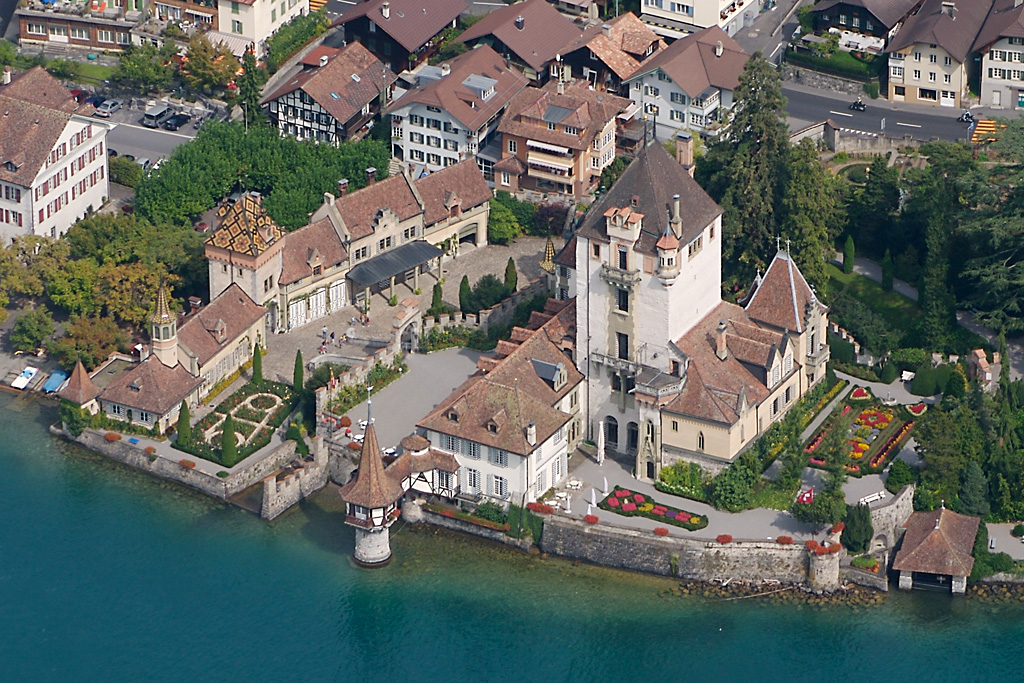
Strättligen Castle

Strättligen Castle in Thun, Switzerland
High Medieval (11th–13th c.)

Strättligen Castle stands as a notable example of a high medieval hill castle located in Thun, within the Bern region of Switzerland. Constructed in the 13th century by the barons of Strättligen, the castle originally served as a strategic fortification overseeing the surrounding territory and trade routes near the city of Thun.

Historical background and significance

The castle was established during the high medieval period, a time marked by feudal expansion and the construction of numerous fortifications across Europe. The barons of Strättligen, a noble family of regional importance, chose this elevated location to assert control and provide defense against rival factions. Throughout its history, Strättligen Castle played a role in local power struggles and the administration of the surrounding lands.

While the castle's prominence declined over the centuries, it remained a symbol of medieval authority in the Bernese Oberland. The castle's ownership and function evolved, reflecting the shifting political landscape of the region.

Architectural features and layout

The castle is classified as a hill castle, built on a natural elevation to maximize defensive advantages. The surviving ruins reveal the typical medieval castle elements, including curtain walls, defensive towers, and residential quarters. The layout was designed to provide both protection and habitation for the lord and his retinue.

A prominent feature of the site is the powder tower, dating from 1699. This structure was added during the post-medieval period, reflecting the evolving needs for gunpowder storage and artillery defense. The tower's robust construction and strategic placement highlight the adaptation of the castle's defenses to early modern warfare technologies.

Defensive structures

The castle's fortifications include remnants of thick stone walls and battlements that once enclosed the courtyard. Defensive towers were positioned to cover key approaches, enabling archers and later artillery to repel attackers. The elevated position enhanced visibility and control over the surrounding landscape, including the nearby city of Thun and access routes to the Bernese Alps.

Residential and functional spaces

Within the castle walls, there would have been living quarters for the barons and their household, along with storage rooms, a chapel, and service areas. Although much of the internal structure is now lost, archaeological studies and comparisons with similar castles suggest a multi-level keep or donjon was part of the complex, serving as the last line of defense and the lord's residence.

Preservation and current condition

Today, Strättligen Castle is classified as well-preserved ruins. The site is accessible to visitors and offers insight into medieval military architecture and feudal life in the Bern region. The powder tower remains a distinctive landmark, illustrating the castle's long history and adaptation over time.

Efforts to maintain and stabilize the ruins have ensured that the castle's structural elements remain visible and safe for exploration. Interpretive signage and guided tours help contextualize the castle's historical significance for visitors.

Visiting Strättligen Castle

Strättligen Castle is open to the public, providing a unique opportunity to explore a medieval hill castle with a blend of original and later architectural features. The site offers panoramic views of Thun, the surrounding countryside, and the distant Bernese Alps, making it a favored destination for history enthusiasts and hikers alike.

Visitors should wear sturdy footwear due to uneven terrain and be prepared for outdoor conditions. The castle's location near Thun makes it accessible by local transport and car, with nearby parking available.

Strättligen Castle in the context of Swiss medieval fortifications

Strättligen Castle is part of a broader network of medieval castles in Switzerland that illustrate the region's feudal past and strategic military architecture. Its hilltop position is characteristic of castles built to control trade routes and assert noble power during the Middle Ages.

The castle's longevity and the addition of the powder tower reflect the transition from medieval to early modern military practices, showcasing how fortifications adapted to the introduction of gunpowder weaponry.

Frequently asked questions (FAQ)

How do I get to Strättligen Castle?
Strättligen Castle is located in Thun, Switzerland, easily accessible by public transportation or car. If you are traveling by train, take a train to Thun and then a short bus ride or a pleasant walk to the castle.
What is the historical significance of Strättligen Castle?
Strättligen Castle dates back to the 13th century and is an important example of medieval architecture in the region. It served as a noble residence and has witnessed significant historical events throughout its existence, making it a key site in Thun's history.
When was Strättligen Castle built?
Construction of Strättligen Castle began in the late 13th century, with various modifications and expansions occurring over the centuries. The castle's architecture reflects the evolving styles and needs of its inhabitants through the ages.
Can I take guided tours of Strättligen Castle?
Yes, guided tours of Strättligen Castle are available, providing visitors with in-depth knowledge of its history and architecture. It is advisable to check the castle's official website for tour schedules and availability, especially during peak tourist seasons.
Why is Strättligen Castle a popular tourist attraction?
Strättligen Castle is popular for its stunning views of Lake Thun and the surrounding mountains, as well as its rich history and well-preserved architecture. Visitors are drawn to its picturesque setting and the opportunity to explore a significant cultural landmark.
Is it possible to host events at Strättligen Castle?
Yes, Strättligen Castle offers facilities for hosting various events, including weddings and corporate gatherings. The unique atmosphere and historical backdrop make it a memorable venue for special occasions.
What are the opening hours for Strättligen Castle?
Strättligen Castle is typically open to visitors from April to October, with specific opening hours varying by season. It is recommended to check the castle's official website for the most current opening hours before planning your visit.
What are the ticket prices for visiting Strättligen Castle?
Ticket prices for Strättligen Castle vary depending on age and group rates. Generally, entrance fees are affordable, and discounts may be available for children and seniors, so be sure to check the official site for detailed pricing information.
What is the best time to visit Strättligen Castle?
The best time to visit Strättligen Castle is during the spring and summer months when the weather is pleasant and the gardens are in full bloom. Visiting during this time allows you to enjoy the scenic surroundings and participate in seasonal events that may be held at the castle.
Are there any nearby attractions to visit while at Strättligen Castle?
Yes, nearby attractions include the picturesque Old Town of Thun, the Thun Panorama, and the beautiful Lake Thun. These sites offer additional opportunities to explore the rich culture and stunning landscapes of the region.

Loading map...

Visitor reviews

No reviews yet. Been here? Write the first review and help other travelers!

Write the first review

Visited this castle? Share your experience

Your review helps other travelers and adds first-hand knowledge to our encyclopedia.

Write a review

(5/5)

0/2000 characters

Your review will be visible after admin approval

Nearby castles

3.5 km

Hunegg Castle

Hilterfingen, Switzerland

Hunegg Castle, located in Hilterfingen, Switzerland, is a striking example of 19th-century castle architecture blending Renaissance Revival and Art Nouveau styles. Constructed between 1861 and 1863 for the Prussian nobleman Baron Albert Emil Otto von Parpart, the castle reflects the tastes and aspirations of the European aristocracy during the Modern period. Despite its relatively recent origin compared to medieval fortresses, Hunegg Castle carries significant cultural and architectural value, particularly through its well-preserved interiors and stylistic details. Historical background and ownership The castle was commissioned by Baron von Parpart, a member of the Prussian nobility, who intended it as a prestigious residence. Unfortunately, his tenure was brief, as he passed away in 1869, only a few years after the castle's completion. Following his death, the property changed hands and was acquired by Lemke-Schuckert, an architect from Wiesbaden renowned for his expertise in historicist styles. Lemke-Schuckert undertook a comprehensive renovation of the castle's interior, introducing elements characteristic of the Art Nouveau movement. This artistic style, popular in the late 19th and early 20th centuries, is known for its organic forms, intricate detailing, and elegant craftsmanship. The renovation transformed the interior spaces into a showcase of this aesthetic, complementing the castle’s Renaissance Revival exterior. Architectural features and style Exterior design Hunegg Castle's exterior is a fine example of Renaissance Revival architecture, a style that sought to revive and reinterpret the forms and motifs of the European Renaissance. The castle features symmetrical façades, ornate window frames, and decorative stonework that evoke the grandeur and refinement of 16th-century palaces. Its silhouette is marked by towers and turrets, which add to its picturesque and romantic character, common in 19th-century castle constructions aiming to evoke historical grandeur rather than serve defensive purposes. Interior and Art Nouveau elements The interior of Hunegg Castle is particularly notable for its Art Nouveau decorations, which include stylized floral motifs, curved lines, and elegant woodwork. The renovation by Lemke-Schuckert preserved or carefully recreated these elements, providing visitors with an immersive experience of turn-of-the-century design trends. The castle's rooms, halls, and chambers are furnished and adorned to reflect the lifestyle and artistic preferences of its late 19th-century inhabitants. Current use and preservation Today, Hunegg Castle serves as the Renaissance Revival and Art Nouveau Museum, dedicated to preserving and presenting the artistic heritage of these two influential styles. The museum's careful curation ensures that the castle’s interiors remain as authentic as possible, with many original furnishings and decorative elements preserved or restored. Visitors can explore the castle to gain insight into the architectural and cultural history of the period, as well as the personal tastes of the castle’s former owners. The castle’s well-maintained condition and its function as a museum contribute to its status as a significant cultural landmark in the region. It is an important destination for those interested in architectural history, decorative arts, and the evolution of European aristocratic residences in the 19th century. Location and surroundings Situated in the picturesque town of Hilterfingen on the shores of Lake Thun, Hunegg Castle benefits from a scenic setting that enhances its romantic appeal. The surrounding landscape includes well-tended gardens and parkland that complement the castle’s historic character. The location also offers visitors opportunities to explore the natural beauty of the Swiss Alps and nearby cultural attractions. Visiting information and accessibility As a museum, Hunegg Castle welcomes visitors interested in its architectural and artistic heritage. While specific visiting hours and ticket prices may vary, the castle typically offers guided tours that provide detailed insights into its history and design. Accessibility features and visitor amenities are designed to accommodate a wide range of guests, making it an engaging destination for both casual tourists and scholars. Visitors are encouraged to plan their visit during the warmer months when the gardens and surroundings are at their most attractive, enhancing the overall experience of this historic site.

Modern (19th–20th c.)
Details
3.6 km
Oberhofen Castle — Switzerland castle

Oberhofen Castle

Oberhofen am Thunersee, Switzerland

Oberhofen Castle stands as a striking example of a High Medieval hill castle nestled on the shores of Lake Thun in Oberhofen am Thunersee, Switzerland. Its origins trace back to around 1200, anchored by a robust central keep or bergfried that served as a formidable defensive structure. Over the centuries, the castle evolved architecturally and functionally, reflecting the shifting tides of regional power, ownership, and stylistic trends. Medieval origins and early history The castle's foundation is attributed to the Freiherr von Oberhofen family during the High Middle Ages. The earliest notable event was the marriage of Ita von Oberhofen to a member of the von Eschenbach family around 1200, which transferred ownership and initiated the construction of a new moated castle on the lake's edge during the 13th century. This early phase established the castle’s strategic position overlooking the lake and surrounding lands. In the early 14th century, the castle became entangled in the political upheavals of the region. The von Eschenbach family was compelled to sell Oberhofen Castle and its associated lands to the powerful Habsburg dynasty in 1306. The Habsburgs, through a series of vassals including the Kyburg family, administered the castle as part of their extensive territories. The castle's history is marked by notable figures such as Walter IV von Eschenbach, who was assassinated in 1308 alongside King Albert I of Germany, a testament to the turbulent times. The Habsburgs’ influence waned after their defeats in the Burgdorferkrieg (1383-84) and the Battle of Sempach (1386), leading to Bernese expansion into the Bernese Oberland and eventual acquisition of Oberhofen in 1397. Bernese rule and administrative role Following Bern’s takeover, Oberhofen Castle became the seat of a Bailiwick, serving as the administrative center for the region. The castle passed through several prominent Bernese patrician families, including the von Scharnachthal and von Erlach families. When the male line of the von Erlach family ended in 1652, the city of Bern assumed direct control, reinforcing the castle’s role in governance. Bernese renovations in the late 17th century introduced Baroque architectural elements, partially surrounding the medieval keep with new buildings. The Garden Room was constructed on the lake side, and the original water tower was demolished, reflecting a shift from purely defensive to more residential and administrative functions. 19th-century romantic revival and architectural transformation In the 19th century, Oberhofen Castle underwent significant transformation under the ownership of the Neuchâtel-Prussian Pourtàles family. Between 1849 and 1852, the castle was extensively renovated and expanded in the Romantic Neo-Gothic style, a popular architectural movement that sought to revive medieval aesthetics with a picturesque flair. The renovations included the rebuilding of the north-eastern side of the keep and the entire western facade. The water tower was reconstructed and crowned with a fanciful spire, reinstating a lakeside architectural feature lost in earlier centuries. The addition of corner towers, battlements, and tiled roofs enhanced the castle’s fairy-tale appearance. Inside, the castle was lavishly updated with new interiors designed by Theodor Zerleeder, a Bernese architect. Notable rooms include a grand dining hall, a library filled with ornate woodwork, and a unique Turkish smoking room inspired by the wealthy houses of Cairo. This room reflects the cosmopolitan influences brought by Count Albert Alexander de Pourtalè, who had diplomatic ties to Istanbul. The castle’s grounds were transformed with the creation of a 2.5-hectare English-style landscaped park south of the main buildings. The park takes advantage of the region’s mild climate to cultivate a diverse array of plants, offering stunning views of the Bernese Alps and Lake Thun. Architectural features and layout The castle’s centerpiece is the massive bergfried, measuring approximately 11 by 12.5 meters, with walls about two meters thick. This tower exemplifies medieval military architecture designed for defense and surveillance. Surrounding the bergfried are residential and administrative buildings added over centuries, including the late medieval palas and the chapel consecrated in 1473 on the lake side of the keep. The castle’s lakeside location is enhanced by the presence of a water tower, rebuilt in the 19th century to complement the Romantic aesthetic. The castle complex includes multiple towers, battlements, and fortified walls that create an imposing silhouette against the lake and mountains. Cultural heritage and museum today Since 1952, Oberhofen Castle has been part of the Historical Museum of Bern, serving as a museum that showcases the castle’s rich history and the lives of its inhabitants over eight centuries. The castle’s interiors display period furnishings, artworks, and exhibits that illuminate the social and political history of the region. The castle chapel features impressive 15th-century frescoes, providing insight into the religious art and practices of the late medieval period. Visitors can also experience the unique Turkish smoking room, a rare example of 19th-century Orientalist interior design in Switzerland. The castle’s park is renowned for its beauty and tranquility, offering panoramic views that make it one of the most picturesque gardens in the Alpine region. The mild climate supports a variety of plant species, enhancing the visitor experience throughout the seasons. Oberhofen Castle remains well preserved, retaining its medieval core alongside the Romantic additions, making it a significant cultural landmark in Switzerland. Its combination of military architecture, administrative history, and 19th-century Romantic revival makes it a unique destination for those interested in history, architecture, and landscape design. Visitor experience and significance Visitors to Oberhofen Castle can explore the extensive museum collections spread across the first and second floors, which detail the castle’s architectural evolution and the daily lives of its former residents. The eastern smoking room atop the tower offers spectacular views of Lake Thun and the surrounding mountains, providing a memorable highlight. The castle’s location on a hill overlooking the lake affords visitors a unique perspective on the natural and historical landscape of the Bernese Oberland. The well-maintained English-style park invites leisurely strolls and contemplation amid historic surroundings.

High Medieval (11th–13th c.)
Details
4.1 km

Amsoldingen Castle

Amsoldingen, Switzerland

Amsoldingen Castle, located in the village of Amsoldingen in Switzerland, is a significant example of early medieval architecture, dating back to the 10th century AD. Originally constructed as the residence for the wealthy provost of the collegiate church of Amsoldingen, the castle reflects the intertwined history of religious and secular power in medieval Europe. The castle and the neighboring ecclesiastical buildings were part of a complex that symbolized the influence of the church in the region. Historical background and ownership The castle was initially built to house the provost overseeing the collegiate church dedicated to St. Mauritius. Over time, both the provost and the church experienced a decline in wealth and influence. By 1484, ownership of the castle transferred to St. Vincent's cathedral in Bern, marking a shift from local ecclesiastical control to a more centralized authority. Shortly thereafter, in 1496, the college of canons in Bern sold the castle and its surrounding lands to the prosperous merchant Barthlome May. This transition from ecclesiastical to private ownership illustrates the changing socio-economic landscape of the late medieval period. In 1536, Barthlome's grandson, Sulpitius May, sold the castle, after which it passed through several owners. By the late 17th century, the castle was owned by Samuel Bodmer, an engineer and surveyor. Bodmer resided in the castle between 1711 and 1724 while designing an extensive flood control system for the area around Thun Lake and the Aare River. This project was crucial for protecting local villages and farmland from flooding, highlighting the castle's role beyond a mere residence. Throughout the 18th and early 19th centuries, the castle belonged to the Luternau family, who enhanced the estate by developing parks around the castle grounds. The property changed hands multiple times in the early 19th century, passing from Ludwig Zeerleder to Alfred de Rougemont von Bonstetten, and then to Beat Ludwig Tscharner von Erlach. Under von Erlach's ownership, the castle underwent significant renovations in 1846, adopting a neo-Gothic architectural style that reflected the 19th-century romantic revival of medieval forms. Architectural features and renovations The castle's original construction in the 10th century corresponds with the Ottonian period of architecture, characterized by the use of stone and robust, fortress-like structures. The castle was built to serve both residential and defensive purposes, typical of early medieval hill castles in the region. The building materials included stone scavenged from the ruins of Aventicum, the ancient Roman city nearby, linking the site to earlier historical layers. The neo-Gothic renovation in the mid-19th century introduced stylistic elements such as pointed arches, decorative battlements, and ornate windows, transforming the castle's medieval silhouette into a romanticized version of a Gothic fortress. This restoration was part of a broader European trend during the 19th century that sought to revive medieval architectural forms, often with a focus on aesthetic appeal rather than strict historical accuracy. St. Mauritius collegiate church: history and architecture The castle is closely associated with the neighboring collegiate church of St. Mauritius, which shares a similarly ancient origin. The first church on the site was constructed in the 6th century in an early Romanesque style. The current church dates from the 10th century and is an example of Ottonian three-aisle church architecture. It was built on the foundations of the earlier church using stone from Aventicum. According to tradition, the church's endowment or stift was founded in the 10th century by King Rudolph II of Burgundy. It was one of twelve churches established around Lake Thun, marking an important ecclesiastical network in the region. The church is first mentioned in written records in 1228. Significant modifications occurred around 1210, including the construction of a crypt and renovation of the south aisle. The interior was richly decorated with murals by around 1300, including a notable painting of Saint Christopher on the north wall that remains visible today. Between 1345 and 1486, a Romanesque bell tower was added after the demolition of the southern apse. Over the centuries, the church's fortunes waned, culminating in its dissolution as a collegiate church in 1484 when it was incorporated into the newly created St. Vincent's cathedral stift in Bern. It then became the parish church for Amsoldingen. The Protestant Reformation reached the area in 1528, after which the church served a Protestant congregation. The church suffered fire damage in 1576, leading to major renovations including a new roof and the raising of the main apse. A new pulpit was installed in 1577, and the oldest of the four bells currently in the tower was hung in 1579. The wooden ceiling dates from the mid-17th century, and a mural depicting the Last Supper was painted in 1668. Landscape and surroundings The castle's grounds were enhanced during the 18th and early 19th centuries with the creation of parks and landscaped gardens, particularly under the ownership of the Luternau family. These gardens complemented the castle's architectural presence and reflected changing tastes in estate design during this period. The castle is situated near Lake Thun and the Aare River, key geographic features that influenced its historical significance. The flood control works designed by Samuel Bodmer in the early 18th century highlight the strategic importance of controlling water in this region. Current status and cultural significance Today, Amsoldingen Castle stands as a well-preserved monument reflecting multiple phases of architectural and historical development from the early medieval period through the 19th century neo-Gothic revival. Its close connection to the collegiate church of St. Mauritius adds to its cultural and religious significance in the region. The castle and church are important heritage sites that illustrate the evolution of ecclesiastical and secular power in medieval Switzerland. Their architectural features, historical associations with notable figures such as King Rudolph II and Samuel Bodmer, and the artistic elements within the church make them valuable destinations for scholars and visitors interested in medieval history, architecture, and Swiss cultural heritage.

Early Medieval (5th–10th c.)
Details