Strassberg Castle
Strassberg Castle is a significant medieval fortress perched on a small hill at approximately 1100 meters above sea level near Churwalden, Switzerland. Constructed in the 12th century, this hill castle was strategically designed to control and protect the vital alpine road connecting Chur to Lenzerheide, overseeing trade and collecting customs duties. Its location allowed it to dominate the surrounding landscape and serve as a defensive stronghold against potential invaders or unauthorized traders.
Early construction and architectural features
The earliest part of the castle, a ring wall built in the second half of the 12th century, forms the core defensive structure. This wall was constructed from layered masonry using a combination of rubble stones and glacial erratics, reflecting the local geological resources. The wall includes arrow slits oriented to cover the road below, providing defenders with advantageous firing positions. Original window openings and privies within the wall suggest that residential quarters were integrated along the northern side of the ring wall.
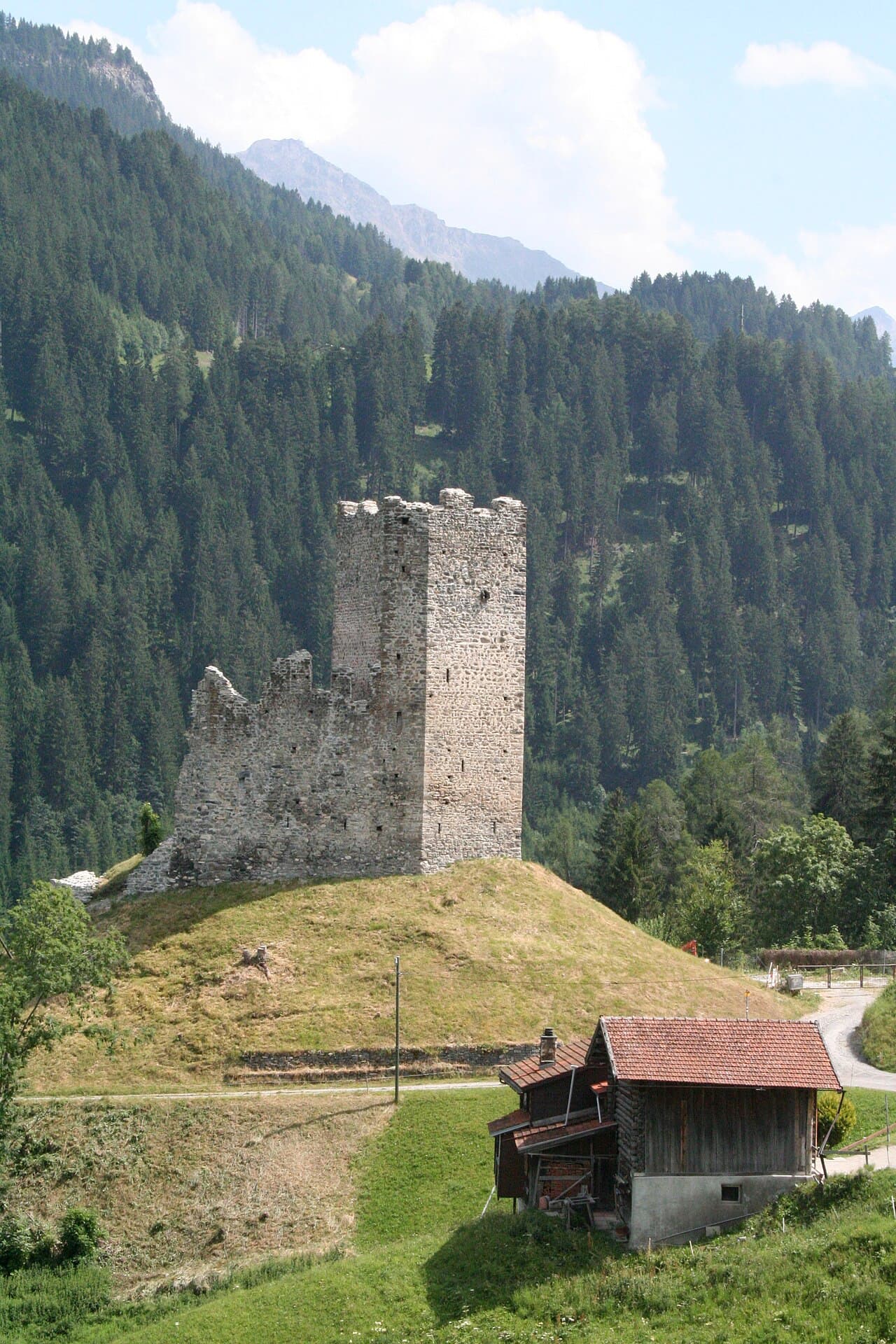
In the early 13th century, a prominent square bergfried tower was added on the west side of the ring wall. This four-story tower with an attic and mezzanine was designed both as a lookout and a last refuge in case of siege. Its entrance was elevated on the second floor, a common defensive feature to hinder attackers. The tower included living spaces on the upper floors, complete with a privy featuring a sloped drainage channel, and was topped with battlements and a pyramidal tent-like roof. The eastern section of the ring wall was simultaneously heightened by an additional story, as evidenced by bricked-up battlements still visible today.
Historical ownership and significance
The first historical mention of the castle dates to 1275 as castrum dictum Strasceberch, owned by the influential Freiherr von Vaz. The Lords of Strassberg appear in records from 1253, likely serving as ministerialis knights under the Vaz family. The castle was integral to the Vaz's control over regional trade and served to protect the nearby Churwalden Abbey, their family burial site.
After the extinction of the Vaz family in 1339, ownership passed to the Counts of Toggenburg. They received imperial permission to establish a customs station at Strassberg in 1348, although this was contested and revoked by the Bishop of Chur. Persistence paid off when Emperor Sigismund reaffirmed customs rights in 1413, leading to arbitration involving Zürich due to ongoing disputes. The castle remained a customs and administrative center under Toggenburg vassals until the death of the last Toggenburg count, Frederick VII, in 1436.
Subsequently, the castle passed to the Counts of Montfort, who granted freedoms to the town of Churwalden and ensured the castle remained accessible to the community. The vogt, or governor, was required to reside at the castle only with the town's permission, reflecting a shift toward local governance.
Financial pressures led to the castle's sale in 1466 to Archduke Sigismund of Austria. It changed hands again in 1471 to Ulrich von Matsch before reverting to Sigismund in 1479. By the late 15th century, the castle showed signs of decline and damage.
Destruction and decline
During the Swabian War on March 5, 1499, retreating troops of the League of the Ten Jurisdictions deliberately burned Strassberg Castle to prevent its capture by Austrian forces. This event marked the beginning of the castle's ruinous state. By the 16th century, Strassberg was already abandoned and in decay. Over the following centuries, the ruins suffered further deterioration, including damage from quarrying activities.
Modern restoration and stabilization efforts between 2008 and 2009 have preserved the remaining structures, allowing visitors to explore and appreciate the castle's medieval architecture and historical significance.
Architectural remains and layout
The surviving ruins of Strassberg Castle reveal a complex layout centered around the main ring wall and the bergfried tower. The ring wall encloses what was once a residential building along its northern side, with visible remnants of windows and privies indicating domestic use. The bergfried tower, with its multiple floors and defensive features, dominates the western corner of the enclosure.
East of the main ring wall lies the site of a larger outer ring wall or bailey, now mostly lost. This outer enclosure likely contained a gatehouse and additional defensive works, including a narrow zwinger on the mountain-facing side designed to trap attackers between walls. The exact configuration and connection between the inner and outer defenses remain partially unclear due to the fragmentary nature of the ruins.
Additional features include a masonry latrine supported by wooden corbels and stone benches built into the walls, suggesting attention to comfort and hygiene within the castle. The top floor of the bergfried likely featured a balcony or arbor, providing views over the surrounding alpine landscape.
Cultural and strategic importance
Strassberg Castle played a vital role in the political and economic landscape of medieval Graubünden. By controlling the alpine passes and trade routes, it enabled its owners to collect customs duties and exert influence over regional commerce. Its proximity to Churwalden Abbey linked it to religious and dynastic traditions, reinforcing its status as a seat of power.
The castle's history of changing ownership reflects the complex feudal relationships and territorial disputes characteristic of the High and Late Middle Ages in this part of Switzerland. The interventions by emperors, bishops, and local leagues illustrate the contested nature of authority in the region.
Visiting strassberg castle today
Today, Strassberg Castle is a remarkable example of a High Medieval hill castle in Switzerland, offering insight into medieval military architecture and feudal governance. Visitors can explore the well-preserved ring wall, the bergfried tower remains, and the surrounding ruins that outline the castle's former defensive and residential spaces.
The site is accessible via hiking trails from Churwalden and nearby areas, making it a popular destination for history enthusiasts and outdoor adventurers alike. Interpretive signage and guided tours provide context about the castle's construction, historical role, and eventual decline.
Frequently asked questions (FAQ)
- How do I get to Strassberg Castle?
- Strassberg Castle is accessible by hiking trails from Churwalden, Switzerland. The castle is located on a hill about 1100 meters above sea level and can be reached on foot with moderate hiking effort.
- What is the historical significance of Strassberg Castle?
- Strassberg Castle was built in the 12th century to guard important alpine trade routes and collect customs duties. It played a key role in regional politics and commerce during the High Middle Ages.
- Can I explore the ruins of Strassberg Castle?
- Yes, visitors can explore the ruins, including the ring wall and bergfried tower remains. Restoration efforts have stabilized the site, making it safe and informative for tourists.
- When was Strassberg Castle built?
- The castle was originally constructed in the 12th century, with major additions like the bergfried tower added in the early 13th century.
- Is Strassberg Castle open year-round?
- The castle ruins are generally accessible year-round, but visitors should check local conditions and weather, especially in winter, as the site is located in an alpine environment.
Photo gallery

Information
Sources & official resources
Verify the information above using these authoritative references.
Loading map...
Visitor reviews
No reviews yet. Been here? Write the first review and help other travelers!
Write the first reviewVisited this castle? Share your experience
Your review helps other travelers and adds first-hand knowledge to our encyclopedia.