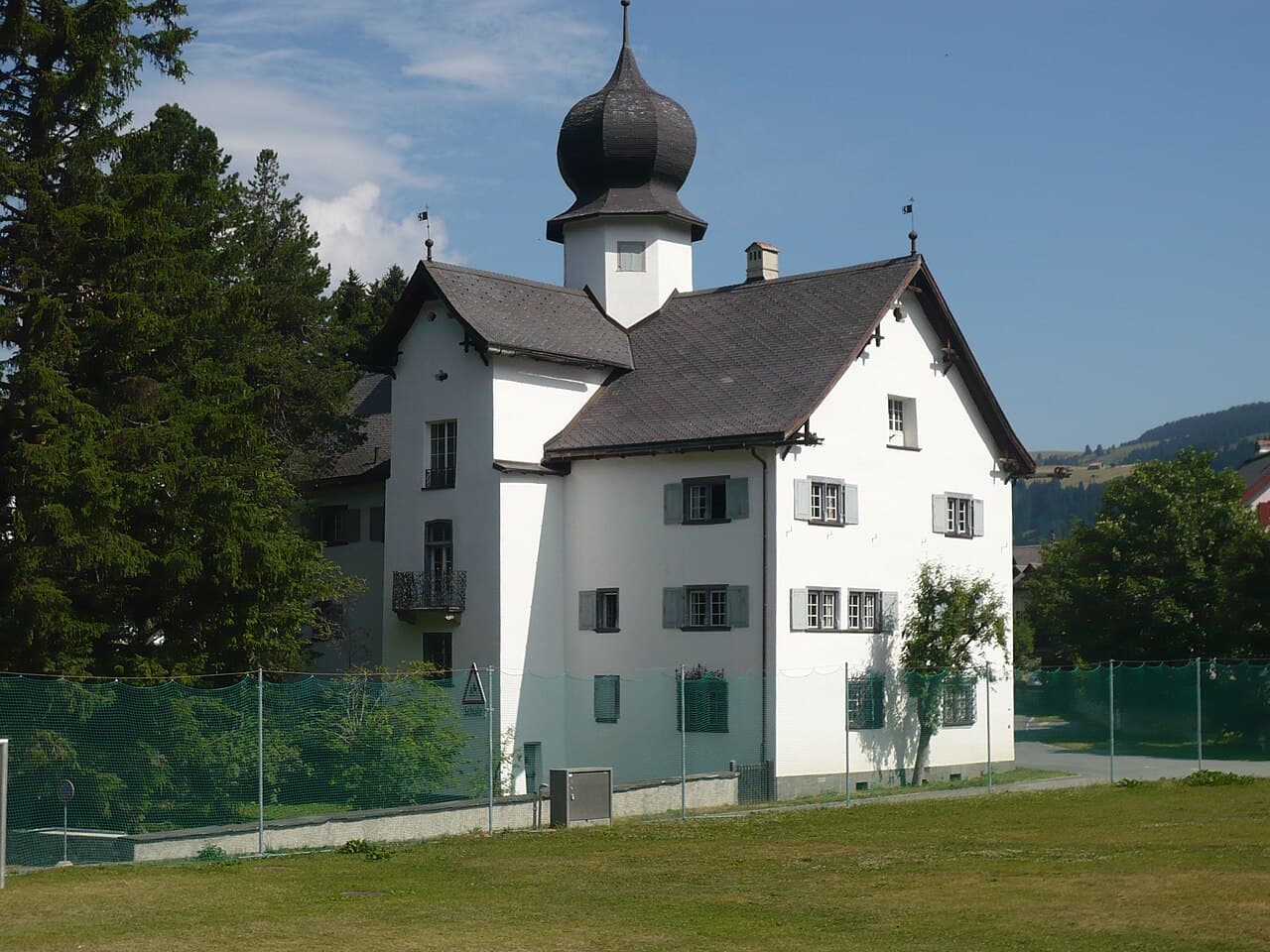
Parpan Castle — Switzerland castle

Parpan Castle

Parpan Castle in Churwalden, Switzerland

Parpan Castle is a notable hill castle located in the municipality of Churwalden within the Canton of Graubünden, Switzerland. Recognized as a Swiss heritage site of national significance, the castle stands as a testament to the region's medieval fortification architecture and historical importance in the Alpine area.

Historical background and significance

The origins of Parpan Castle date back to the High Medieval period, a time when the control of mountain passes and valleys was crucial for territorial defense and trade regulation. The castle was strategically positioned on a hillside, offering commanding views over the surrounding landscape and the routes connecting various Alpine communities.

Throughout its history, the castle served as a stronghold for local nobility and administrators who exercised control over the region. Its role extended beyond military defense to include administrative and judicial functions, reflecting the multi-purpose nature of such fortifications in medieval Switzerland.

Architectural features and construction

Design and layout

Parpan Castle exemplifies typical hill castle construction, utilizing the natural topography for defensive advantage. The castle's layout includes robust stone walls adapted to the hillside contours, with remnants indicating a complex of courtyards, residential quarters, and defensive structures such as battlements and towers.

Building materials and techniques

The primary construction material is local stone, shaped and assembled to create thick defensive walls capable of withstanding sieges and Alpine weather conditions. The masonry techniques reflect the craftsmanship of the High Medieval period, with careful stone fitting and mortar usage ensuring durability.

Preservation and current condition

Today, Parpan Castle is classified as partially preserved, with significant ruins that provide insight into its original structure and scale. Conservation efforts have focused on stabilizing the remaining walls and preventing further deterioration, allowing visitors to appreciate the castle's historical context and architectural form.

The castle's status as a Swiss heritage site of national significance ensures ongoing protection and recognition within Switzerland's cultural heritage framework.

Visiting Parpan Castle

Parpan Castle is accessible to visitors interested in medieval architecture and Swiss history. Its hillside location offers scenic views and an immersive experience of the region's historical landscape. While the castle remains a ruin, interpretative signage and guided tours help contextualize its importance.

Visitors should prepare for uneven terrain and limited facilities, typical of heritage sites situated in natural settings. The best time to visit is during the warmer months when access is easier and the surrounding environment is at its most vibrant.

Parpan Castle in the context of Swiss castles

Within the broader landscape of Swiss fortifications, Parpan Castle represents the strategic use of hilltop sites to control key routes and assert regional power during the medieval period. Its preservation contributes valuable knowledge about the architectural and historical development of castles in the Canton of Graubünden and the Alpine region.

Frequently asked questions (FAQ)

How do I get to Parpan Castle?
Parpan Castle is located in the picturesque region of Switzerland and is easily accessible by car or public transport. If you are traveling by train, the nearest station is in Chur, from where you can take a bus or taxi to reach the castle.
What is the historical significance of Parpan Castle?
Parpan Castle dates back to the 12th century and played a crucial role in the defense and governance of the region. Its strategic location allowed it to oversee the surrounding valleys and protect trade routes, making it an important historical landmark in Swiss history.
When was Parpan Castle built?
Parpan Castle was constructed in the early 12th century, with its foundation attributed to the counts of Werdenberg. Over the centuries, it has undergone various renovations and restorations, reflecting different architectural styles and periods.
Can I visit Parpan Castle year-round?
Yes, Parpan Castle is open to visitors throughout the year, although some areas may have limited access during the winter months due to weather conditions. It is always advisable to check the official website for specific opening hours and any seasonal events.
Why is the architecture of Parpan Castle unique?
The architecture of Parpan Castle showcases a blend of medieval and Renaissance styles, characterized by its imposing towers and sturdy walls. This unique design not only served defensive purposes but also reflected the status of its inhabitants during its peak.
Is it possible to take guided tours of Parpan Castle?
Yes, guided tours are available for visitors who wish to learn more about the history and architecture of Parpan Castle. These tours provide in-depth insights and fascinating stories that bring the castle's past to life.
What are the ticket prices for visiting Parpan Castle?
Ticket prices for Parpan Castle vary depending on the type of tour and whether you are a student, adult, or senior. Generally, entrance fees are affordable, making it accessible for families and tourists alike.
What is the best time to visit Parpan Castle?
The best time to visit Parpan Castle is during the spring and early autumn when the weather is pleasant and the surrounding scenery is at its most beautiful. Additionally, visiting during these seasons allows you to enjoy various outdoor activities and nearby attractions.
Are there any nearby attractions to visit while at Parpan Castle?
Yes, there are several nearby attractions, including the scenic hiking trails in the surrounding mountains and the charming village of Parpan itself. Visitors can also explore the historic city of Chur, which is just a short drive away and offers a variety of cultural experiences.

Photo gallery

Parpan Castle
Click to view

Photo by upload by Adrian Michael•CC BY-SA 3.0

1 photo • Click any image to view in full screen

Information

Hill Castle

Loading map...

Visitor reviews

No reviews yet. Been here? Write the first review and help other travelers!

Write the first review

Visited this castle? Share your experience

Your review helps other travelers and adds first-hand knowledge to our encyclopedia.
Write a review

(5/5)

0/2000 characters

Your review will be visible after admin approval

Nearby castles

5.4 km
Strassberg Castle — Switzerland castle

Strassberg Castle

Churwalden, Switzerland

Strassberg Castle is a significant medieval fortress perched on a small hill at approximately 1100 meters above sea level near Churwalden, Switzerland. Constructed in the 12th century, this hill castle was strategically designed to control and protect the vital alpine road connecting Chur to Lenzerheide, overseeing trade and collecting customs duties. Its location allowed it to dominate the surrounding landscape and serve as a defensive stronghold against potential invaders or unauthorized traders. Early construction and architectural features The earliest part of the castle, a ring wall built in the second half of the 12th century, forms the core defensive structure. This wall was constructed from layered masonry using a combination of rubble stones and glacial erratics, reflecting the local geological resources. The wall includes arrow slits oriented to cover the road below, providing defenders with advantageous firing positions. Original window openings and privies within the wall suggest that residential quarters were integrated along the northern side of the ring wall. In the early 13th century, a prominent square bergfried tower was added on the west side of the ring wall. This four-story tower with an attic and mezzanine was designed both as a lookout and a last refuge in case of siege. Its entrance was elevated on the second floor, a common defensive feature to hinder attackers. The tower included living spaces on the upper floors, complete with a privy featuring a sloped drainage channel, and was topped with battlements and a pyramidal tent-like roof. The eastern section of the ring wall was simultaneously heightened by an additional story, as evidenced by bricked-up battlements still visible today. Historical ownership and significance The first historical mention of the castle dates to 1275 as castrum dictum Strasceberch, owned by the influential Freiherr von Vaz. The Lords of Strassberg appear in records from 1253, likely serving as ministerialis knights under the Vaz family. The castle was integral to the Vaz's control over regional trade and served to protect the nearby Churwalden Abbey, their family burial site. After the extinction of the Vaz family in 1339, ownership passed to the Counts of Toggenburg. They received imperial permission to establish a customs station at Strassberg in 1348, although this was contested and revoked by the Bishop of Chur. Persistence paid off when Emperor Sigismund reaffirmed customs rights in 1413, leading to arbitration involving Zürich due to ongoing disputes. The castle remained a customs and administrative center under Toggenburg vassals until the death of the last Toggenburg count, Frederick VII, in 1436. Subsequently, the castle passed to the Counts of Montfort, who granted freedoms to the town of Churwalden and ensured the castle remained accessible to the community. The vogt, or governor, was required to reside at the castle only with the town's permission, reflecting a shift toward local governance. Financial pressures led to the castle's sale in 1466 to Archduke Sigismund of Austria. It changed hands again in 1471 to Ulrich von Matsch before reverting to Sigismund in 1479. By the late 15th century, the castle showed signs of decline and damage. Destruction and decline During the Swabian War on March 5, 1499, retreating troops of the League of the Ten Jurisdictions deliberately burned Strassberg Castle to prevent its capture by Austrian forces. This event marked the beginning of the castle's ruinous state. By the 16th century, Strassberg was already abandoned and in decay. Over the following centuries, the ruins suffered further deterioration, including damage from quarrying activities. Modern restoration and stabilization efforts between 2008 and 2009 have preserved the remaining structures, allowing visitors to explore and appreciate the castle's medieval architecture and historical significance. Architectural remains and layout The surviving ruins of Strassberg Castle reveal a complex layout centered around the main ring wall and the bergfried tower. The ring wall encloses what was once a residential building along its northern side, with visible remnants of windows and privies indicating domestic use. The bergfried tower, with its multiple floors and defensive features, dominates the western corner of the enclosure. East of the main ring wall lies the site of a larger outer ring wall or bailey, now mostly lost. This outer enclosure likely contained a gatehouse and additional defensive works, including a narrow zwinger on the mountain-facing side designed to trap attackers between walls. The exact configuration and connection between the inner and outer defenses remain partially unclear due to the fragmentary nature of the ruins. Additional features include a masonry latrine supported by wooden corbels and stone benches built into the walls, suggesting attention to comfort and hygiene within the castle. The top floor of the bergfried likely featured a balcony or arbor, providing views over the surrounding alpine landscape. Cultural and strategic importance Strassberg Castle played a vital role in the political and economic landscape of medieval Graubünden. By controlling the alpine passes and trade routes, it enabled its owners to collect customs duties and exert influence over regional commerce. Its proximity to Churwalden Abbey linked it to religious and dynastic traditions, reinforcing its status as a seat of power. The castle's history of changing ownership reflects the complex feudal relationships and territorial disputes characteristic of the High and Late Middle Ages in this part of Switzerland. The interventions by emperors, bishops, and local leagues illustrate the contested nature of authority in the region. Visiting strassberg castle today Today, Strassberg Castle is a remarkable example of a High Medieval hill castle in Switzerland, offering insight into medieval military architecture and feudal governance. Visitors can explore the well-preserved ring wall, the bergfried tower remains, and the surrounding ruins that outline the castle's former defensive and residential spaces. The site is accessible via hiking trails from Churwalden and nearby areas, making it a popular destination for history enthusiasts and outdoor adventurers alike. Interpretive signage and guided tours provide context about the castle's construction, historical role, and eventual decline.

High Medieval (11th–13th c.)
Details
8.8 km

Ortenstein Castle

Tomils, Switzerland

Ortenstein Castle stands as a significant monument of Swiss medieval heritage, located in the municipality of Tomils in Switzerland. This late medieval fortress was originally constructed in the 15th century, embodying the architectural and military design typical of that period. The castle's history is marked by conflict and resilience, most notably during the Schamserfehde in 1451, a regional feud that led to the destruction of the original structure. Historical context and significance The Schamserfehde was a violent conflict impacting the region, during which many castles were destroyed or abandoned. Ortenstein Castle was among those razed but was uniquely granted the privilege to be rebuilt, setting it apart from other contemporary fortifications that were not allowed reconstruction. This privilege underscores the castle's strategic and political importance in the region during the late medieval period. Following its reconstruction, Ortenstein Castle became a notable seat of power and administration. It was first recorded under municipal ownership in 1527, indicating its role within the local governance and community of Tomils. Over the centuries, the castle has transitioned through various owners, reflecting the shifting social and political dynamics of the region. Architectural features and layout Ortenstein Castle is characteristic of late medieval castle architecture in Switzerland. While specific architectural details are less documented, it typically features robust defensive elements such as thick stone walls, battlements, and possibly a keep or donjon, which were common in castles of this era. Its design would have been influenced by the need for defense against sieges and local conflicts, as well as residential and administrative functions. The castle's location in Tomils likely provided a strategic vantage point over the surrounding landscape, which was crucial for surveillance and defense. The presence of courtyards, gatehouses, and possibly a moat or other water defenses would have enhanced its protective capabilities, although these features require further verification. Ownership and current status Today, Ortenstein Castle remains privately owned, a status it has held since leaving municipal control after its early history. Despite private ownership, the castle is recognized as a Swiss heritage site of national significance, highlighting its cultural and historical value. This designation ensures that the castle is protected under Swiss heritage laws and contributes to the preservation of the nation's medieval architectural legacy. The castle's condition is generally well preserved, allowing visitors and scholars alike to appreciate its historical and architectural significance. However, as a private property, public access may be limited, and any visitation should be planned accordingly. Ortenstein Castle in the broader context of Swiss castles Ortenstein Castle is part of Switzerland's rich tapestry of medieval fortifications, which includes a variety of castle types such as hill castles, water castles, and tower houses. Its survival and reconstruction after the Schamserfehde reflect the turbulent history of the region and the importance of such structures in asserting territorial control and local governance during the late medieval period. As a late medieval castle, Ortenstein contributes to our understanding of the architectural evolution from purely military fortresses to multifunctional residences that also served administrative and symbolic roles. Its preservation as a heritage site enables ongoing study and appreciation of medieval Swiss culture and architecture. Visiting information and cultural importance While Ortenstein Castle is privately owned and may not be regularly open to the public, its status as a heritage site encourages interest from historians, architects, and tourists. The castle's location in Tomils places it within a scenic region of Switzerland, known for its natural beauty and historical landmarks. Visitors interested in Swiss medieval castles can explore the surrounding area and other nearby heritage sites to gain a fuller picture of the region's historical landscape. The castle's enduring presence continues to inspire appreciation for Switzerland's medieval past and architectural heritage.

Late Medieval (14th–15th c.)
Details
8.8 km

Rietberg Castle

Pratval, Switzerland

Rietberg Castle is a prominent hill castle located in Pratval, Switzerland, with its origins tracing back to the 13th century. The castle's central tower, the oldest surviving structure, was constructed during this period, possibly incorporating an earlier 12th-century tower. This tower served as the stronghold for the Lords of Rietberg, who were initially vassals of the Freiherr von Sax-Misox in 1286. By the 14th century, their allegiance shifted to the Bishop of Chur, under whose authority the castle and its surrounding estates were managed. Medieval origins and feudal significance The 13th-century construction of Rietberg Castle reflects the typical architectural style of high medieval hill castles in the region, characterized by a robust central keep designed for defense and residence. The castle's strategic location allowed the Lords of Rietberg to oversee their extensive holdings across Schams, Chur, and Oberhalbstein. As the bishop's representatives in Oberhalbstein and Oberengadin, they played a crucial role in local governance and administration during a period marked by feudal complexity and territorial disputes. Ownership transitions and political conflicts The lineage of the Lords of Rietberg ended with Johann von Reitberg, the last male heir, who died in 1349. Before his death, Johann sought to secure the castle's future by arranging its inheritance to his wife, Berta von Rhäzüns, and his relative, Hermann von Landenberg. However, these plans were contested by the Bishop of Chur, who asserted his claim over the castle and its estates. By 1353, the bishop successfully compelled the Landenbergs to relinquish their claims, though disputes persisted until 1388. To resolve these, the bishop compensated the Lords of Rhäzüns and Lumerins, consolidating his control over Rietberg Castle. Mortgaging and noble stewardship Throughout the late medieval period, the castle was frequently used as collateral for loans or as a reward for support by the bishopric. Notable mortgage holders included Jakob von Castelmur in 1398, Conradin Rambach and the cathedral chapter in 1409, Bartolomäus Planta in 1426, and Hans Wellenberg in 1447. The castle passed through various noble families, reflecting the complex financial and political networks of the time. By 1450, it was mortgaged to Hans Ringg, whose family retained it into the late 15th century. Renaissance and early modern period ownership In the 16th century, ownership of Rietberg Castle transitioned to Anton von Travers around 1530, followed by Hercules von Salis in 1554. The Planta family acquired it in 1617, marking a significant chapter in the castle's history. This period was marked by religious and political turmoil in the region, culminating in the Bündner Wirren conflicts between Catholics and Protestants. The murder of pompeius planta One of the castle's most notable historical events was the assassination of Pompeius Planta in 1621. He was killed by Jörg Jenatsch, a prominent figure in the Bündner Wirren, during the intense religious and political struggles that shaped the region's early modern history. This event underscored the castle's role not only as a noble residence but also as a focal point of regional power struggles. Architectural features and preservation Rietberg Castle retains significant elements of its high medieval architecture, especially its central tower, which exemplifies the defensive and residential design typical of the era. The castle's position as a hill castle provided natural defensive advantages, with thick stone walls and limited access points. Over the centuries, modifications and restorations have been made, yet the castle remains a well-preserved example of medieval fortification in the Swiss canton of Graubünden. Castle layout and defensive structures The castle's layout includes a fortified keep, surrounding curtain walls, and ancillary buildings that supported the daily functions of the noble household and its administrative duties. The elevated site allowed for surveillance of the surrounding valleys and control over important transit routes. Defensive features such as battlements and narrow windows for archers contributed to its security during periods of conflict. Cultural significance and modern status Today, Rietberg Castle stands as a testament to the region's feudal history and the shifting allegiances of medieval and early modern Switzerland. Its association with notable families and historical events like the Bündner Wirren enhances its cultural importance. The castle is a valuable heritage site within the canton of Graubünden, attracting visitors interested in medieval architecture and Swiss history. While not extensively renovated for tourism, the castle's preservation allows scholars and visitors to appreciate its architectural and historical context. It remains a symbol of the complex political landscape of the Swiss Alps during the Middle Ages and the Renaissance, reflecting the interplay between local nobility and ecclesiastical power.

High Medieval (11th–13th c.)
Details

