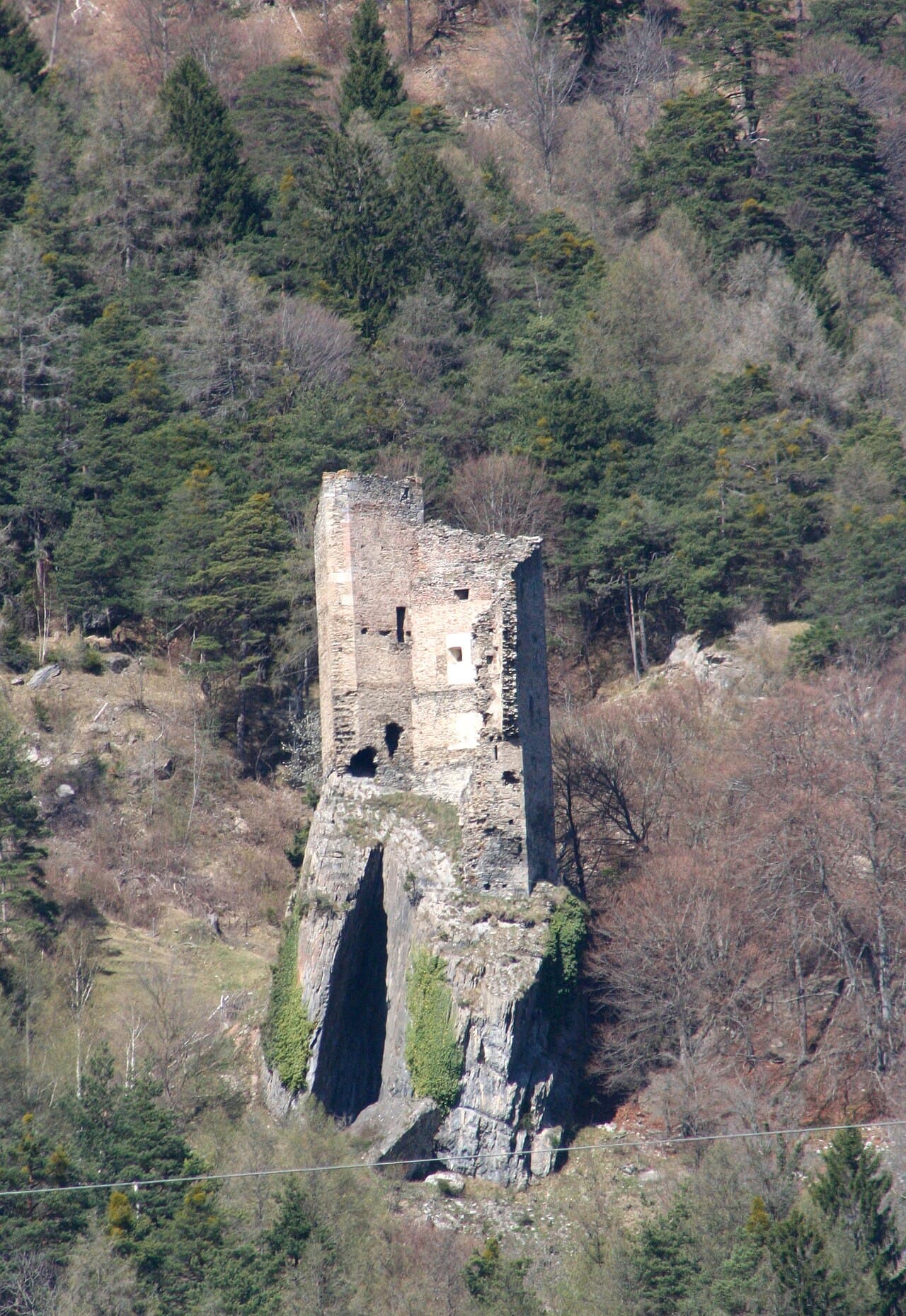
Haldenstein Castle
Haldenstein Castle stands as a significant medieval fortress located on a rocky outcrop above the valley near the Calanda massif in the municipality of Haldenstein, Switzerland. Constructed probably in the 10th or 11th century, it originally served as the family seat for the Ministerialis Haldenstein family, who were vassals to the powerful Lord of Vaz. This castle exemplifies a classic hill castle built in a strategic elevated position, providing natural defenses and commanding views over the surrounding landscape.
The early history of Haldenstein Castle is closely tied to the feudal dynamics of the region. By the 12th century, the Haldenstein family had divided into two branches: the Haldensteins and the Lichtenstein family, the latter residing at the nearby Lichtenstein Castle. Each lineage controlled parts of the local village and surrounding agricultural lands. Following the extinction of the Lichtenstein line at the end of the 13th century, their estates and castle were absorbed by the Haldenstein family, consolidating their regional influence.
Medieval ownership and conflicts
In 1299, a notable dispute arose between Johann von Vaz and the Bishop of Chur over an unauthorized expansion of Haldenstein Castle, reflecting the complex power struggles between secular and ecclesiastical authorities in the region. By the 14th century, the lordship of Haldenstein had aligned with the Bishop of Chur, indicating shifting loyalties. Ulrich von Haldenstein, a prominent figure of the family, served as a soldier for the Habsburgs in 1362 but returned to the Bishop's service by 1379. The Haldenstein family line ended around the close of the 14th century, after which the castle passed through several owners.
Architectural features and development
The castle's architecture is characterized by its compact footprint, constrained by the limited space on the rocky outcrop. Unlike larger fortifications, Haldenstein Castle lacks extensive curtain walls or outbuildings, focusing instead on a central tower that was expanded vertically over time. This vertical development was a response to spatial limitations, with multiple construction phases visible in the surviving tower walls. The tower's increasing height over successive periods illustrates the adaptive strategies employed by its occupants to enhance defense and residential space.
Access to the castle is challenging, as it is reached only by a narrow, steep trail winding along the mountainside. This difficult approach further emphasizes the castle's defensive advantages, deterring potential attackers and controlling movement through the valley.
Later history and decline
In 1542, following the marriage of Jacques von Marmels' widow to Johann Jacob von Castion, a French minister, ownership of Haldenstein Castle changed hands. Von Castion chose to abandon the old fortress, constructing a new residence known as Haldenstein Castle closer to the town, leading to the original fortress being referred to as Alt-Haldenstein or Old Haldenstein Castle.
Subsequent owners included Gregor von Hohenbalken, Lord of Aspermont, who acquired the property in 1567, followed by the Scheuenstein family in 1608, and later the Salis-Maienfeld family. The castle suffered significant damage during earthquakes in 1769 and 1787, after which it was gradually abandoned and fell into ruin.
Heritage status and preservation
Today, Alt-Haldenstein Castle is recognized as a Swiss heritage site of national significance. Its ruins provide valuable insights into early medieval fortification techniques and feudal history in the Canton of Graubünden. Preservation efforts focus on stabilizing the remaining structures and maintaining the site as an important cultural landmark.
Visitors to the site experience a glimpse into medieval life and architecture, as the castle's remains reflect centuries of historical developments and architectural adaptations. The castle's location offers scenic views and a tangible connection to the region's feudal past.
Frequently asked questions (FAQ)
- How do I reach Haldenstein Castle?
- Haldenstein Castle is accessible via a narrow and steep mountain trail. Visitors should be prepared for a challenging hike, as the path winds along the rocky outcrop above the valley.
- What is the historical significance of Haldenstein Castle?
- Haldenstein Castle was built in the 10th or 11th century as the seat of the Ministerialis Haldenstein family and played a role in regional feudal conflicts and alliances, including disputes involving the Bishop of Chur and the Habsburgs.
- Can I visit the interior of the castle?
- As the castle is in ruins, only the remains of the tower and some walls are accessible. Visitors can explore the site but should exercise caution due to uneven terrain and partial preservation.
- When was the castle abandoned?
- The castle was gradually abandoned after suffering earthquake damage in 1769 and 1787, leading to its decline and ruin in the late 18th century.
- Is Haldenstein Castle open year-round?
- The castle ruins are generally accessible year-round, but visitors should check local conditions and weather, as the mountain trail can be hazardous in winter or wet conditions.
Photo gallery

Information
Current owner
Private owner
Loading map...
Visitor reviews
No reviews yet. Been here? Write the first review and help other travelers!
Write the first reviewVisited this castle? Share your experience
Your review helps other travelers and adds first-hand knowledge to our encyclopedia.



